- Animals
- ›Chordates
- ›Vertebrates
- ›Ray-finned Fishes
- ›Spiny-rayed fishes
- ›Cusk-eels
- ›Dwarf Brotulas
- ›Typhlias
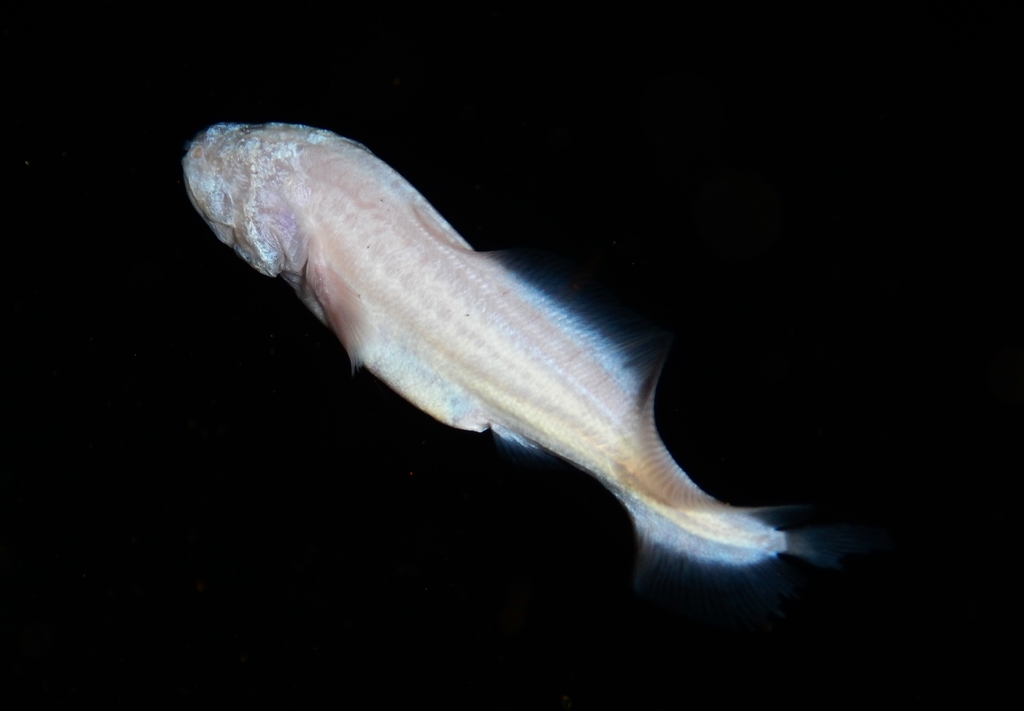
Mexican Blind Brotula
Typhlias pearsei
The Mexican blind brotula (Typhlias pearsei) is a species of viviparous brotula, of the family Dinematichthyidae, endemic to Mexico, where it is found in sinkholes and caves. It is known as sak kay in Mayan and dama blanca ciega in Spanish. This cavefish grows to a standard length of 9.7 cm (3.8 in). It is the only known member of its genus.
From the article Mexican blind brotula on Wikipedia (CC BY-SA), quoted section by section
Description
The Mexican blind brotula has a large, laterally compressed, scaleless head with no eyes, but several papillae and cavities which contain sensory organs. The nostrils are located on the upper lip and the mouth has a longitudinal split at the back. The body bears scales and has long dorsal and anal fins which terminate close to, but are separate from, the caudal fin. The dorsal fin has no spines and 75 to 87 soft rays, and the anal fin has no spines and 59 to 68 soft rays. The male has two pairs of pseudoclaspers, the inner ones being in front of the outer ones. The standard length is about 9.7 cm (3.8 in). The skin does not contain pigment, making the fish appear pinkish-white.
Range & habitat
The Mexican blind brotula inhabits the cenotes (water-filled sink holes connected through subterranean rivers) and aquifers in the Yucatán Peninsula of Mexico, where the temperature is between 23 and 27 °C (73 and 81 °F) throughout the year. These are typically anchialine (connected to the sea), but the Mexican blind brotula is only known from the sections with fresh or brackish water.
Wikipedia: “Distribution”
What it does
The Mexican blind brotula is the top predator in the Yucatán aquifer system and is probably not very numerous. It feeds on crustaceans such as shrimps and mysids that also inhabit the aquifers. In some locations, it is associated with another blind fish, the blind swamp eel (Ophisternon infernale) and in one cave system, with the catfish Rhamdia guatemalensis. It does not react to light, but is very sensitive to vibrations. It is a viviparous fish, giving birth to up to a dozen young between December and February. The newborns are yellowish and about 2.4 to 3.7 cm (0.9 to 1.5 in) in length.
Wikipedia: “Ecology”
In human culture
The generic name derives from the Greek typhlos meaning "blind" and the specific name honours the American ecologist, Arthur Sperry Pearse (1877-1956), who was the collector of the type specimen used by Carl Leavitt Hubbs to describe the species. The generic synonym "Typhliasina" was declared as an unneeded replacement name in 2017.
Wikipedia: “Etymology”
Where it lives
Recorded sightings
—
geo-referenced records in GBIF, from museums, herbaria and field observers.
Drag the globe to turn it. Dots are where records exist, not a range map; darker means more records.
In the stacks
Searching the stacks…
Every page naming Typhlias pearsei in the Biodiversity Heritage Library →
This page is assembled live from iNaturalist, GBIF, Wikipedia, the Source Library and the Internet Archive. It is not yet part of the hand-edited codex. iNaturalist taxon 1316905.