- Animals
- ›Chordates
- ›Vertebrates
- ›Ray-finned Fishes
- ›Spiny-rayed fishes
- ›Blennies, Damselfishes and Allies
- ›Damselfishes
- ›Typical Damselfishes and Anemonefishes
- ›Neoglyphidodon
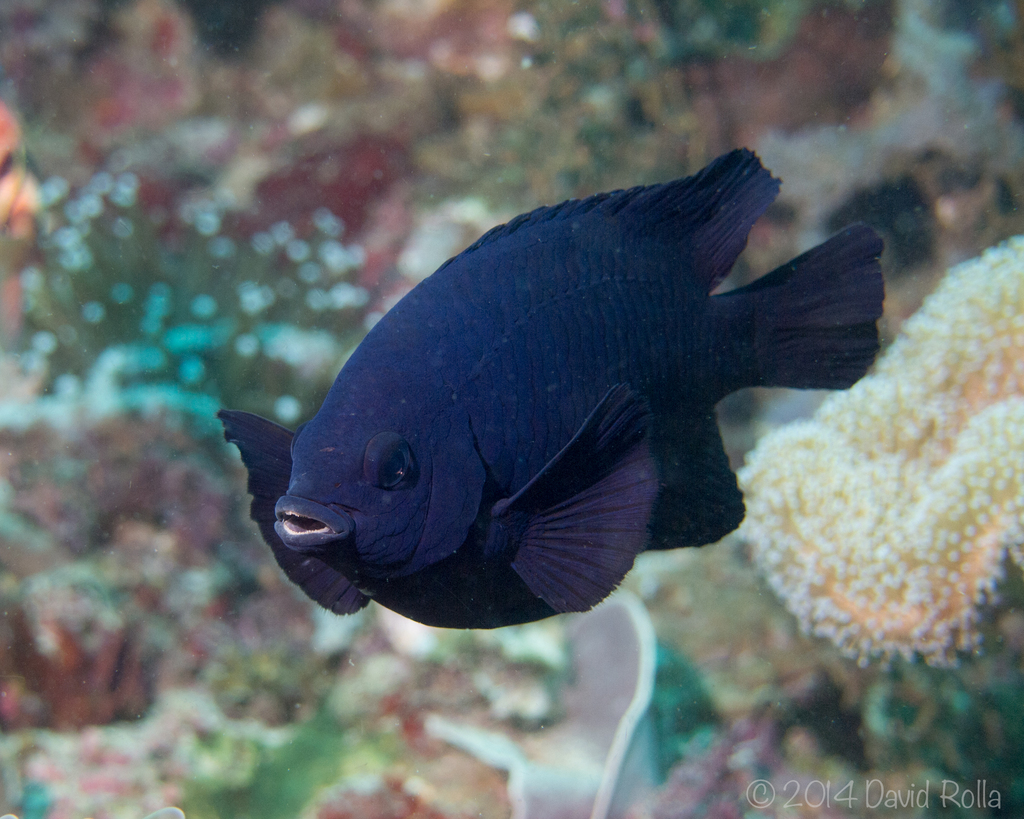
Black Damsel
Neoglyphidodon melas
Neoglyphidodon melas (bowtie damselfish, black damsel, bluefin or royal damsel) is a damselfish from the Indo-West Pacific. It occasionally makes its way into the aquarium trade. It grows to a size of 18 cm (7.1 in) in length.
From the article Neoglyphidodon melas on Wikipedia (CC BY-SA), quoted section by section
Description
Neoglyphidodon melas may be identified by its dark blue-black coloration in adulthood. However, juveniles are pale blue with a yellow stripe across their dorsal surface, and sport yellow-lined caudal fin rays and bright blue anal and pelvic fins with dark outer rays. Neoglyphidodon melas possesses 13 dorsal spines, 13–15 soft dorsal rays, 2 anal spines, and 12–15 soft anal rays. The body is laterally compressed, allowing this species to navigate through tight crevices in coral reefs, while their long pectoral fins further aiding in maneuverability and agility. Neoglyphidodon melas may grow to 11.8–18 cm and reach 100 g at maturity.
Range & habitat
Neoglyphidodon melas may be found throughout the Indo-Pacific region, with sightings in the Red Sea, East Africa, the Indo-Malayan archipelago, the Ryukyu Islands, China, the Philippines, Palau, New Guinea, the Solomon Islands, Vanuatu and northern Australia. Within these seas, this species is found in coralline, rocky lagoons, as well as marine reefs that contain soft corals, which constitute the majority of their diets. It is most commonly found between depths of 1–12 m.
Wikipedia: “Distribution and habitat”
What it does
Bowtie damselfish are coprophagous organisms, as the adults feed on the nutrient rich feces of the giant clams, Tridacna gigas. Larval bowtie damselfish feed solely on plankton, and are found living around the stalks of Acropora corals, potentially for protection and access to passing food. Juvenile bowtie damselfish feed mainly on soft corals, which constitutes 87% of their preferred diet. Once the fish reaches full maturation it will find a giant Tridacna clam of its own to live near, consuming its excrement in addition to its soft coral diet. As age and size of the adult bowtie damselfish increase, so does its consumption of Tridacna clam waste. The feces of the giant Tridacna clam provides essential proteins for the adult bowtie damselfish, and increases its chance of survival and reproduction. Adult bowtie damselfish lacking a residential giant clam display higher signs of aggression towards other fish than those with their own Tridacna clam, likely due to food instability. Competition between bowtie damselfish increases with resource scarcity, and fish near clams are more likely to grow larger and find mates.
Wikipedia: “Diet”
Where it lives
Recorded sightings
—
geo-referenced records in GBIF, from museums, herbaria and field observers.
Drag the globe to turn it. Dots are where records exist, not a range map; darker means more records.
In the stacks
Searching the stacks…
Every page naming Neoglyphidodon melas in the Biodiversity Heritage Library →
This page is assembled live from iNaturalist, GBIF, Wikipedia, the Source Library and the Internet Archive. It is not yet part of the hand-edited codex. iNaturalist taxon 132370.