- Animals
- ›Chordates
- ›Vertebrates
- ›Birds
- ›Perching Birds
- ›Old World Flycatchers, Robins, and Chats
- ›Cyanoptila
On eBird ↗
Blue-and-white Flycatcher
Live sightings near you, the range map, bar charts of when it is seen, and Macaulay Library photos and recordings.
Blue-and-white Flycatcher
Cyanoptila cyanomelana
The blue-and-white flycatcher (Cyanoptila cyanomelana) is a migratory songbird in the Old World flycatcher family Muscicapidae. The species is also known as the Japanese flycatcher. It breeds in Japan, Korea, and in parts of north eastern China and the Russian Far East. It winters in South East Asia, especially in Vietnam, Cambodia, Thailand, Sumatra and Borneo. This species has been recorded as a vagrant from the Sinharaja Rainforest in Sri Lanka in 2014.
From the article Blue-and-white flycatcher on Wikipedia (CC BY-SA), quoted section by section
Description
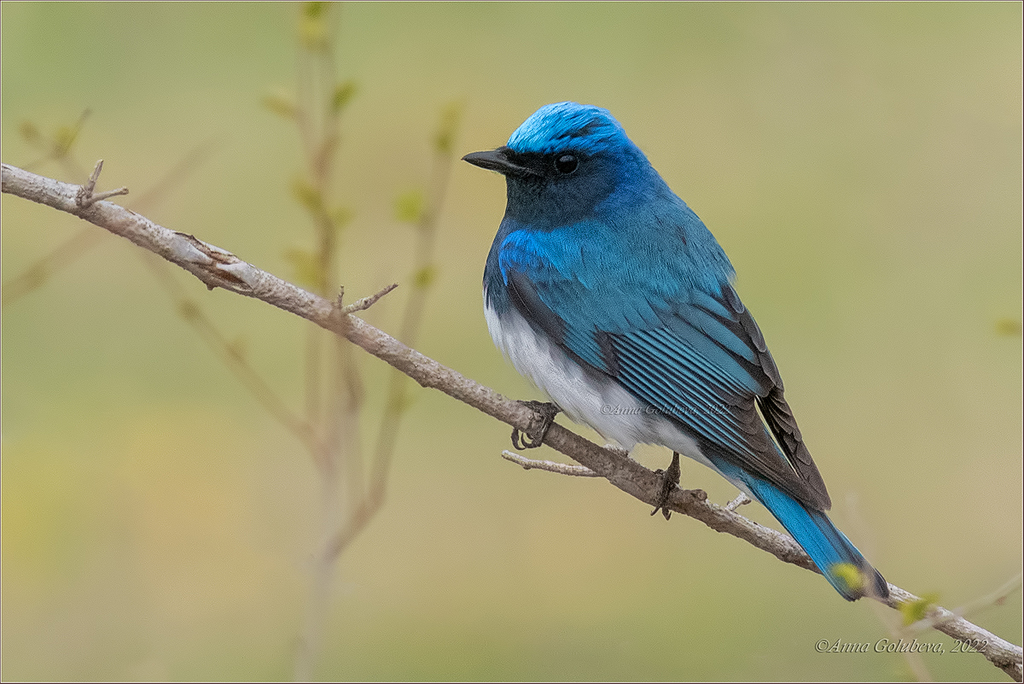
The blue-and-white flycatcher is a large flycatcher (16–17 cm long, weight 25 g on average) with a striking plumage pattern. The male is deep cobalt blue, with black on the face down to the upper part of the breast and flanks, the rest of the underside white. There is also a prominent white patch on the base of the outer tail feathers. Immature males have the adult male's blue wings, but are otherwise brown like females. The female is smaller on average than the male, with head, face and most of upperparts grey-brown, and pale beige-white on the lower part of the middle of the throat, young males are very similar. The female has a smaller-headed profile than other brown flycatchers in range. The song is a short, melancholic sounding series of whistles.
Range & habitat
Blue-and-white flycatchers breed in primary and secondary lowland and submontane forests (including taiga, wooded slopes, and gullies) up to 1200 metres, and also in riverine thickets and plantations. Outside the breeding season, it uses coastal woodland, scrub, parks, and gardens, and in Borneo winters at elevations up to 1850 metres in forested hills, lower montane forest, plantations, and logged lowland forest. These flycatchers are most active in the morning.
Wikipedia: “Habitat”
What it does
It feeds mainly on insects and larvae, but also eats berries, including pokeweed.
Wikipedia: “Diet”
In human culture
The species was first described in 1829 by Coenraad Jacob Temminck under the binomial name Muscicapa cyanomelana, and was transferred to its own genus Cyanoptila by Edward Blyth in 1847, on the basis of structural differences from other flycatchers, including its wing length and bill dimensions. The genus name comes from ancient Greek; "kuanos" meaning dark blue, and "ptilon", plumage. The specific cyanomelana also comes from "kuanos", paired with melas, melanos meaning dark, black.
Subspecies. Two subspecies are accepted:
C. c. cyanomelana (Temminck, 1829) - breeds in Japan and the southern Kuril Islands; it migrates south to winter in Myanmar, Thailand, and the Greater Sundas. C. c. intermedia (Weigold, 1922) - breeds in northeastern China (Heilongjiang southward to northeastern Hebei, north and east of Beijing), southeastern Russia (Amur Oblast and Primorsky Krai), and the Korean peninsula; it migrates south to winter in Myanmar, Thailand, and the Greater Sundas. A former third subspecies from further southwest in China is now treated as a separate species, Zappey's flycatcher C. cumatilis.
Wikipedia: “Taxonomy and etymology”
Listen
Looking for field recordings…
Where it lives
Recorded sightings
—
geo-referenced records in GBIF, from museums, herbaria and field observers.
Drag the globe to turn it. Dots are where records exist, not a range map; darker means more records.
In the stacks
Searching the stacks…
Every page naming Cyanoptila cyanomelana in the Biodiversity Heritage Library →
This page is assembled live from iNaturalist, GBIF, Wikipedia, the Source Library and the Internet Archive. It is not yet part of the hand-edited codex. iNaturalist taxon 13258.