On eBird ↗
Buffy-crowned Wood-Partridge
Live sightings near you, the range map, bar charts of when it is seen, and Macaulay Library photos and recordings.
Buffy-crowned Wood-Partridge
Dendrortyx leucophrys
The buffy-crowned wood partridge (Dendrortyx leucophrys) is a species of bird in the Odontophoridae family. It is found in Costa Rica, El Salvador, Guatemala, Honduras, Mexico, and Nicaragua. Its natural habitat is subtropical or tropical moist montane forests. Small groups forage in underbrush, secondary growth, near forest clearings and coffee plantations. The species local name is "chir-ras-qua" after its noisy call. It has a chicken-like appearance due to its long tail and legs. Its pale iris...
From the article Buffy-crowned wood partridge on Wikipedia (CC BY-SA), quoted section by section
Description
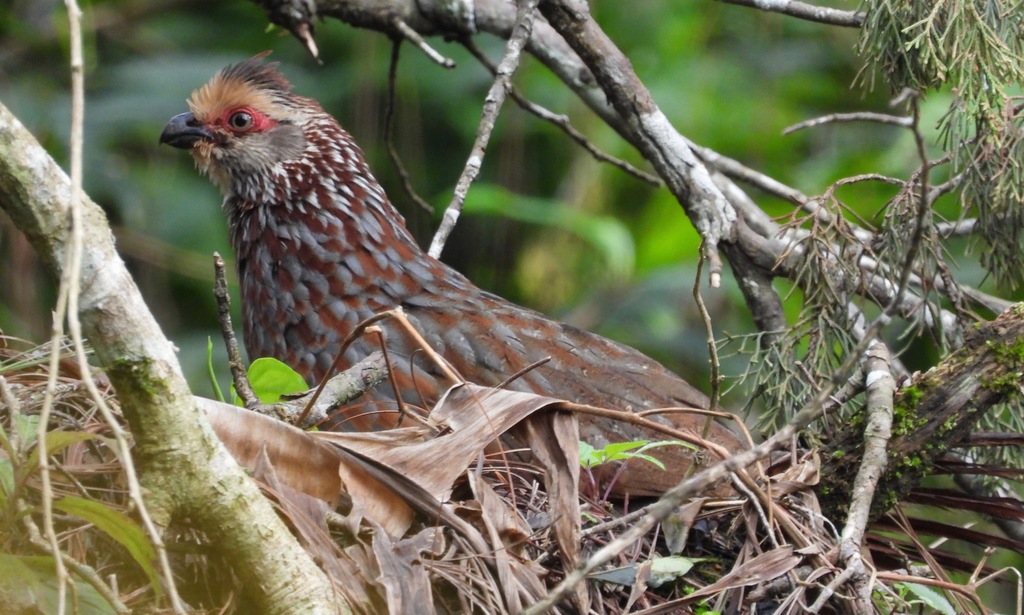
The buffy-crowned wood partridge is 28 to 35.5 cm (11.0 to 14.0 in) long. Males weigh an estimated 397 g (14.0 oz) and females an estimated 340 g (12 oz). The nominate subspecies' forehead, supercilium, chin, and throat are white. It has a patch of bare red skin around the eye. The crown, its short crest, and the nape are chestnut and the back, wings, and tail are chesnut and gray. The belly is blue-gray with chestnut streaks. D. l. hypospodius is larger, darker, and grayer. The stripes on the breast are very dark and much narrower.
Range & habitat
The buffy-crowned wood partridge is found in three separate areas. The nominate subspecies is found from Chiapas in southern Mexico into western Guatemala and in Honduras, El Salvador, northwestern Nicaragua, and far eastern Guatemala. D. l. hypospodius is found in central Costa Rica. The species inhabits several humid to semi-humid montane forest types including oak-pine, evergreen, and cloudforest. It can be found in secondary forest, partially logged areas, and coffee plantations.
Wikipedia: “Distribution and habitat”
What it does
The buffy-crowned wood partridge apparently forages by scratching through leaf litter. Its diet has not been well studied but includes seeds, buds, small fruits, and invertebrates. It moves about in family groups of four to six and in the non-breeding season in coveys of up to 12.
Wikipedia: “Feeding”
Listen
Looking for field recordings…
Where it lives
Recorded sightings
—
geo-referenced records in GBIF, from museums, herbaria and field observers.
Drag the globe to turn it. Dots are where records exist, not a range map; darker means more records.
In the stacks
Searching the stacks…
Every page naming Dendrortyx leucophrys in the Biodiversity Heritage Library →
This page is assembled live from iNaturalist, GBIF, Wikipedia, the Source Library and the Internet Archive. It is not yet part of the hand-edited codex. iNaturalist taxon 1327.