- Animals
- ›Chordates
- ›Vertebrates
- ›Birds
- ›Perching Birds
- ›Old World Flycatchers, Robins, and Chats
- ›Pogonocichla
On eBird ↗
White-starred Robin
Live sightings near you, the range map, bar charts of when it is seen, and Macaulay Library photos and recordings.
White-starred Robin
Pogonocichla stellata
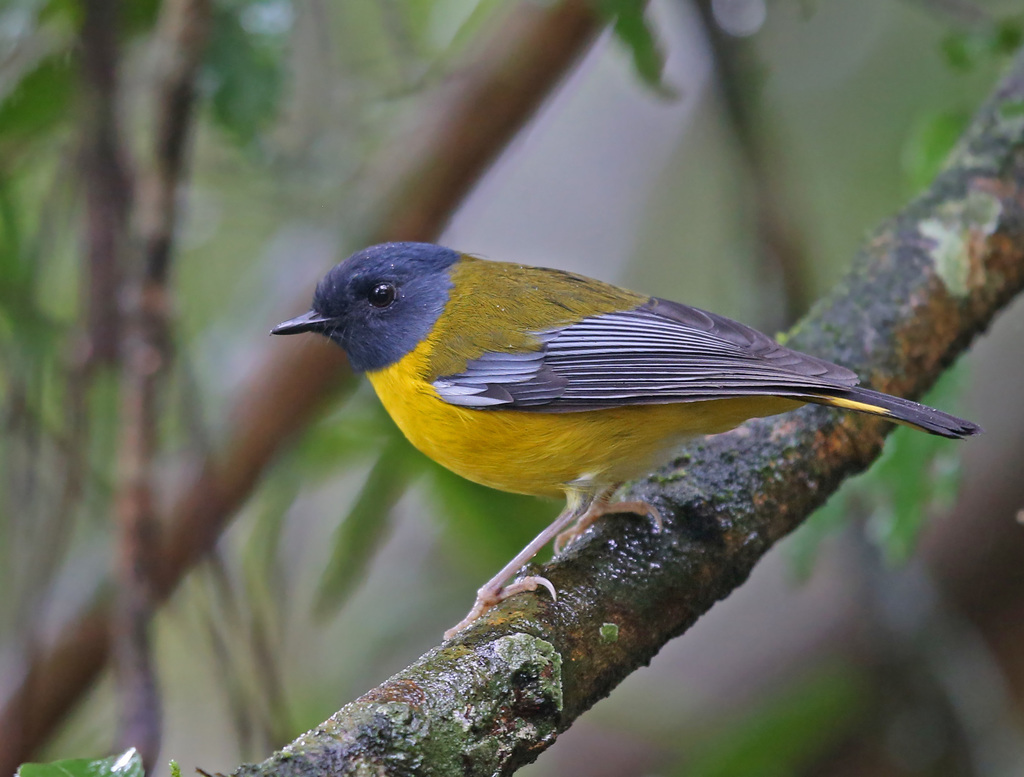
The white-starred robin (Pogonocichla stellata) is a species of bird in the Old World flycatcher and chat family Muscicapidae. It is also sometimes more simply called the starred robin. It is monotypic within the genus Pogonocichla. There are around twelve subspecies. The species is found in East and southern Africa. It occurs in forested areas in the Afromontane of sub-Saharan Africa. It is a brightly coloured robin with a bright yellow breast and belly, a slate coloured head with spots on the eyes and throat and blueish wings.
The white-starred robin gives a range of calls that vary geographically. The diet is dominated by insects, although some fruit is taken as well. It is a territorial and seasonal breeder that lays up to three eggs in a domed nest. The generic name Pogoncichla is derived from the Greek pogon for beard, a reference to the white spots on the throat and face, and kikhle for thrush. Similarly the specific name stellata and the species' common name are also derived from the facial spots.
From the article White-starred robin on Wikipedia (CC BY-SA), quoted section by section
Description
The white-starred robin is a small robin, 15 to 16 cm (5.9–6.3 in) in length and weighing between 18 and 25 g (0.63–0.88 oz), with the females being slightly smaller than the males. The plumage of the nominate race is slate-grey on the head, with a white spot in front of each eye and another small one on the throat. The mantle and part of the wings are green (moss-green in the mantle, olive-green on the wings), the rest of the wings are bluish grey, and the tail is black with yellow lateral stripes. The breast and belly are bright yellow, and the legs are pinkish. The plumage of both sexes are alike. The bill is broad and black, and unlike other robin species, is surrounded by well-developed rictal bristles used in flycatching. Juvenile birds are blackish-brown above with golden flecks, and yellow with brown scaling below. The nominate race has a sub-adult plumage, which is dusky olive above, yellow breast and belly, with grey streaks, and the tail is as adult but brownish instead of black. This sub-adult plumage is retained for up to two years. The race pallidiflava is as the nominate, but with a paler yellow on the breast and belly. intensa is quite different, with a bronze-washed back, a yellow rump and slate edges on the flight feathers. The race ruwenzori is like intensa but with a deeper yellow on the breast. …
Range & habitat
The white-starred robin is a principally found in primary or secondary moist evergreen forest. It needs forest with a good understory of shrubs and vines. It also occupies forest edges, pine and wattle plantations, evergreen woodlands and forest edge gardens. It occasionally is reported in bamboo or heath zones in some mountains. In the northern parts of its range, near the equator, it occurs in mountains between 1,500 and 2,200 m (4,900–7,200 ft) in elevation (sometimes as high as 3,300 m (10,800 ft)), further south in Zimbabwe it seldom occur above 1,300 m (4,300 ft), and in South Africa it can occur at sea level. The white-starred robin is a partial migrant. This migration is altitudinal, with birds moving to lower altitudes during the winter (April to September), and is much more pronounced in the southern parts of the range. In Malawi birds descend to the shores of lake Malawi (300 m (980 ft)), birds in South Africa and Mozambique move as low as sea-level, and may move 120 km (75 mi) from their breeding sites. In Malawi studies established that the males remained in their breeding territories, while the females moved away during the winter.
Wikipedia: “Habitat”
What it does
The white-starred robin feeds principally on insects and fruits. In one study of fecal samples conducted in KwaZulu-Natal in South Africa, beetles, moths and ants predominated in the samples, being found 83%, 58% and 43% of the time respectively. Other remains found included those of spiders, flies, caterpillars, amphipods, true bugs, wasps, grasshoppers and centipedes. The remains of fruit were found in 34% of the samples, with Canthium, Cassipourea, Ficus, Hedychium, Ilex, Kiggelaria and Rhus being found. The species has also been recorded feeding on other species, including snails, termites, mantids and even small frogs (of the genus Arthroleptis).
Wikipedia: “Diet and feeding”
Listen
Looking for field recordings…
Where it lives
Recorded sightings
—
geo-referenced records in GBIF, from museums, herbaria and field observers.
Drag the globe to turn it. Dots are where records exist, not a range map; darker means more records.
In the stacks
Searching the stacks…
Every page naming Pogonocichla stellata in the Biodiversity Heritage Library →
This page is assembled live from iNaturalist, GBIF, Wikipedia, the Source Library and the Internet Archive. It is not yet part of the hand-edited codex. iNaturalist taxon 13272.