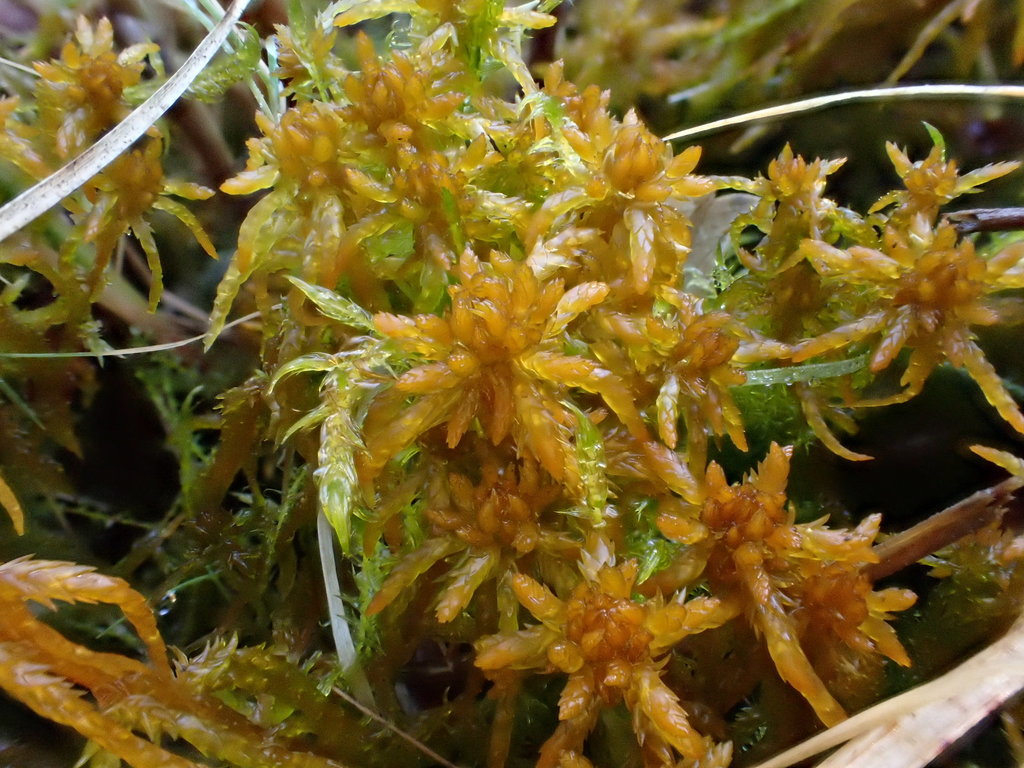
Orange Peatmoss
Sphagnum subsecundum
Sphagnum subsecundum, the slender cow-horn bog-moss, is a species of moss in the family Sphagnaceae. It is the namesake of a species complex. The complex has a nearly worldwide distribution in wetlands, with the species proper found in Europe, eastern North America and North Africa (in the Tunisian peatlands of Dar Fatma).
From the article Sphagnum subsecundum on Wikipedia (CC BY-SA), quoted section by section
Description
This specific moss type can be described as a small and delicate bog-moss, typically with a golden-orange or yellow-brown colour, though it can appear as green in the shade. The branch leaves are generally under 1.2 mm in length and are asymmetrical on the lower parts. When viewed from above, they appear to be predominantly to one side, hence the characteristic curved appearance. The stem leaves are equilateral-triangular in shape and can be as short as 0.5 mm. The stems are typically dark brown in colour.
Wikipedia: “Characteristics”
Range & habitat
Sphagnum subsecundum predominantly occupies moderately nutrient-enriched wetland. It is commonly found in flushes, fens, ditches and swamps. It will occasionally appear in semi-submerged landscapes, such as areas that encounter winter flooding.
== References ==
Wikipedia: “Habitat”
Where it lives
Recorded sightings
—
geo-referenced records in GBIF, from museums, herbaria and field observers.
Drag the globe to turn it. Dots are where records exist, not a range map; darker means more records.
In the stacks
Searching the stacks…
Every page naming Sphagnum subsecundum in the Biodiversity Heritage Library →
This page is assembled live from iNaturalist, GBIF, Wikipedia, the Source Library and the Internet Archive. It is not yet part of the hand-edited codex. iNaturalist taxon 132799.