- Plants
- ›Mosses
- ›Peat mosses and allies
- ›Peat mosses and allies
- ›peat moss family
- ›Sphagnum
- ›Acutifolia
- ›Acutifolia
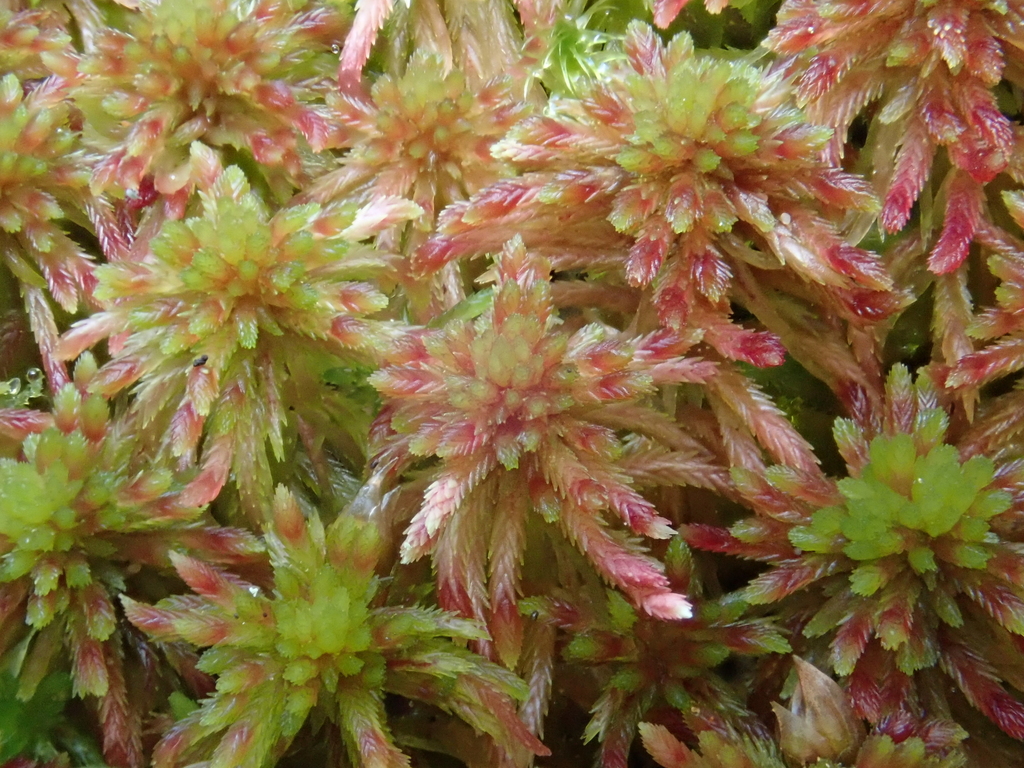
Five-ranked Bogmoss
Sphagnum quinquefarium
Sphagnum quinquefarium, the five-ranked bog-moss, is a species of peat moss belonging to the family Sphagnaceae. It is characterised by its distinctive five-ranked leaf arrangement and three spreading branches per fascicle. It typically grows in loose, upright formations in damp, shaded woodlands rather than in peatlands, preferring areas with high atmospheric humidity. The medium-sized moss has a pale green to yellowish-green colouring, often marked with pink or red patches, and can be distinguished from similar species by its prismatic branch appearance and parallel-sided stem leaves. Found throughout the Northern Hemisphere, it is most abundant in oceanic and sub-oceanic regions, particularly in northwestern Europe and the Carpathian Mountains, with populations also occurring in eastern Asia and coastal North America. While commonly hybridising with S. capillifolium in areas where their ranges overlap, the species maintains its distinctness through different habitat preferences. Conservation status varies significantly across its range, from being common in some regions to vulnerable and legally protected in others, such as Hungary.
From the article Sphagnum quinquefarium on Wikipedia (CC BY-SA), quoted section by section
Description
Sphagnum quinquefarium is a medium-sized peat moss that typically grows in loose, upright formations rather than dense clusters. The plant has pale green to yellowish-green colouring, often marked with pink or pale red patches, though occasionally the entire plant may appear red. The capitula (plant tops) have a distinctive wide triangular form, measuring only 1 mm in length. The plant's stem is slender (0.5–0.8 mm in diameter) and surrounded by 3–4 layers of transparent (hyaline) cells, with a well-developed inner core that appears yellowish to yellow-brown, sometimes showing reddish zones. This core is protected by an outer layer of cells that occasionally feature small pores. A distinctive characteristic of S. quinquefarium is its branch arrangement. Unlike most other species in the Sphagnaceae, which typically have two spreading branches per fascicle, S. quinquefarium consistently has three spreading branches. The branches grow in clusters (fascicles) spaced apart along the stem, with each cluster typically containing 4–5 branches of two different types. Each cluster features three spreading branches that extend 15–25 mm and taper toward their tips, accompanied by one or two hanging (pendent) branches that are at least as long as the spreading ones. …
Range & habitat
Unlike most peat mosses, Sphagnum quinquefarium rarely grows in peatlands. Instead, it favours damp hillsides where it grows beneath dwarf shrubs or in open woodlands, particularly those dominated by birch (Betula) trees. The species shows a strong preference for upland areas and well-drained spruce forests, and can also be found growing in acidophilous beech forests and on wet andesite rocks. The species thrives in areas of high humidity and is frequently found growing alongside other peat mosses, particularly Sphagnum capillifolium var. capillifolium and S. palustre. Its common companion plants include heather (Calluna vulgaris), birch trees, and various species of bilberry and cranberry (Vaccinium species). Sphagnum quinquefarium shows a distinctly oceanic distribution pattern, being most abundant in regions with strong maritime influence. In Europe, it reaches its greatest abundance in the northwestern regions, particularly in southern Scandinavia, though it is notably absent from the northernmost areas. In Central and Eastern Europe, the species is especially abundant in the Carpathian Mountain range. It is very common throughout the High Tatras of Slovakia and the Romanian Carpathians, where it occurs across numerous mountain ranges including the Maramureș, Călimani, and Făgăraș Mountains. …
Wikipedia: “Distribution and habitat”
Where it lives
Recorded sightings
—
geo-referenced records in GBIF, from museums, herbaria and field observers.
Drag the globe to turn it. Dots are where records exist, not a range map; darker means more records.
In the stacks
Searching the stacks…
Every page naming Sphagnum quinquefarium in the Biodiversity Heritage Library →
This page is assembled live from iNaturalist, GBIF, Wikipedia, the Source Library and the Internet Archive. It is not yet part of the hand-edited codex. iNaturalist taxon 132800.