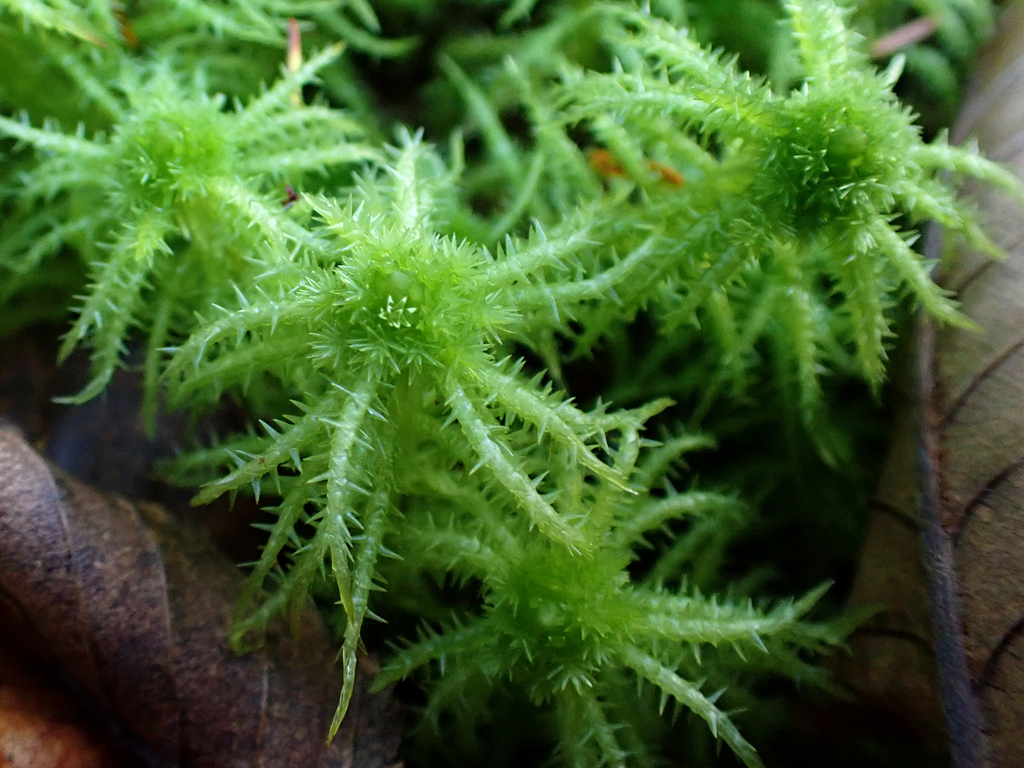
Crome Sphagnum
Sphagnum squarrosum
Sphagnum squarrosum, commonly known as the spiky bog-moss or spreading-leaved bog moss, is a peat moss species found in nutrient-rich, damp soils and wetlands across the Northern Hemisphere, with isolated populations in South America. Its spiky appearance, resulting from strongly spreading branch leaves, distinguishes it from other peat moss species. Playing an important role in wetland succession, the species is one of the first Sphagnum mosses to colonise developing wetlands. It shows considerable tolerance to mineral-rich conditions and actively modifies its habitat through cation exchange processes.
Unlike many other peat mosses that require highly acidic conditions, S. squarrosum thrives in areas with moderate calcium levels, particularly along stream banks, in fens, and in wet woodlands dominated by Salix (willows) and Betula (birches). It disperses efficiently, producing more spores per capsule and per patch than other Sphagnum species. It shows high genetic diversity across its range, having survived the Last Glacial Maximum in multiple European refugia. The species serves as the specific host for the fungal parasite Discinella schimperi, which infects about half of all documented populations.
From the article Sphagnum squarrosum on Wikipedia (CC BY-SA), quoted section by section
Description
Sphagnum squarrosum is readily identified by its distinctive spiky appearance, which sets it apart from other peat mosses. This large, robust species forms loose carpets in pale to yellow-green colours, though it may develop pale brown colouration in exposed alpine or arctic habitats. Its common name "spiky bog-moss" comes from its most striking feature: branch leaves that spread outward at sharp angles from the branches like tiny stars, a growth pattern botanists term squarrose. The plant's structure follows the typical Sphagnum pattern, but with distinctive characteristics. At its crown, it possesses a very large and prominent apical bud. The stem is strong, measuring 0.7–1.3 mm in diameter, with a dark brown internal cylinder that becomes paler in shade forms. The stem cortex comprises 2–3 layers of hyaline (colourless and translucent) cells, with the superficial layer showing indistinct thinnings known as 'shadow pores'. The branch cortex contains specialised pore-bearing cells called retort cells (flask-shaped cells that aid in water conduction), which are often relatively indistinct from other cortical cells and occurring in groups of one to four, with an internal cylinder that is pale brown or yellowish. …
Range & habitat
Sphagnum squarrosum has a broad geographical range spanning much of the Northern Hemisphere, occurring throughout North America and Eurasia. While it is widely distributed, the species shows particular concentration in northern regions of Europe. Its circumpolar range has been well-documented through specimens from Canada (including the Northwest Territories and Yukon), the United States (including Alaska), Greenland, multiple European countries, Japan, and various regions of Russia. The 2017 report of populations in southeastern Brazil has extended its known range into South America, representing its southernmost occurrence globally.
Unlike many other peat mosses that require highly acidic conditions, S. squarrosum thrives in mineral-rich environments with moderate calcium levels. This tolerance is supported by laboratory studies showing the species maintains consistent photosynthetic rates across a wide pH range (5.2–7.5). The species actively shapes its environment through cation exchange, absorbing calcium and releasing protons to gradually alter water chemistry. This ability makes it an important pioneer species in wetland development, often appearing alongside S. fimbriatum in early successional stages before more acid-loving bog species can establish. The species shows distinct habitat preferences across its range. …
Wikipedia: “Habitat, distribution, and ecology”
What it does
Sphagnum squarrosum is a monoicious species (having both male and female reproductive organs on the same plant) and frequently produces spores throughout its range. The species has efficient dispersal capabilities. Among studied Sphagnum species, it produces both the highest number of spores per capsule and the highest overall spore output per patch of growth. Studies have found no evidence of reduced fitness in self-fertilised plants. Large capsules and small spores enhance the species' long-distance dispersal efficiency. Compared to other Sphagnum species, Sphagnum squarrosum retains fewer spores within its capsules after dispersal, resulting in greater spore release and wider distribution. Research on island colonization reveals that S. squarrosum is an effective long-distance disperser, successfully establishing populations as far as 40 km (25 mi) from parent sources. The species is notable for being able to colonise habitats closer to the sea than other Sphagnum species, demonstrating higher tolerance to salt spray and ionic concentrations. Like other Sphagnum mosses, spore production in natural populations is relatively rare, with studies finding only about 2% of patches producing spore capsules. However, as a monoicious species, S. …
Wikipedia: “Reproduction and dispersal”
In human culture
Genetic studies of European populations suggest that S. squarrosum likely survived the Last Glacial Maximum in multiple scattered refugia across Europe. Analysis of chloroplast DNA variation indicates that the species maintained relatively stable historical population sizes and experienced less severe population bottlenecks during glacial periods compared to some other Sphagnum species. The species has high genetic diversity, with widely distributed haplotypes and weak geographic structure in Europe. This pattern suggests the species spread from multiple refugial populations after the last ice age. Some genetic variants found at higher altitudes may represent ancient lineages that were once more widely distributed across European tundra following the LGM.
Wikipedia: “Evolutionary history”
Where it lives
Recorded sightings
—
geo-referenced records in GBIF, from museums, herbaria and field observers.
Drag the globe to turn it. Dots are where records exist, not a range map; darker means more records.
In the stacks
Searching the stacks…
Every page naming Sphagnum squarrosum in the Biodiversity Heritage Library →
This page is assembled live from iNaturalist, GBIF, Wikipedia, the Source Library and the Internet Archive. It is not yet part of the hand-edited codex. iNaturalist taxon 132807.