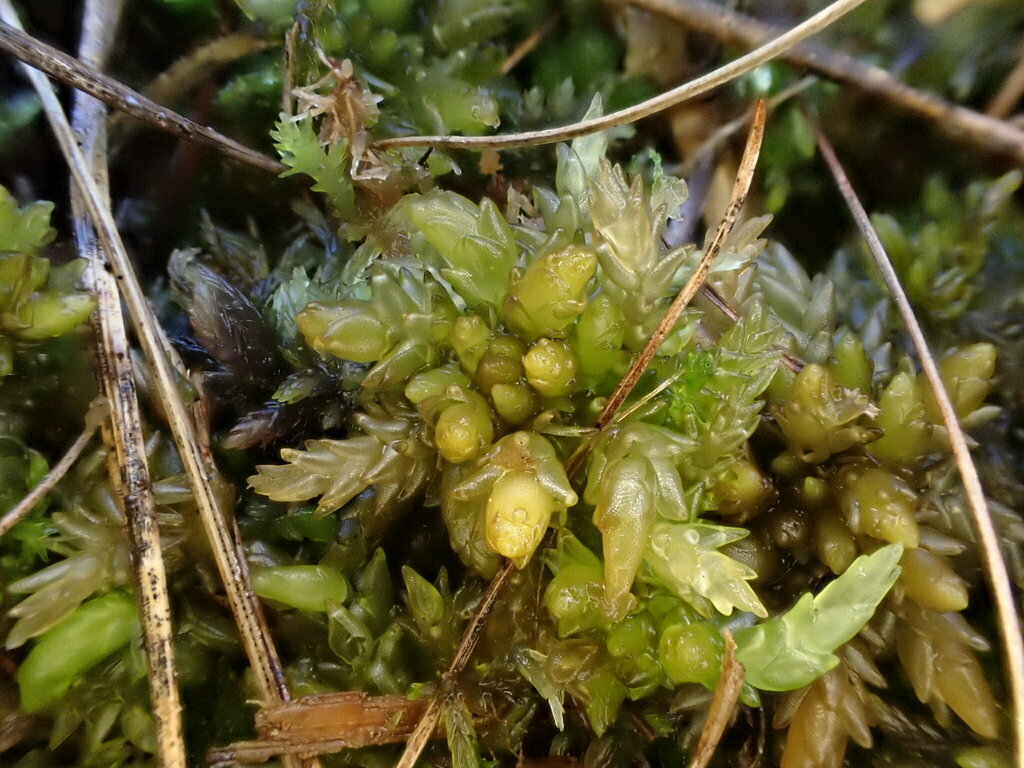
Flat-leaved Bog-moss
Sphagnum platyphyllum
Sphagnum platyphyllum, the flat-leaved bogmoss, is a species of moss in the family Sphagnaceae. It is a circumpolar peat moss found in arctic and subarctic regions of Europe and Asia, with populations also occurring in North America. The species typically grows in loose mats in wet, moderately nutrient-rich environments, particularly in areas dominated by sedges and locations that experience seasonal flooding. First described as a variety in 1875 and elevated to species status in 1884, it belongs to the subgenus Subsecunda within the "Pacific Rim clade". While most populations are haploid, the species shows evidence of a complex evolutionary history, including rare allodiploid populations. Although widely distributed and classified as a least-concern species globally, it faces varying levels of conservation concern across its range, being critically endangered in several European countries due to habitat degradation, peat extraction, and climate change. The species is distinctive among peat mosses for its poorly developed capitula with protruding stem buds, and its dioecious reproduction, with male plants and spore-producing structures being rare in many regions.
From the article Sphagnum platyphyllum on Wikipedia (CC BY-SA), quoted section by section
Description
Sphagnum platyphyllum is a species of peat moss that typically grows in a loose, spreading manner. The plants display varying colours, most commonly appearing in dull shades of pale green to olive-green, sometimes showing purple tinges, and rarely appearing yellowish-brown. Unlike many other peat mosses, this species has poorly developed capitula (the dense cluster of branches at the plant's tip) with distinctive large, oval stem buds protruding from them. The plant's growth pattern is characterised by somewhat widely spaced clusters of branches (called fascicles), which typically contain three or fewer branches each. These branches are relatively short with blunt ends, with usually one branch being slightly weaker and hanging downward, though otherwise similar to its spreading companions. Rarely, specimens may be found without any branch clusters at all. The stem is relatively delicate, measuring up to 0.9 mm in diameter. It is surrounded by a protective layer of cells (the cortex) that is typically two cells thick, though this can vary between one and three layers in places. When stained for microscopic examination, these outer cortical cells often reveal a single large pore or thinned area in their walls. …
Range & habitat
Sphagnum platyphyllum typically grows in loose mats in wet environments that are moderately nutrient-rich (mesotrophic) to slightly nutrient-enriched (mildly eutrophic). The species can be found either submerged or growing close to the water surface. It shows a particular affinity for areas dominated by sedges (Carex species) and locations that experience seasonal flooding, such as the margins of pools, rivers, and lakes, as well as in fens. In these habitats, it commonly grows alongside common reed (Phragmites australis), rushes (Juncus species), reedmace (Typha species), and the brown moss Drepanocladus revolvens. Notably, it rarely occurs with other species of Sphagnum. The species can occasionally be found growing in pools or water channels over mineral-based soils. The species has a circumpolar distribution, meaning it is found in a band around the Earth in arctic and sub-arctic regions of Europe and Asia. In North America, it is uncommon in western and central regions but extends southward along the eastern seaboard as far as Alabama and Louisiana. Throughout Europe, the species shows a predominantly north-eastern distribution pattern, reaching its greatest abundance in Scandinavia whilst extending as far south as Portugal and Bulgaria. While generally a lowland to subalpine species, it tends to occur at progressively higher elevations in the southern parts of its range. …
Wikipedia: “Habitat and distribution”
Where it lives
Recorded sightings
—
geo-referenced records in GBIF, from museums, herbaria and field observers.
Drag the globe to turn it. Dots are where records exist, not a range map; darker means more records.
In the stacks
Searching the stacks…
Every page naming Sphagnum platyphyllum in the Biodiversity Heritage Library →
This page is assembled live from iNaturalist, GBIF, Wikipedia, the Source Library and the Internet Archive. It is not yet part of the hand-edited codex. iNaturalist taxon 132810.