On eBird ↗
Red-keeled Flowerpecker
Live sightings near you, the range map, bar charts of when it is seen, and Macaulay Library photos and recordings.
Red-keeled Flowerpecker
Dicaeum australe
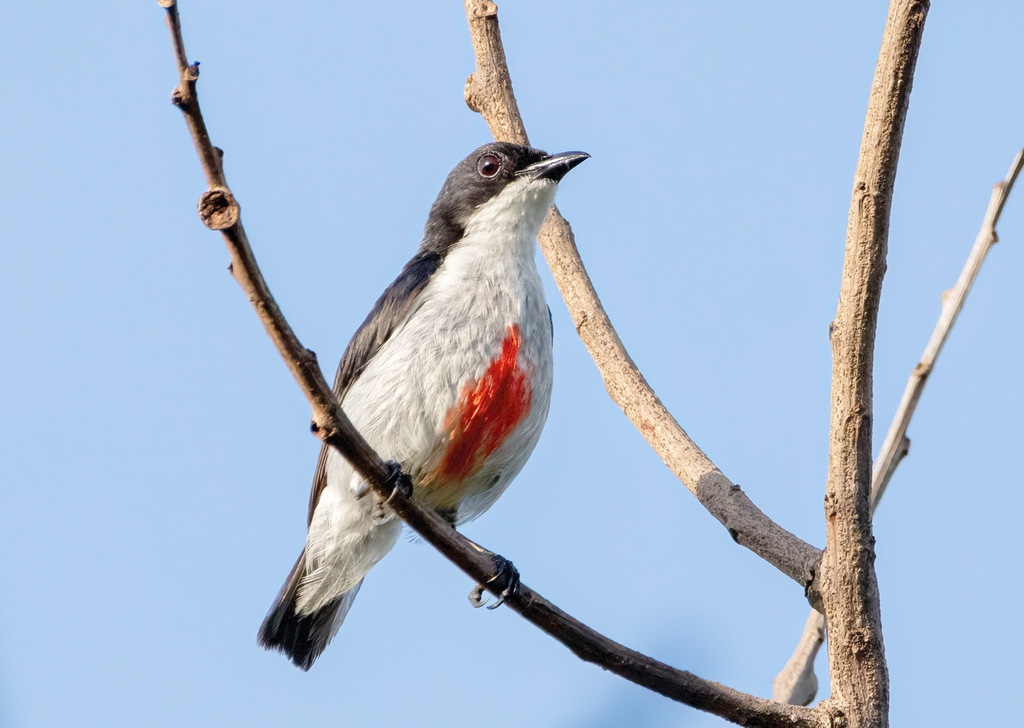
The red-keeled flowerpecker or red-striped flowerpecker (Dicaeum australe) is a species of bird in the family Dicaeidae. It is endemic to the Philippines. It is one of the more common birds in the Philippines as it is able to thrive in a wide array of habitats. The black-belted flowerpecker (D. haematostictum) was formerly regarded as a subspecies of this bird.
From the article Red-keeled flowerpecker on Wikipedia (CC BY-SA), quoted section by section
Description
Small, relatively long curved bill of medium thickness, sexes similar, races vary by having black breast and broad scarlet keel haematostictum or no black and narrow scarlet keel australe male upperparts glossy blue black; chin and sides of throat white; rest of underparts gray with diagnostic narrow scarlet stripe down center of the breast and belly; underwing and pectoral tufts white. female like male but paler. imm dark grayish brown above, brownish olive gray below. Bill and lags black; eye dark chestnut. The Black-belted flowerpecker was once considered a subspecies of Red-keeled flowerpecker but has since been classified as a separate species
Wikipedia: “Description and taxonomy”
Range & habitat
This species is extremely adaptable to almost any habitat except montane forest, found in lowland forest, second growth, agricultural areas and parks. The IUCN has classified the species as least concern as it is common throughout its wide range. Its adaptability to be able to thrive in degraded habitat has made one of the few Philippine endemic birds that does not have a declining population.
Wikipedia: “Habitat and conservation status”
What it does
Feeds on small fruits, mistletoes, flowers and also takes small insects. Forages mostly in the canopy and middle stratum. Found singly, in pairs or mixed species flocks with other flowerpeckers and small birds. Breeding has been observed from April to August but . Relative to how common this species is, not much is actually known about this bird's biology.
Wikipedia: “Ecology and behavior”
Listen
Looking for field recordings…
Where it lives
Recorded sightings
—
geo-referenced records in GBIF, from museums, herbaria and field observers.
Drag the globe to turn it. Dots are where records exist, not a range map; darker means more records.
In the stacks
Searching the stacks…
Every page naming Dicaeum australe in the Biodiversity Heritage Library →
This page is assembled live from iNaturalist, GBIF, Wikipedia, the Source Library and the Internet Archive. It is not yet part of the hand-edited codex. iNaturalist taxon 13382.