On eBird ↗
Mistletoebird
Live sightings near you, the range map, bar charts of when it is seen, and Macaulay Library photos and recordings.
Mistletoebird
Dicaeum hirundinaceum
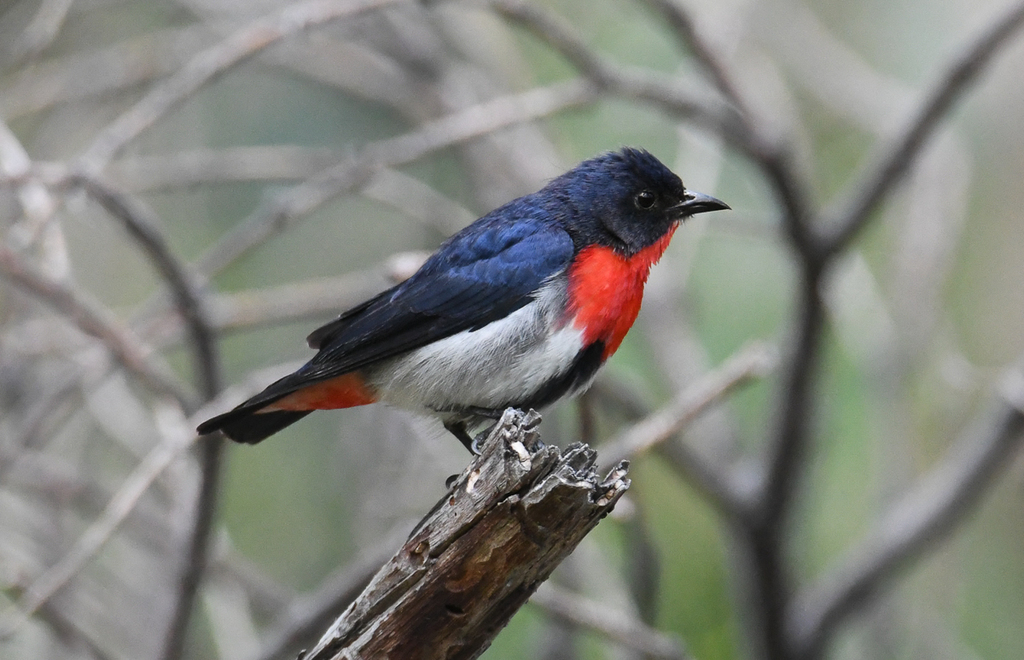
The mistletoebird (Dicaeum hirundinaceum), also known as the mistletoe flowerpecker, is a species of flowerpecker native to most of Australia (though absent from Tasmania and the driest desert areas) and also to the eastern Maluku Islands of Indonesia in the Arafura Sea between Australia and New Guinea. The mistletoebird eats mainly the berries of the parasitic mistletoe and is a vector for the spread of the mistletoe's seeds through its digestive system.
From the article Mistletoebird on Wikipedia (CC BY-SA), quoted section by section
Description
The mistletoebird is small, 9–10 cm (3.5–3.9 in) long and 7.5–11 g (0.26–0.39 oz) weight. The male is glossy blue-black above, with a red chest and a slight red under-tail, and a black centre stripe running down its white belly. The female is dark grey above, with a white throat, light grey underparts, and just a touch of pinkish-red under the tail. The eyes, bill, and legs are black; the bill is just over a centimetre long, slender, slightly down-curved and sharply pointed. Immature birds are similar to the female, but have an orange-pink bill instead of black. There is a variance in size and colour across their distribution. The adult mistletoebird is smaller in the north of its distribution and females in the north have lighter coloured underparts compared to darker ones in the south. The mistletoebird has long pointed wings and a short square tail with a slight notch at the tip. They usually occur singularly or in twos but occasionally in small family groups or flocks and very occasionally in mixed-species flocks when food is in abundance. Their flight is swift and they are usually seen flying above or high in the tree canopy on distinctively pointed wings. Their posture is usually upright when perched but adopt a more horizontal, swaying posture when alarmed. …
Range & habitat
Mistletoebirds are nomadic where movement is generally local and is associated with the fruiting of mistletoe. Mistletoebirds mostly occur in forests and woodlands dominated by any species of Eucalyptus from the dry interior to the coastal rain forests, but they do not frequent high altitude areas in winter as they adopt a torpid state when cold. Mistletoebirds are more likely to occur in mature stands where trees are larger and more likely to have become infested with mistletoe, rather than in regenerated areas. There are over 1300 species of mistletoe around the world and about 100 in Australia, where a common variety in the drier climates is the grey mistletoe (Amyema quandang). All mistletoes share a common growth form where water and nutrients are obtained from their host tree via a specialized vascular attachment, but as mistletoe manufacture their own carbohydrates using photosynthesis, they are referred to as 'half parasitic'. Although common on the mainland of Australia, there are no mistletoes in Tasmania. Less specialized fruit-eating species, such as the honeyeater, source much of their protein from arthropods. …
Wikipedia: “Habitat”
What it does
The mistletoebird is a specialist frugivore that primarily eats the berries of mistletoes. Foraging time takes up 25% of the mistletoebird's daytime activities in summer and 29% in winter. The increased fruit consumption in winter could be related to the bird's increased thermo-regulatory costs during the cold of winter. Mistletoe fruit dominates the mistletoebird's diet, accounting for 85% of foraging observations. Arthropods formed 13% and the remainder was from nectar, insects, and other berries. The only other known frugivore with a similar degree of dietary specialization is Pesquet's parrot (or vulturine parrot) of New Guinea that feeds almost exclusively on strangler figs. In becoming frugivore specialists, both these birds live off the fruit of parasites that germinate in the canopy of host trees, where the fruit of the parasite has specific seed placement requirements on host branches and resists consumption by frugivore nonspecialist birds. The mistletoe plant minimizes opportunistic consumption of their berries by less specialized dispersal birds by producing few, inconspicuous fruits over a long period. Specialist frugivorous birds, by eating mainly fruit, have a diet rich in carbohydrates and poor in protein. …
Wikipedia: “Feeding”
Listen
Looking for field recordings…
Where it lives
Recorded sightings
—
geo-referenced records in GBIF, from museums, herbaria and field observers.
Drag the globe to turn it. Dots are where records exist, not a range map; darker means more records.
In the stacks
Searching the stacks…
Every page naming Dicaeum hirundinaceum in the Biodiversity Heritage Library →
This page is assembled live from iNaturalist, GBIF, Wikipedia, the Source Library and the Internet Archive. It is not yet part of the hand-edited codex. iNaturalist taxon 13388.