- Animals
- ›Chordates
- ›Vertebrates
- ›Ray-finned Fishes
- ›Spiny-rayed fishes
- ›Rivulines, Killifishes, and Livebearers
- ›Cyprinodontoidei
- ›Four-eyed Fishes, Onesided Livebearers, and White-eye
- ›Four-eyed Fishes
- ›Anableps
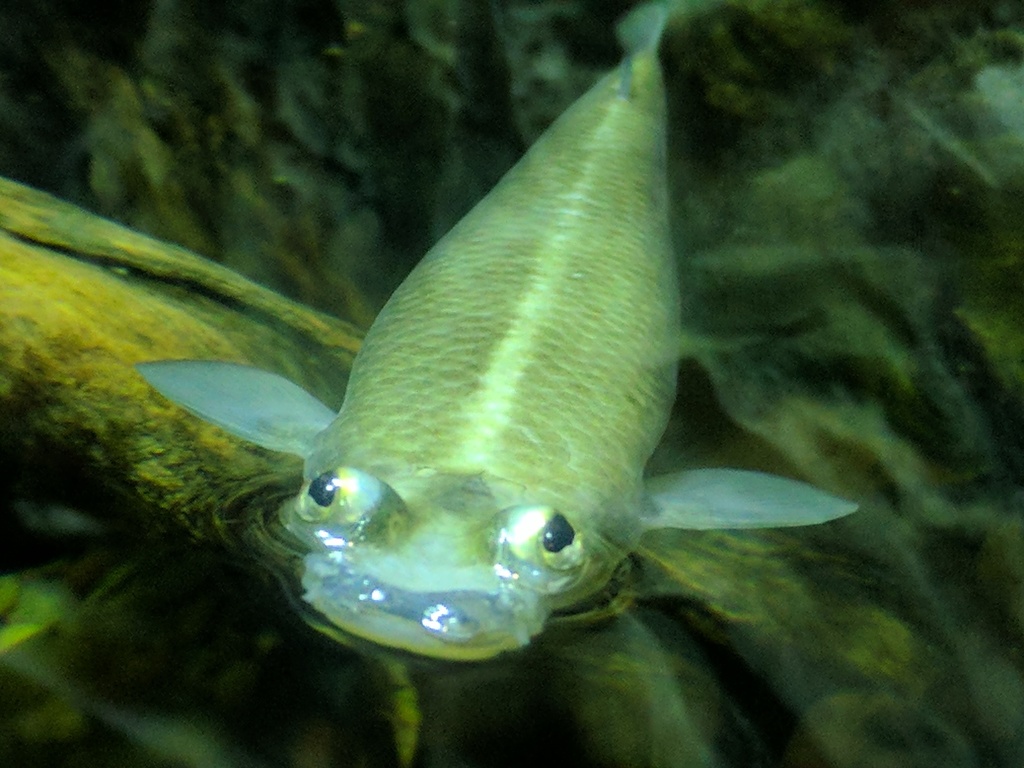
Largescale Four-eyed Fish
Anableps anableps
Anableps anableps, the largescale four-eyes, is a species of four-eyed fish found in fresh and brackish waters of northern South America and Trinidad. This species grows to a length of 24.5 centimetres (9.6 in) standard length (SL). This fish can occasionally be found in the aquarium trade. The fish does not actually have four eyes. Instead, each eye is split into two lobes by a horizontal band of tissue, each lobe with its own pupil and separate vision. This allows the fish to see above and below the surface of the water at the same time. This species has been documented to occasionally feed on land. Both sexes exhibit asymmetrical genitalia.
From the article Anableps anableps on Wikipedia (CC BY-SA), quoted section by section
Description
Anableps anableps is a slender elongate fish with very distinct eyes that project prominently from the head. Each eye is divided lengthwise and thus has two pupils; the fish positions itself in such a way that the dividing line between the two parts of the eye lies on the surface of the water, so that one pupil has an aerial view while the other is submerged. It is brown in color with some countershading. This fish also exhibits some sexual dimorphism. Females are larger and much heavier than males, reaching an average of 18.5 cm (7.3 in) standard length (SL) and 80 g (2.8 oz) in weight, while males reach an average of 14.5 cm (5.7 in) SL and 31 g (1.1 oz) in weight. At maximum, females may reach up to 24.5 cm (9.6 in) SL and 200 g (7.1 oz), while the largest males reach 18.5 cm (7.3 in) SL and 70 g (2.5 oz). Other differences between the sexes include the presence of a gonopodium. Juveniles and adult females possess an anal fin, while male fish have the anal fin modified into an intromittent organ with the tip angled to one side. This structure, called the gonopodium, is used in reproduction. Adult females have 11 anal fin rays, where rays 1–3 and 11 are unbranched. Female fish also have a modified scale called a foriculum covering either the left or right genital opening. A. …
Range & habitat
Anableps anableps is found in the tropical western Atlantic Ocean and the southern Caribbean Sea. Its range extends from Trinidad and Venezuela to the delta of the Amazon River in Brazil. However, some sources report occurrences as far south as the Bay of All Saints in Brazil, and some occurrences very far inland. It mostly occurs in estuaries and on coastal mudflats, where it shares its habitat with A. microlepis. Unlike A. microlepis, however, A. anableps can survive in freshwater environments for extended periods.
Wikipedia: “Distribution and habitat”
What it does
Anableps anableps typically stays close to the surface of the water, utilizing its unique eyes to see above and below the surface of the water at the same time. It rarely ever dives below the surface, though it must periodically submerge its eyes to prevent desiccation. This species forms schools of 10 to 50 individuals. A. anableps has a generalist diet, feeding on insects and other small invertebrates (such as small crabs), small fish, and on algae. A large part of its diet consists of detritus, but the highest diversity of prey items comes from insects. It has occasionally been observed catching insects by jumping in the air, but otherwise, it ingests prey on or near the surface. It also ingests silt, consuming diatoms, mussels, and isopods among the grains. Sometimes it emerges from the water and feeds on mudbanks. In the water, the fish uses a combination of biting and suction to capture its prey. It feeds by depressing the lower jaw and protruding the upper jaw, and ingesting the prey by suction. If the prey is too large to swallow, it is gripped by the teeth, the upper jaw is retracted, and the fish bites the prey. This cycle of protrusion and biting can be repeated until the prey is able to be swallowed. …
Wikipedia: “Ecology”
At the table
Researchers favor this species for its unique eye morphology. The unique appearance of this species has attracted the attention of the public, as this species can be found in many films, lectures, and in both public and home aquariums.
Despite its use in the aquarium trade, Anableps anableps was classified as Least Concern by the IUCN in 2020. No specific population trends are known, however.
== References ==
Wikipedia: “Human uses and impacts”
Where it lives
Recorded sightings
—
geo-referenced records in GBIF, from museums, herbaria and field observers.
Drag the globe to turn it. Dots are where records exist, not a range map; darker means more records.
In the stacks
Searching the stacks…
Every page naming Anableps anableps in the Biodiversity Heritage Library →
This page is assembled live from iNaturalist, GBIF, Wikipedia, the Source Library and the Internet Archive. It is not yet part of the hand-edited codex. iNaturalist taxon 133993.