On eBird ↗
Lina's Sunbird
Live sightings near you, the range map, bar charts of when it is seen, and Macaulay Library photos and recordings.
Lina's Sunbird
Aethopyga linaraborae
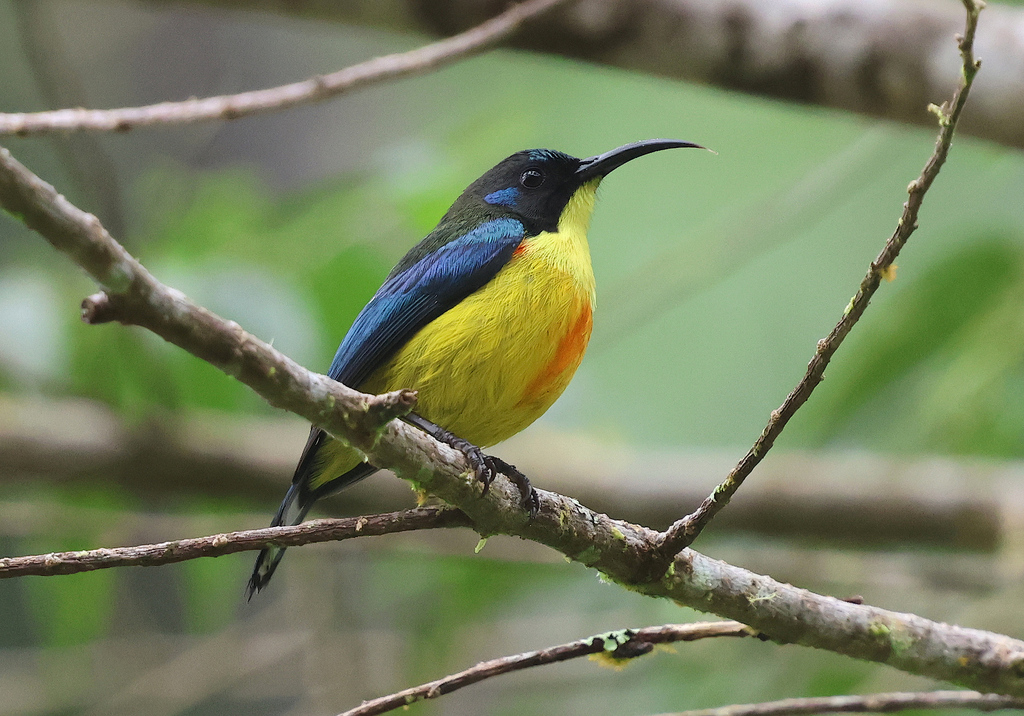
Lina's sunbird (Aethopyga linaraborae) is a species of bird in the family Nectariniidae It is endemic to mountains in the island of Mindanao in the Philippines. It is one of the most striking sunbirds in the country with the male having an iridescent blue color and an orange spot on its yellow breast. It is named after Dioscoro S. Rabor's wife, Lina who would assist Dioscoro on expeditions. Its natural habitat is tropical moist montane forest above 1000m. It is threatened by habitat loss.
From the article Lina's sunbird on Wikipedia (CC BY-SA), quoted section by section
Description
This is a small sunbird found only in the highland forests of East Mindanao. This species exhibits sexual dimorphism in which the male has an irridescent blue crown, cheek and wing. The female has an all gray head, olivee wings and some faint streaking on the underparts. Both male and female have a orange mark in the middle of the chest, yelow underparts and an olive back. LIke all sunbirds, it has a long curved bill. Its call is describe as a long series of high pitched tweets with an upward inflection. This species was formerly conspecific with the Apo sunbird but was split by Robert Kennedy, Pedro Gonzales and Hector Miranda in 1997. They decided to name this species after Lina Rabor whose husband is Dioscoro Rabor who is known for as the "Father of Philippine Biology and Conservation" and described 69 bird species
Wikipedia: “Description and taxonomy”
Range & habitat
It occupies montane mossy forest from 970 to 2,000 m and above in the mountains of Eastern Mindanao. IUCN has assessed this bird as near threatened making it the only Philippine sunbird that is not assessed as least concern as its range is heavily restricted to the mountains of east Mindanao. Despite its limited range, it is said to be locally common. As it occurs in rugged and inaccessible mountains, this has allowed a large portion of its habitat to remain intact. However, there it is still affected by habitat loss through deforestation, mining, land conversion and slash-and-burn - just not to the same extent as lowland forest. Mt. Tagubud in New Bataan, where it is mainly seen by birdwatchers, has faced considerable deforestation.
== References ==
Wikipedia: “Habitat and conservation status”
What it does
This species has not yet been comprehensively studied. It is presumed to have a typical sunbird diet of primarily nectar and supplemented with the occasional insect. Males in breeding condition with enlarged testes have been collected n May but this is not yet fully understood.
Wikipedia: “Ecology and behavior”
Listen
Looking for field recordings…
Where it lives
Recorded sightings
—
geo-referenced records in GBIF, from museums, herbaria and field observers.
Drag the globe to turn it. Dots are where records exist, not a range map; darker means more records.
In the stacks
Searching the stacks…
Every page naming Aethopyga linaraborae in the Biodiversity Heritage Library →
This page is assembled live from iNaturalist, GBIF, Wikipedia, the Source Library and the Internet Archive. It is not yet part of the hand-edited codex. iNaturalist taxon 13422.