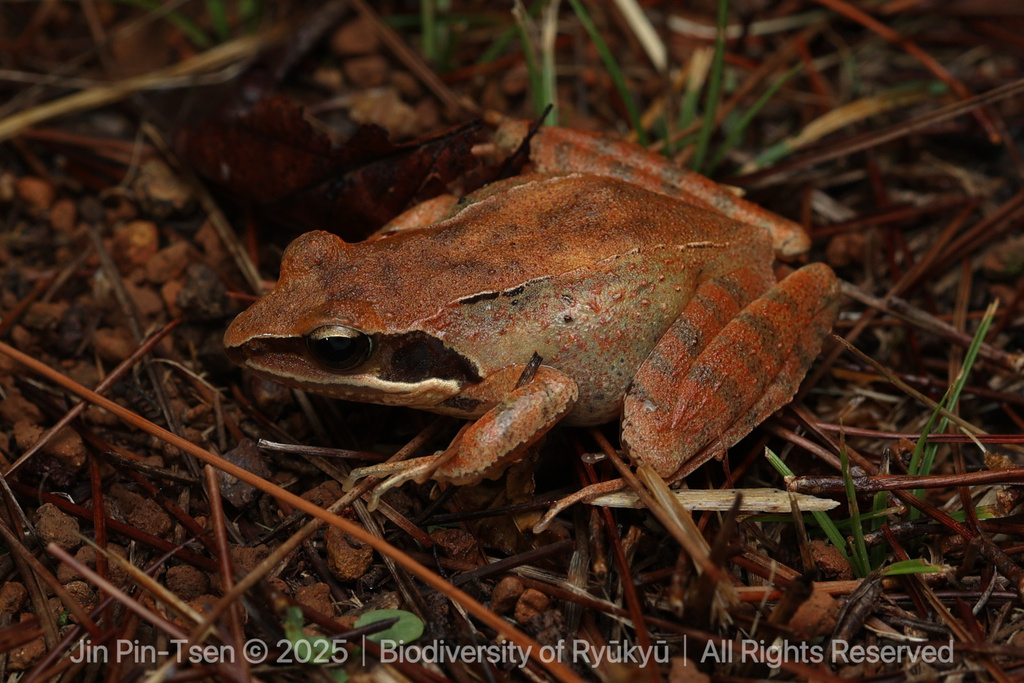
Ryukyu Brown Frog
Rana ulma
Rana ulma is a species of frog in the family Ranidae. It is endemic to Okinawa Islands, in the central Ryukyu Islands of Japan. It is currently only known from northern Okinawa Island and from Kume Island. Common names Okinawa frog and Ryukyu brown frog have been used for this species; the latter can refer to this species or to Rana kobai. The specific name ulma means "coral island" in Uruma dialect of Okinawa.
From the article Rana ulma on Wikipedia (CC BY-SA), quoted section by section
Description
Adult males measure 33–39 mm (1.3–1.5 in) and adult females 42–51 mm (1.7–2.0 in) in snout–vent length (SVL). The snout is low and fairly pointed. The tympanum is distinct and relatively large (more so in males than in females). A supratympanic fold is present. The forelimbs are rather stout whereas the hindlimbs are long. The fingers are slender and have no webbing. The toes are moderately webbed. Alcohol-preserved specimens are dorsally light gray brown. A distinct dark brown marking runs over the eye and tympanum towards the arm insertion. Males have no vocal sack. Males aggregate for breeding and form a chorus where they call synchronously. The call resembles that of chickens. Tadpoles of Gosner stages 33–39 measure 26–33 mm (1.0–1.3 in) in total length. SVL at metamorphosis is about 12 mm (0.5 in).
Range & habitat
Rana ulma occurs in lowland to montane forests at elevations of 10–350 m (33–1,148 ft) above sea level. During the breeding season that takes place in December, adults congregate around small montane streams. The eggs are deposited in the shallows of headwaters, sometimes in small pools. The egg masses are loose and contain only about ten eggs; the total clutch size is about 320 eggs. Outside the breeding season, this species is terrestrial. Predators of this frog include the pitviper Ovophis okinavensis, which prey upon breeding adults. Also the frog Limnonectes namiyei is a potential predator. This species is suffering from habitat loss caused by human settlements. It is not known from protected areas, but the Kume Island population enjoys the status of "a locally protected population".
== References ==
Wikipedia: “Habitat, ecology, and conservation”
Listen
Looking for field recordings…
Where it lives
Recorded sightings
—
geo-referenced records in GBIF, from museums, herbaria and field observers.
Drag the globe to turn it. Dots are where records exist, not a range map; darker means more records.
In the stacks
Searching the stacks…
Every page naming Rana ulma in the Biodiversity Heritage Library →
This page is assembled live from iNaturalist, GBIF, Wikipedia, the Source Library and the Internet Archive. It is not yet part of the hand-edited codex. iNaturalist taxon 134806.