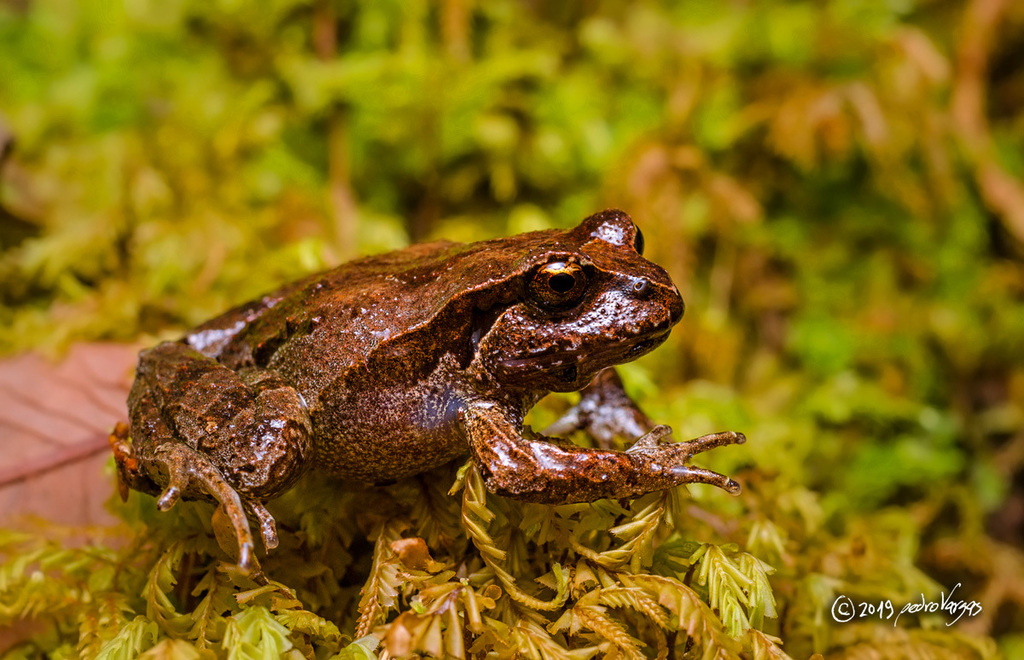
Chiloe Island Ground Frog
Eupsophus calcaratus
Eupsophus calcaratus (common name: Chiloe Island ground frog) is a species of frog in the family Alsodidae.
It is endemic to Patagonia (southern Argentina and Chile). It has one of the broadest distributions of any Chilean frog.
From the article Eupsophus calcaratus on Wikipedia (CC BY-SA), quoted section by section
Description
Eupsophus calcaratus are moderate-sized frogs measuring 31–36 mm (1.2–1.4 in) in snout–vent length. Head is wider than long and snout is rounded. Skin is only slightly granulated but has many spots and reticulated pattern. The colouration is highly variable, but it usually has a characteristic, hourglass-shaped pattern in its head. The tadpoles develop in water-filled cavities on the ground. Males show parental care: they remain with the eggs and tadpoles. Tadpoles are endotrophic.
Range & habitat
Its natural habitat is humid Nothofagus temperate forest. It occurs in shady microhabitats (swamps and streams borders). The species is common in appropriate habitats. Nevertheless, habitat loss and degradation due to deforestation is a major threat, and water pollution caused by forestry work is also a threat.
== References ==
Wikipedia: “Habitat and conservation”
Listen
Looking for field recordings…
Where it lives
Recorded sightings
—
geo-referenced records in GBIF, from museums, herbaria and field observers.
Drag the globe to turn it. Dots are where records exist, not a range map; darker means more records.
In the stacks
Searching the stacks…
Every page naming Eupsophus calcaratus in the Biodiversity Heritage Library →
This page is assembled live from iNaturalist, GBIF, Wikipedia, the Source Library and the Internet Archive. It is not yet part of the hand-edited codex. iNaturalist taxon 134934.