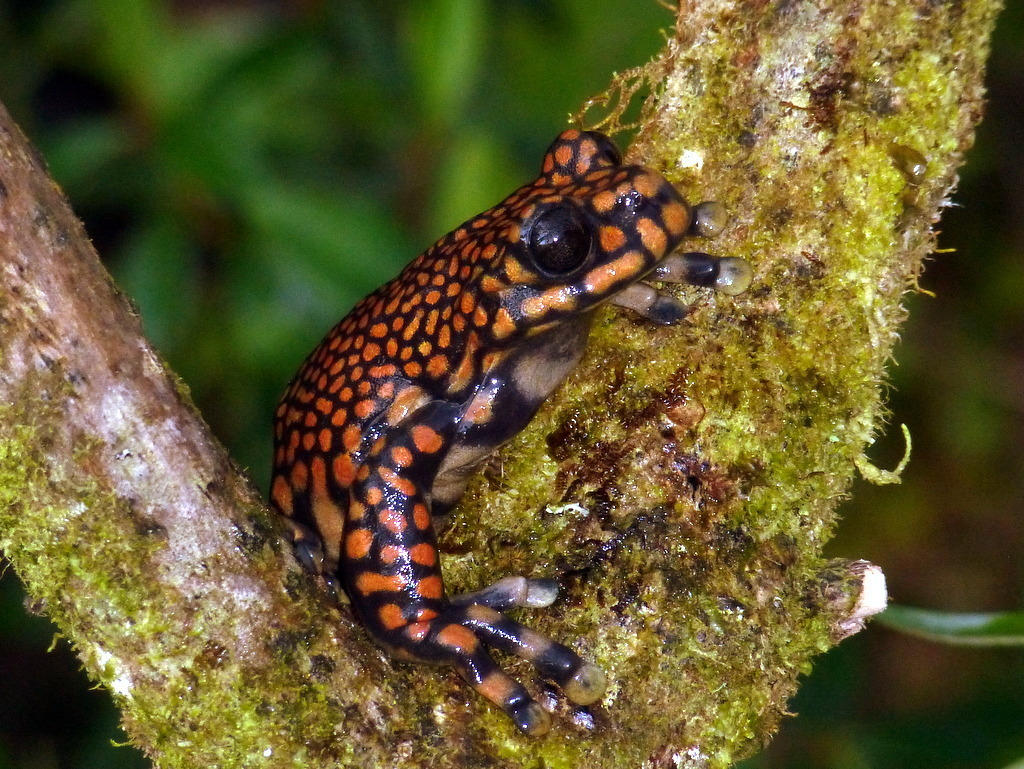
Prince Charles Torrenteer
Hyloscirtus princecharlesi
The Prince Charles stream tree frog (Hyloscirtus princecharlesi) is a species of frogs in the family Hylidae found in Ecuador. It is considered an endangered species threatened by habitat loss, climate change, pathogens, and other hazards.
In June 2012, the species was described as new to science by Luis A. Coloma et al. in the journal Zootaxa and named in honour of Charles III, King of the United Kingdom, recognising the then-Prince's work advocating rainforest conservation.
From the article Prince Charles stream tree frog on Wikipedia (CC BY-SA), quoted section by section
Range & habitat
The frog is endemic to Ecuador, and found only in the northeast, in the Cordillera de Toisán, in Imbabura Province. They're found between 2720 and 2794 meters above sea level, in the tierra fría zone.
Wikipedia: “Distribution”
In human culture
Its name is a patronymic that honors King Charles III, for his rainforest conservation work, such as the 2007 Prince's Rainforests Project, and as head of the UK World Wildlife Fund. In all his campaigns, he has used frogs as a symbol of the rainforest, and been affectionately called the "Frog Prince".
== References ==
Wikipedia: “Cultural importance”
Listen
Looking for field recordings…
Where it lives
Recorded sightings
—
geo-referenced records in GBIF, from museums, herbaria and field observers.
Drag the globe to turn it. Dots are where records exist, not a range map; darker means more records.
In the stacks
Searching the stacks…
Every page naming Hyloscirtus princecharlesi in the Biodiversity Heritage Library →
This page is assembled live from iNaturalist, GBIF, Wikipedia, the Source Library and the Internet Archive. It is not yet part of the hand-edited codex. iNaturalist taxon 134988.