On eBird ↗
Lord Howe Gerygone
Live sightings near you, the range map, bar charts of when it is seen, and Macaulay Library photos and recordings.
Lord Howe Gerygone
Gerygone insularis
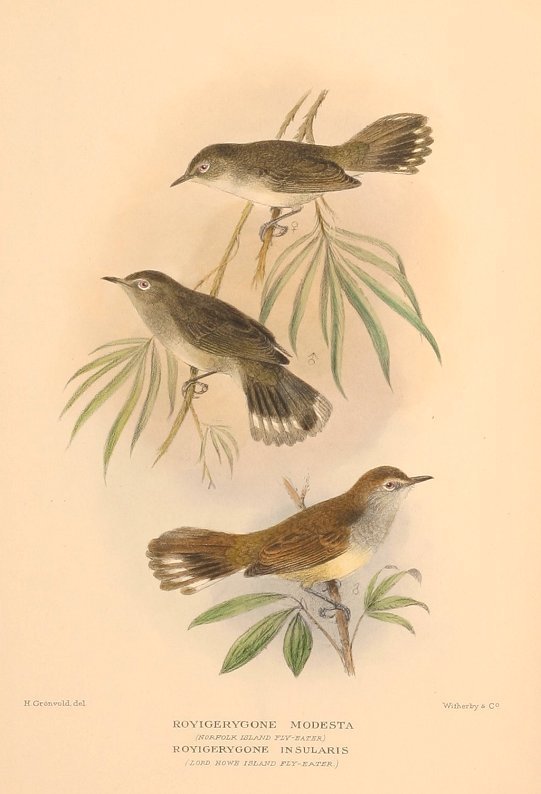
The Lord Howe gerygone or Lord Howe gerygone flyeater (Gerygone insularis) is an extinct small bird in the family Acanthizidae, brown and greyish in color. Its head was brown apart from a pale grey eye-ring and a grey throat and chin, many parts of the animal varied to the colour of yellow, this being apparent in its bright yellow belly. It made its home in the canopies of the island's forest until the early 20th century. The bird has had a variety of monikers: locally, it was known as the "rain-bird" due to its activity after the rains, or the "pop-goes-the-weasel", due to the similarity of its song to the well-known tune. The bird was endemic to Lord Howe Island in the Tasman Sea (part of New South Wales, Australia). There have been no records of the species since 1928, and it is considered to be extinct. Its extinction is almost certainly due to predation by black rats which were accidentally introduced to the island in 1918 following the shipwreck of the SS Makambo there.
From the article Lord Howe gerygone on Wikipedia (CC BY-SA), quoted section by section
Description
The Lord Howe gerygone was a small brown and grayish perching songbird. The small feathers extending from the bird's eye to its ear were pale grey as well as the section of feathers between its eyes leading to its eyebrows. The Lord Howe gerygone had a ring of feathers around its eye of lighter grey forming a light perimeter around the orbital, which matched the similarly light feathers of its chin and throat. The portion of its body lining the ribcage yet excluding the abdomen had medium brown coloring, with the back of the head leading to the beginning of the tail matching this color scheme. The breast was a shade of pale-grey complemented with a touch of yellow that led to the fully yellow abdomen. The dorsal portion of its tail was a shade of brown gradually turning to black at the tip of the tail. The ventral portion of the tail was all white. The Lord Howe gerygone had pink eyes, similar to those of an albino rat, and a thin grey bill.
Wikipedia: “Appearance”
Range & habitat
It was endemic to Lord Howe Island, Australia. This species of bird was very common and found mostly in canopies of the native forests and secondary regrowths on this island.
Wikipedia: “Habitat”
What it does
A pregnant Lord Howe gerygone would lay a clutch of three pink-tinged, brown-speckled eggs in a domed nest made up of dry bark, fibres, leaves, grass, moss and wool wrapped together with a spider web suspended from a twig. The nest was described by natives as having an entrance on the side, and a projecting hood. (Hull, 1909)
Wikipedia: “Reproduction”
Listen
Looking for field recordings…
Where it lives
Recorded sightings
—
geo-referenced records in GBIF, from museums, herbaria and field observers.
Drag the globe to turn it. Dots are where records exist, not a range map; darker means more records.
In the stacks
Searching the stacks…
Every page naming Gerygone insularis in the Biodiversity Heritage Library →
This page is assembled live from iNaturalist, GBIF, Wikipedia, the Source Library and the Internet Archive. It is not yet part of the hand-edited codex. iNaturalist taxon 13501.