On eBird ↗
Fairy Gerygone
Live sightings near you, the range map, bar charts of when it is seen, and Macaulay Library photos and recordings.
Fairy Gerygone
Gerygone palpebrosa
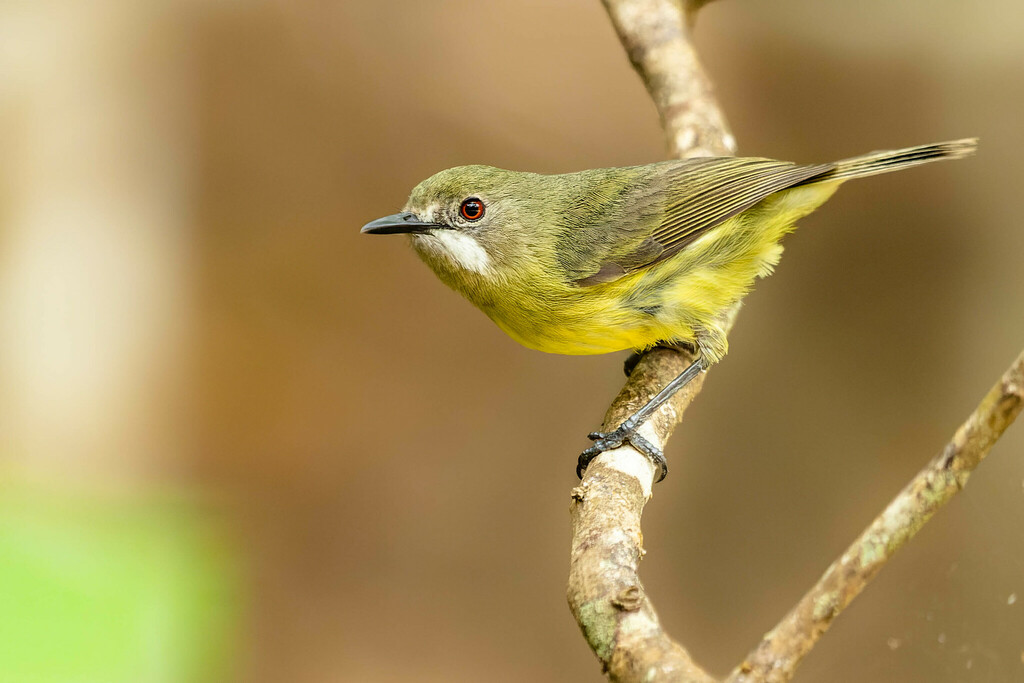
The fairy gerygone (Gerygone palpebrosa), previously known as the fairy warbler, is a species of bird in the family Acanthizidae native to New Guinea and Queensland, Australia.
From the article Fairy gerygone on Wikipedia (CC BY-SA), quoted section by section
Description
Adult birds have olive upperparts and yellow underparts, brownish tails, short black bills and legs, and red eyes. The male has a black throat. The subspecies flavida can be distinguished from subspecies personata by the white tip of its tail.
Range & habitat
It is found in Australia, Indonesia, and Papua New Guinea. Its natural habitats are subtropical or tropical moist lowland forests and subtropical or tropical mangrove forests. The fairy gerygone is listed by the IUCN as being of Least Concern. No particular threats have been identified and the bird has a wide range and stable population.
Wikipedia: “Distribution and habitat”
What it does
Male fairy gerygones hold themselves erect and sing a loud melodious song when they hear the calls of predators, particularly their main predator the black butcherbird. The purpose for this is unclear, though it is possibly a form of advertising to potential mates, promoting the male's prowess at singing in times of danger. The fairy gerygone nests near wasp nests, possibly to keep itself safe from predators.
Wikipedia: “Behaviour”
Listen
Looking for field recordings…
Where it lives
Recorded sightings
—
geo-referenced records in GBIF, from museums, herbaria and field observers.
Drag the globe to turn it. Dots are where records exist, not a range map; darker means more records.
In the stacks
Searching the stacks…
Every page naming Gerygone palpebrosa in the Biodiversity Heritage Library →
This page is assembled live from iNaturalist, GBIF, Wikipedia, the Source Library and the Internet Archive. It is not yet part of the hand-edited codex. iNaturalist taxon 13503.