- Animals
- ›Chordates
- ›Vertebrates
- ›Amphibians
- ›Frogs and Toads
- ›Poison Frogs
- ›Poison Dart Frogs
- ›Dendrobatinae
- ›Andinobates
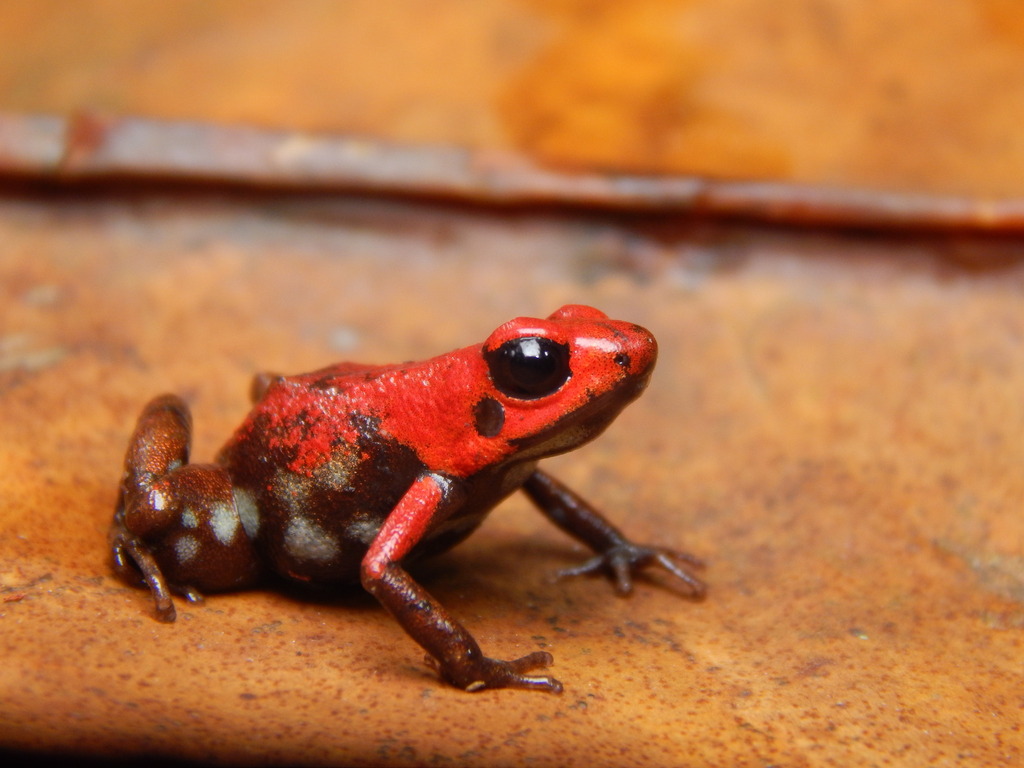
Santander Poison Frog
Andinobates virolinensis
Andinobates virolinensis (the Santander poison frog) is a species of frog in the family Dendrobatidae.
It is endemic to Colombia where it is confined to the Santander and Cundinamarca departments on the Cordillera Oriental.
From the article Andinobates virolinensis on Wikipedia (CC BY-SA), quoted section by section
Description
Andinobates virolinensis are small frogs, measuring up to 19 mm (0.75 in) in snout–vent length. The frog's head and the anterior 2/3 of the body is deep scarlet, which slowly shifts to brown near the vent. The tympanum is brown in color. The upper portions of the front and hind legs are also brown in color. The tadpoles are red-brown on the dorsum and cream-white underneath.
Range & habitat
Andinobates virolinensis live on the floor of cloud forests, where it has been observed between 1300 and 2400 meters above sea level. Females lay the eggs in leaf litter, and the males carry the larvae to the bromeliads. Reproduction occurs throughout the year. Scientists have seen multiple adult frogs sharing the same bromeliad, so they infer that the frogs are not territorial. The diet consists of various arthropods, including mites, springtails, ants, and insect larvae. Thus, their diet is broadly similar to other poison dart frogs.
Wikipedia: “Habitat, life cycle, and diet”
In human culture
This frog's English name, refers to its type locality: Santander on the Cordillera Occidental.
Wikipedia: “Etymology”
Listen
Looking for field recordings…
Where it lives
Recorded sightings
—
geo-referenced records in GBIF, from museums, herbaria and field observers.
Drag the globe to turn it. Dots are where records exist, not a range map; darker means more records.
In the stacks
Searching the stacks…
Every page naming Andinobates virolinensis in the Biodiversity Heritage Library →
This page is assembled live from iNaturalist, GBIF, Wikipedia, the Source Library and the Internet Archive. It is not yet part of the hand-edited codex. iNaturalist taxon 135048.