- Animals
- ›Chordates
- ›Vertebrates
- ›Amphibians
- ›Frogs and Toads
- ›Escuerzos and Smooth-horned Frogs
- ›Proceratophrys
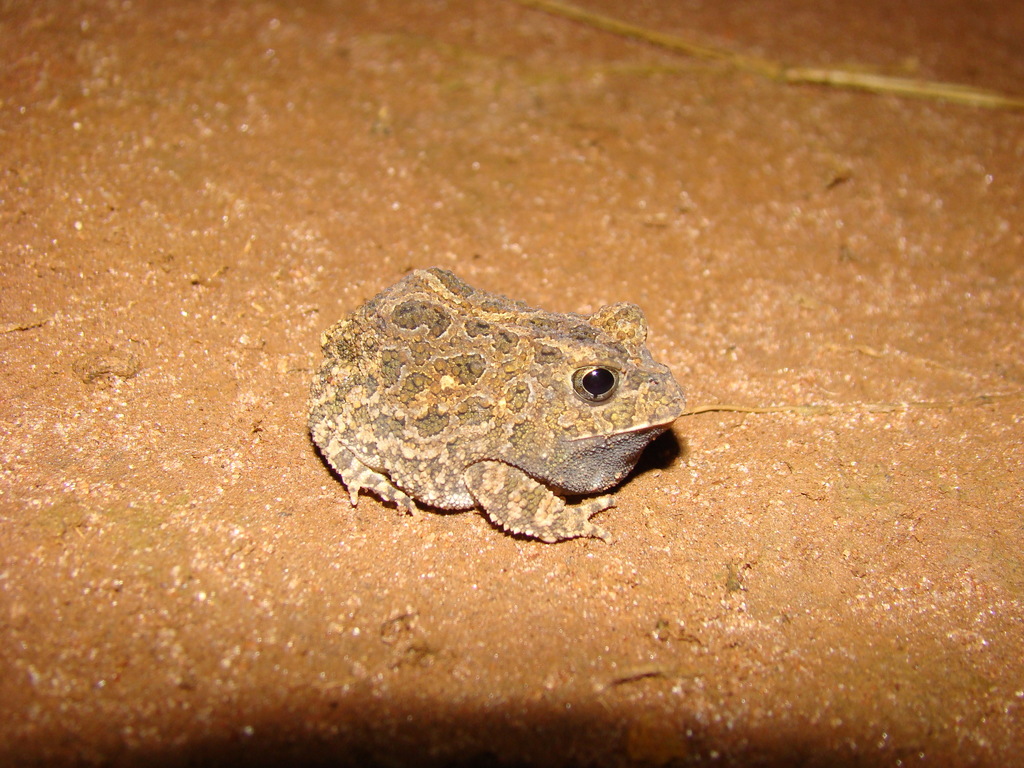
Botucatu Smooth-horned Frog
Proceratophrys moratoi
Proceratophrys moratoi is a species of frog in the family Odontophrynidae. It is endemic to the São Paulo state, Brazil. Its local name is botucatu escuerzo.
From the article Proceratophrys moratoi on Wikipedia (CC BY-SA), quoted section by section
Description
The frog measures about 27.6 to 35.7 mm in snout-vent length. There is no webbed skin on any of its feet.
Range & habitat
This frog lives in swampy places next to streams in savanna and shrubland in the Cerrado biome. People also find them in small forest remnants next to farms. Scientists observed the frog between 410 and 1140 meters above sea level. This frog lives in many protected parks: Área de Preservação Ambiental Corumbataí, Botucatu and Tejupá Perimetro Corumbataí, Estação Ecológica de Itirapina, and RPPN Olavo Egydio Setubal.
Wikipedia: “Habitat”
What it does
The female frog places her eggs in moving water in swamps. The free-swimming tadpoles develop in the swamp. The tadpole is red-brown in color with silver or gray marks. There is a dark spot on the fin on its back. The tail is light brown in color with darker spots. The caudal musculature has dots on it.
Wikipedia: “Reproduction”
Listen
Looking for field recordings…
Where it lives
Recorded sightings
—
geo-referenced records in GBIF, from museums, herbaria and field observers.
Drag the globe to turn it. Dots are where records exist, not a range map; darker means more records.
In the stacks
Searching the stacks…
Every page naming Proceratophrys moratoi in the Biodiversity Heritage Library →
This page is assembled live from iNaturalist, GBIF, Wikipedia, the Source Library and the Internet Archive. It is not yet part of the hand-edited codex. iNaturalist taxon 135129.