On eBird ↗
Chestnut Wood-Quail
Live sightings near you, the range map, bar charts of when it is seen, and Macaulay Library photos and recordings.
Chestnut Wood-Quail
Odontophorus hyperythrus
The chestnut wood quail (Odontophorus hyperythrus) is a species of bird in the Odontophoridae family. It is found only in Colombia. Its natural habitat is subtropical or tropical moist montane forests. It is becoming rare due to habitat loss.
From the article Chestnut wood quail on Wikipedia (CC BY-SA), quoted section by section
Description
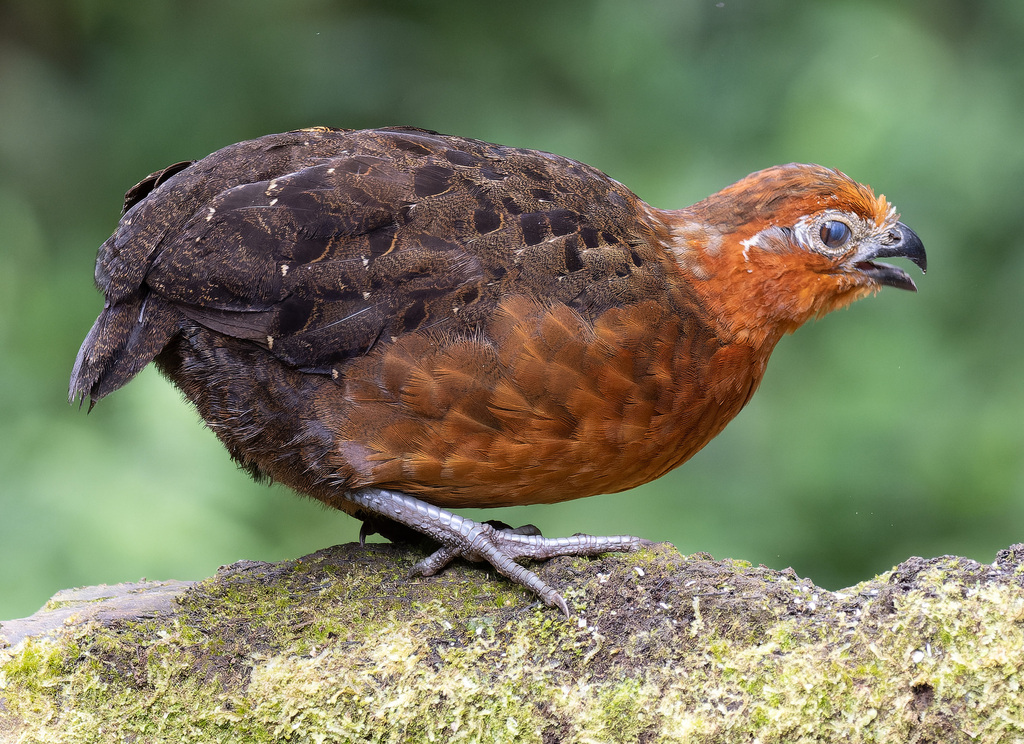
The chestnut wood quail is 25 to 29 cm (9.8 to 11.4 in) long. Males weigh 325 to 380 g (11.5 to 13.4 oz) and females 325 to 330 g (11.5 to 11.6 oz). Both sexes have grayish white feathers around the eye, with the female's more extensive. Adult males have a chestnut head and brown back, rump, and wings. The rump has fine black vermiculation. The throat and undersides are rufous. The adult female's crown is dusky brown and its breast and belly are dark gray. The juvenile is similar to the adult female.
Range & habitat
The chestnut wood quail is found mostly in the western and central Andes of Colombia and locally in the eastern Andes. In elevation it ranges from 1,600 to 2,800 m (5,200 to 9,200 ft). It inhabits the interior and edges of subtropical montane forest, both primary and secondary. It is primarily terrestrial but has been seen roosting as high as 10 m (33 ft) above ground.
Wikipedia: “Distribution and habitat”
What it does
The chestnut wood quail forages by scratching in leaf litter for roots, seeds, fallen berries, and probably also insects.
Wikipedia: “Feeding”
Listen
Looking for field recordings…
Where it lives
Recorded sightings
—
geo-referenced records in GBIF, from museums, herbaria and field observers.
Drag the globe to turn it. Dots are where records exist, not a range map; darker means more records.
In the stacks
Searching the stacks…
Every page naming Odontophorus hyperythrus in the Biodiversity Heritage Library →
This page is assembled live from iNaturalist, GBIF, Wikipedia, the Source Library and the Internet Archive. It is not yet part of the hand-edited codex. iNaturalist taxon 1353.