On eBird ↗
Red-browed Pardalote
Live sightings near you, the range map, bar charts of when it is seen, and Macaulay Library photos and recordings.
Red-browed Pardalote
Pardalotus rubricatus
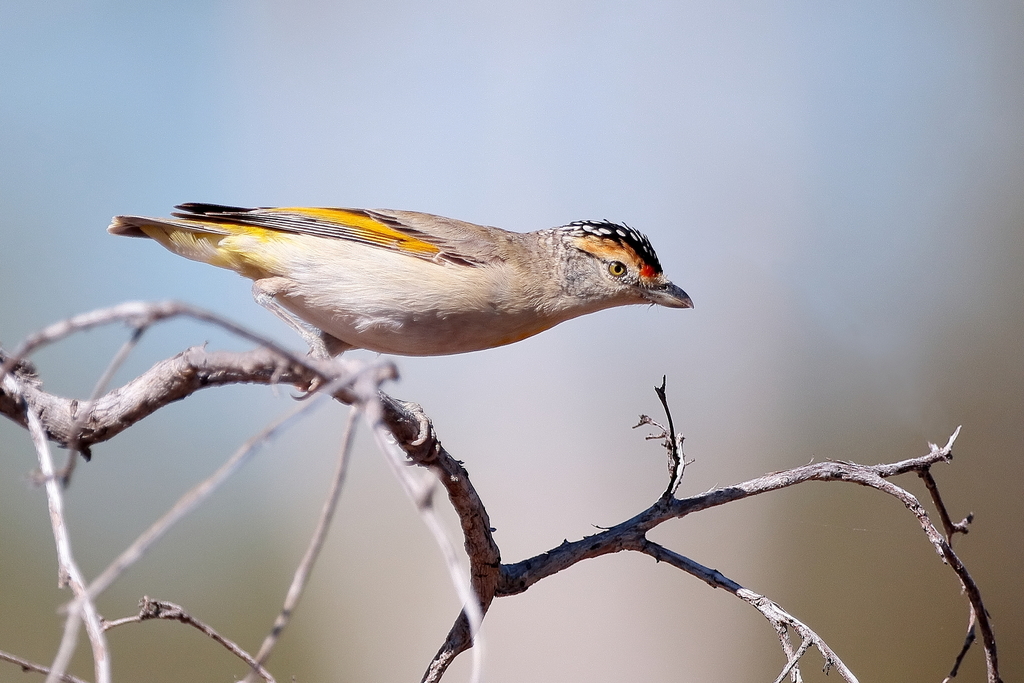
The red-browed pardalote (Pardalotus rubricatus) is a small brightly coloured insectivorous passerine, endemic to Australia (Schodde & Mason 1999). A gleaning specialist, they forage primarily in eucalypt trees (Woinarski 1984). The Latin word rubricatus means red-ochred which is descriptive of their orange-red eyebrow (Higgins & Peter 2002). Other common names include red-browed diamondbird, bellbird, cape red-browed, pale red-browed, fawn-eyed, fawn-eyebrowed and pallid or red-lored pardalote (Higgins & Peter 2002).
From the article Red-browed pardalote on Wikipedia (CC BY-SA), quoted section by section
Description
Adult red–browed pardalotes are a large pardalote with an average length of 105 mm and wingspan of 60–66 mm. Males weigh approximately 10.9g and females weigh 10.8 g. The average length of the male tarsus is 18.3 mm and female tarsus is 18.5 mm (Higgins & Peter 2002). The subspecies yorki are smaller in size, 100–120 mm long and weigh less at 9.3 g. The average length of the male tarsus is 17.4 mm and female tarsus is 17.3 mm (Higgins & Peter 2002), (Simpson, Day & Trusler 1999). Their wingspan is 58–62 mm in length (Schodde & Mason 1999). The red–browed pardalote does not exhibit plumage that changes seasonally and is not sexually dichromatic (Higgins & Peter 2002). The nominate race rubricatus have a pale iris, a black crown with distinctive white spots and a yellow to buff supercilium. They have a red to orange-red brow and a yellow breast patch with yellow wing panels (Higgins & Peter 2002), (Simpson, Day & Trusler 1999). Juvenile birds are generally paler in comparison to adults (Simpson, Day & Trusler 1999). They have a darker iris that is olive to pale olive, a duller crown with less obvious patterning and a dull orange-yellow brow (Higgins & Peter 2002). The sub-species yorki are generally more brightly coloured than the nominate race (Simpson, Day & Trusler 1999). …
Range & habitat
The red-browed pardalote is a widely distributed species ranging from north and central Australia, south and south central Western Australia, northeast South Australia ( Lake Eyre Basin) to south west New South Wales. They may also be found throughout the Great Sandy, Gibson and Great Victoria Desert (Higgins & Peter 2002). They live in a wide range of habitats including woodlands, shrublands, tropical, arid and semi-arid regions of Australia (Higgins & Peter 2002). Eucalypt woodlands, which border watercourses such as riparian river red gum, coolibah woodlands and tall eucalypt shrublands such as mallee, are the preferred habitats (Costello 1981), (Higgins & Peter 2002), (Hornsby 1996), (Pedler & Ragless 1978). In the desert sand-ridge country of Western Australia, red-browed pardalotes forage in the upper story of bloodwoods and marble gums dispersed amongst sand dunes (Pianka & Pianka 1970). They have also been recorded in bloodwood-banksia, low–acacia and eucalypt–paperbark woodlands, mulga, acacia shrublands, spinifex plains and grasslands (Badman 1979), (Cody 1991), (Higgins & Peter 2002), (Rix 1970). Red-browed pardalotes may also inhabit sand dunes, rocky outcrops, valleys and floodplains (Higgins & Peter 2002).
Wikipedia: “Distribution and habitat”
What it does
Red-browed pardalotes are sedentary (Blakers, Davies & Reilly 1985) and hold foraging territories throughout the year (Schodde & Tidemann 1986). They are usually seen singly, in pairs or small groups of up to five or six birds (Higgins & Peter 2002). They are arboreal and spend most of their time foraging in the foliage of eucalypt trees (Woinarski 1985). Their 'scoop-shaped' bill is used to glean insects and lerps (exudates of psyllids) from the leaf surface (Schodde & Mason 1999), (Woinarski 1984). Lerps are a major food source for pardalotes providing sugar and carbohydrates (Woinarski 1984). They also consume arthropods, beetles (Coleoptera species), gum leaf beetle (Paropsis species), flies, mosquitoes, flowerflies, leafhoppers, shield bugs, psyllids, bees, ants, wasps and vegetable matter (Barker & Vestjens 1990).
Wikipedia: “Foraging and diet”
Listen
Looking for field recordings…
Where it lives
Recorded sightings
—
geo-referenced records in GBIF, from museums, herbaria and field observers.
Drag the globe to turn it. Dots are where records exist, not a range map; darker means more records.
In the stacks
Searching the stacks…
Every page naming Pardalotus rubricatus in the Biodiversity Heritage Library →
This page is assembled live from iNaturalist, GBIF, Wikipedia, the Source Library and the Internet Archive. It is not yet part of the hand-edited codex. iNaturalist taxon 13530.