On eBird ↗
Striated Pardalote
Live sightings near you, the range map, bar charts of when it is seen, and Macaulay Library photos and recordings.
Striated Pardalote
Pardalotus striatus
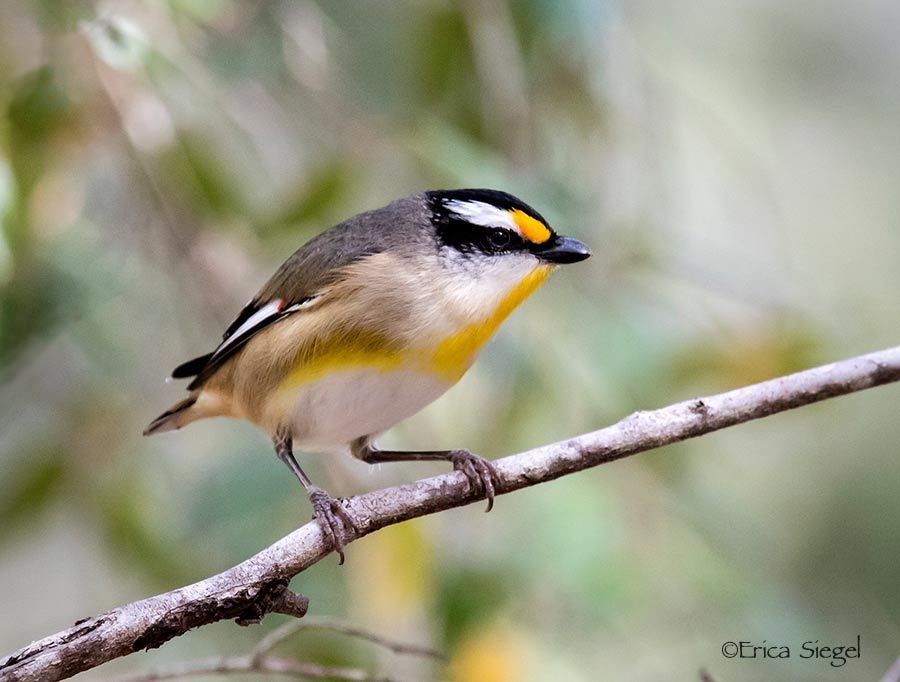
The striated pardalote (Pardalotus striatus) is the least colourful and most common of the four pardalote species. Other common names include pickwick, wittachew and chip-chip. It is a very small, short-tailed bird that is more often heard than seen, foraging noisily for lerps and other small creatures in the treetops.
From the article Striated pardalote on Wikipedia (CC BY-SA), quoted section by section
Description
The striated pardalote's plumage varies considerably across its range. The crown is black, with subspecies substriatus, striatus and ornatus having white streaks. The eyebrow is white, starting with a yellow mark near the beak. All races have a white stripe on the wing and olive backs. The nominate race has a yellow spot on the wing, whilst the other subspecies have a red dot. The male and female are similar, juveniles have duller plumage. Similar species include the spotted pardalote and the red-browed pardalote.
Range & habitat
Striated pardalotes occupy a vast range of habitat types from tall mountain rainforest to arid scrubland, although they favour eucalyptus forest and woodlands. They are found in all parts of Australia except some of the Western Australian deserts.
Wikipedia: “Distribution and habitat”
What it does
Striated pardalotes feed on insects and insect larvae. They usually do so in the high foliage of eucalyptus trees, but may come closer to the ground where there are lower shrubs. Feeding takes place in small groups.
Breeding. Breeding occurs from June to February. Two to five white, oval-shaped eggs are laid in a nest is made of bark fiber, rootlets and fine grass, and placed in tree hollow, a tunnel excavated in the side of a bank or within crevices in man-made objects. Both sexes incubate and care for the young.
Call. Call is a clear, sharp, musical witta-witta, the second part slightly lower, repeated regularly in intervals for long periods; striated pardalotes also give off soft, low trills.
Wikipedia: “Feeding”
Listen
Looking for field recordings…
Where it lives
Recorded sightings
—
geo-referenced records in GBIF, from museums, herbaria and field observers.
Drag the globe to turn it. Dots are where records exist, not a range map; darker means more records.
In the stacks
Searching the stacks…
Every page naming Pardalotus striatus in the Biodiversity Heritage Library →
This page is assembled live from iNaturalist, GBIF, Wikipedia, the Source Library and the Internet Archive. It is not yet part of the hand-edited codex. iNaturalist taxon 13532.