On eBird ↗
Fernwren
Live sightings near you, the range map, bar charts of when it is seen, and Macaulay Library photos and recordings.
Fernwren
Oreoscopus gutturalis
The fernwren (Oreoscopus gutturalis) is a species of bird in the family Acanthizidae. It is monotypic within the genus Oreoscopus.
It is endemic to northern Queensland in Australia. Its natural habitats are tropical moist lowland forest and tropical moist montane forest.
From the article Fernwren on Wikipedia (CC BY-SA), quoted section by section
Description
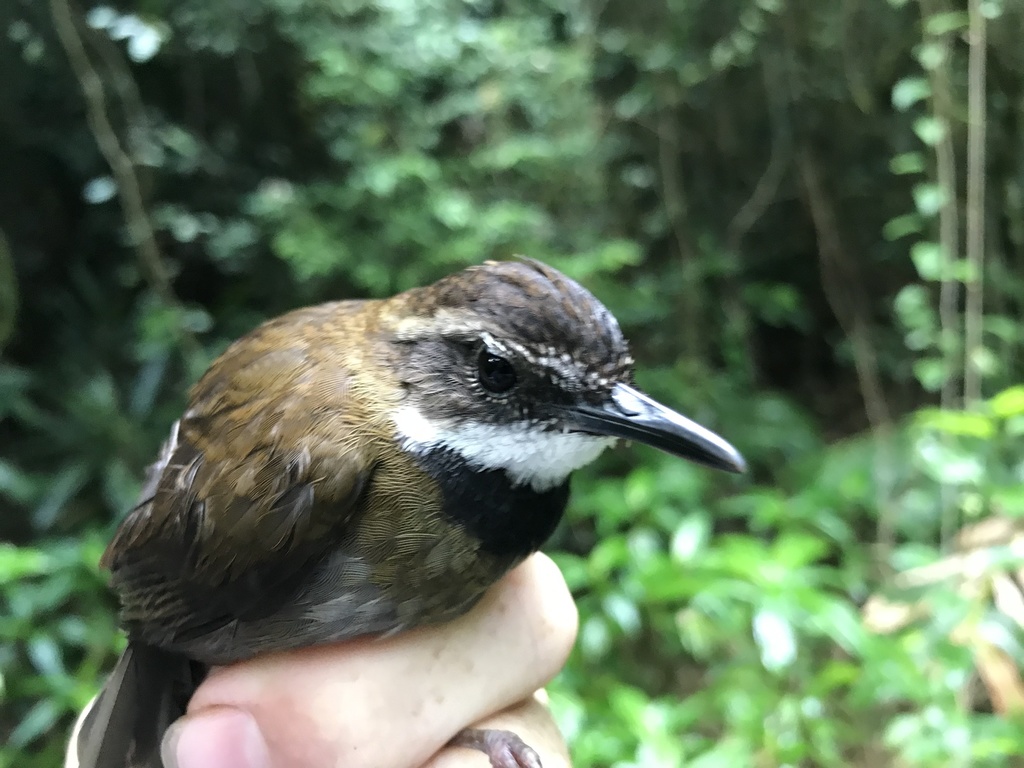
The fernwren has a white eyebrow and throat, enclosing a dark brown face. Beneath the white throat, it has a black bib. It has a long-slender bill. The upperparts are dark olive-brown and the underparts paler. It is 12–14 cm (4.7–5.5 in) in length. The female is very similar to the male. Juveniles are dark brown without the white facial markings of the adult.
Range & habitat
The fernwren is found in northeast Queensland rainforest between 300–1,500 m (980–4,920 ft) above sea-level, although more often above 650 m (2,130 ft). It is found in the Paluma Range, near Townsville, and from the Tully Gorge National Park northwards to Cape Tribulation. It is sedentary and classified as endangered on the IUCN Red List.
Wikipedia: “Distribution and habitat”
What it does
The fernwren forages in the moist leaf-litter amongst the ferns and dense shrubbery, particularly in shady gullies of highland rainforests. As it searches through the accumulated debris of the forest floor, it frequently bows its head and flicks its short tail. It feeds on arthropods and small skinks (Scincidae). It has a variety of calls, including high-pitched squeaks and whistles, a softer chattering sequence, and a buzzing, scolding call.
Wikipedia: “Behaviour”
Listen
Looking for field recordings…
Where it lives
Recorded sightings
—
geo-referenced records in GBIF, from museums, herbaria and field observers.
Drag the globe to turn it. Dots are where records exist, not a range map; darker means more records.
In the stacks
Searching the stacks…
Every page naming Oreoscopus gutturalis in the Biodiversity Heritage Library →
This page is assembled live from iNaturalist, GBIF, Wikipedia, the Source Library and the Internet Archive. It is not yet part of the hand-edited codex. iNaturalist taxon 13542.