- Animals
- ›Chordates
- ›Vertebrates
- ›Ray-finned Fishes
- ›Carps, Characins, Catfishes and Allies
- ›Characins
- ›Characoidei
- ›Iguana Tetras
- ›Bryconops
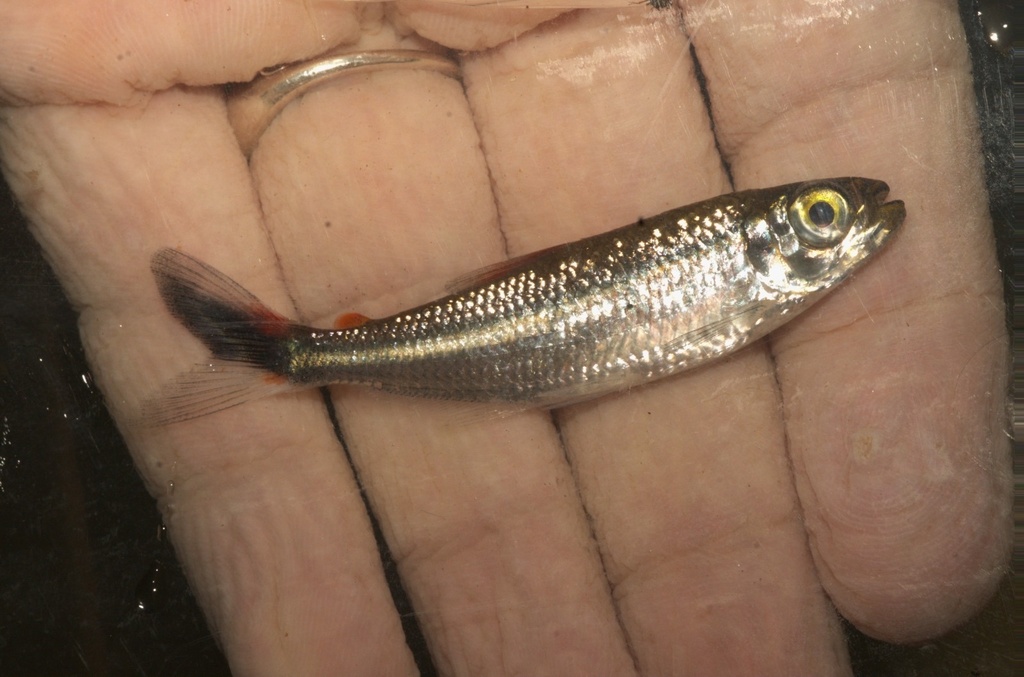
Bryconops florenceae
Bryconops florenceae is a small freshwater fish that inhabits the rivers of South America. Comprehensive research is lacking due to B. florenceae being the most recently described of the genus, but researchers believe it to be a relatively widespread species. It is found throughout the Maroni, Mana, and Sinnamary river basins, which defines its range within Suriname and French Guiana.
Originally documented in a guide to the freshwater fishes of French Guiana published in 1996, B. florenceae was not officially named until 2021. Even in 1996, there was suspicion that it was yet unknown to science, despite resembling many of the native fish already identified.
From the article Bryconops florenceae on Wikipedia (CC BY-SA), quoted section by section
Description
Bryconops florenceae measures from 7.55 to 9.45 cm in standard length when fully grown. This places it slightly to the larger side of the genus Bryconops, though all members are of a similar size (within a roughly 3cm range). Its scales are generally silvery with a touch of tan towards the dorsal region. Silver coloration is not uncommon within Bryconops. One of the features that characterizes B. florenceae is a unique caudal-fin pattern. There is an isolated blotch of dark pigment near the base of the upper lobe, and the distal regions of the fin are left pale. This blotch of coloration is also seen in B. rheoruber, though there are other differences between the two; for instance, the distal regions of B. rheoruber's caudal fin are dusky, as are areas of its snout and jaw.
Sexual dimorphism. Male specimens of B. florenceae are equipped with bony hooks on the rays of the anal and pelvic fins. It is unknown if these hooks are permanent, or are a feature solely seen within mating season. Other members of Bryconops also display this feature.
Range & habitat
Bryconops florenceae was originally documented from the waters of French Guiana in 1996. Its first appearance was in the book "Atlas des Poissons d'eau douce de Guyane (tome 1)", by Paul Planquette et al., though it was not formally named at the time. Therein, B. florenceae was described as a "western form" of Bryconops caudomaculatus, which is found in the Approuague and Oyapock rivers. Its current range is known to extend into Suriname, including the Sinnamary, Maroni, and Mana rivers; it demonstrates a preference for areas of strong current with rocky substrate. Though B. florenceae has not been the subject of specific dietary study, it is most likely to be an insectivore or omnivore, as is the pattern throughout its genus.
Conservation status. Though not formally evaluated by the IUCN, the original description for B. florenceae from researchers suggests an assessment of least concern. This is based upon a large native range and a lack of severe active threats to cut off any part of said range. Nonetheless, it may be the case that B. florenceae ends up as one of several Bryconops species threatened by human activity, such as illegal mining or farmland settlement.
== References ==
Wikipedia: “Distribution and ecology”
In human culture
The specific epithet "florenceae" honors Florence de Rapleye Foerderer, a woman whose will left $7 million each to the Academy of Natural Sciences of Philadelphia, the Philadelphia Zoo, and Gallaudet University (a school for deaf and hard-of-hearing students) after she died in 1999. There was a suggestion to name B. florenceae Bryconops foerdererae, also to honor Foerderer, but speakers of Brazilian Portuguese would have had remarkable difficulty pronouncing "foerdererae". Thus, "florenceae" was chosen instead.
Wikipedia: “Etymology”
Where it lives
Recorded sightings
—
geo-referenced records in GBIF, from museums, herbaria and field observers.
Drag the globe to turn it. Dots are where records exist, not a range map; darker means more records.
In the stacks
Searching the stacks…
Every page naming Bryconops florenceae in the Biodiversity Heritage Library →
This page is assembled live from iNaturalist, GBIF, Wikipedia, the Source Library and the Internet Archive. It is not yet part of the hand-edited codex. iNaturalist taxon 1359876.