- Animals
- ›Chordates
- ›Vertebrates
- ›Ray-finned Fishes
- ›Spiny-rayed fishes
- ›Jacks, Flounders, Barracudas, and Allies
- ›Jacks, Remoras, and Allies
- ›Jacks
- ›Caranginae
- ›Atropus
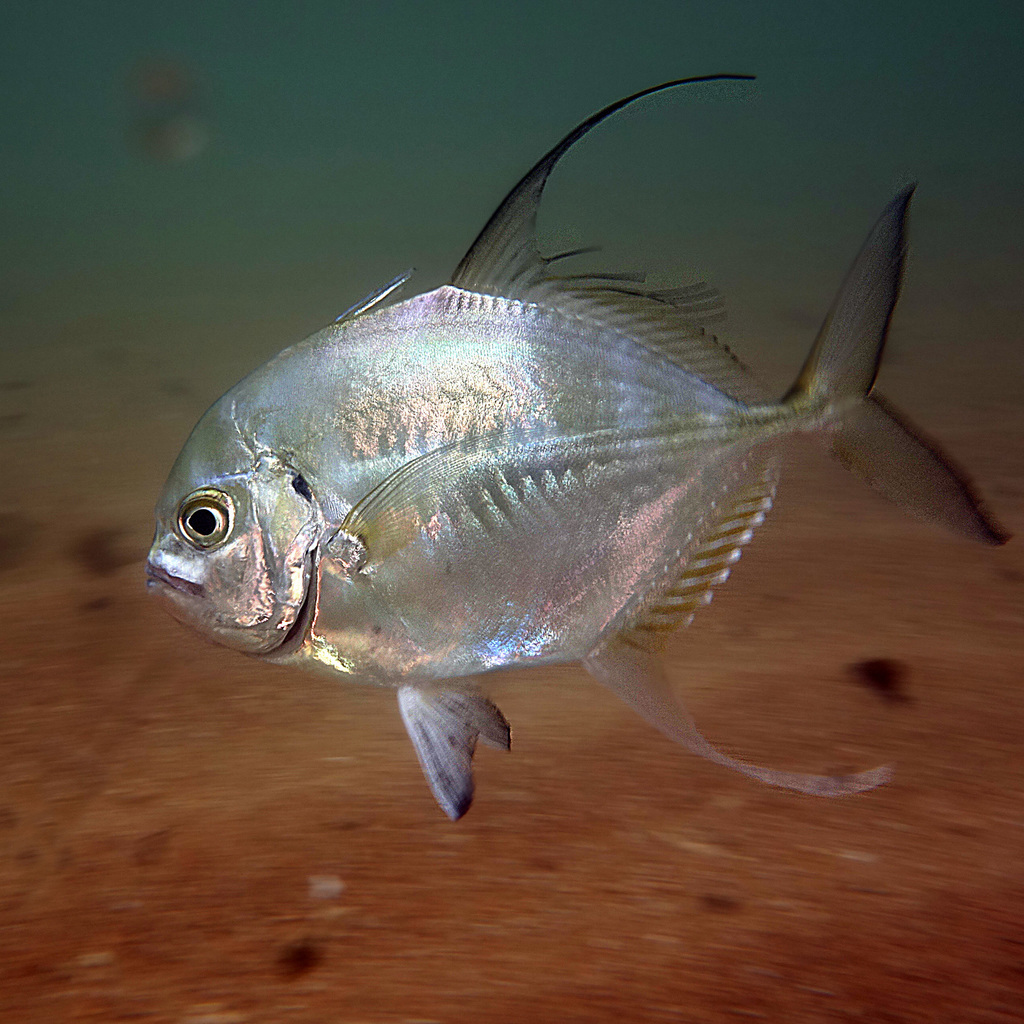
Port Hedland Trevally
Atropus hedlandensis
The bumpnose trevally (Atropus hedlandensis), also known as the bumpnose kingfish or onion kingfish, is a species of relatively small inshore marine fish classified in the jack family Carangidae. The bumpnose trevally is fairly common in the tropical and subtropical waters of the Indo-west Pacific region, ranging from South Africa in the west to Japan and Samoa in the east. It is a small species by carangid standards, reaching a maximum known length of 32 cm (13 in), and can be distinguished from the similarly shaped Atropus armatus by a distinct 'bump' on the snout, which gives the fish its common name. The species inhabits coastal waters, often living along bays and beaches, where it takes shrimp, small crabs, and juvenile fish as prey. The bumpnose trevally is of minor importance to fisheries throughout its range, taken by hook and line, trawls, and seine nets. It is also of minor importance to anglers, taken by baits from beaches and piers, and is considered a modest table fish.
From the article Bumpnose trevally on Wikipedia (CC BY-SA), quoted section by section
Description
The bumpnose trevally is one of the smaller members of the genus Atropus, growing to a known maximum of 32 cm (13 in) in length. It is quite similar in appearance to a number of co-occurring trevallies, especially Atropus armatus and Atropus atropos, with the simplest identifying feature being the distinct break in the contour ('bump') of the interorbital region, which becomes more pronounced with increasing size. The body is compressed and deep, with the head profile very steep in adults, leading to a more convex dorsal profile in comparison to the ventral profile. The dorsal fin is in two sections, the first consisting of eight spines while the second has one spine and between 20 and 22 soft rays. The anal fin has two anteriorly detached spines followed by 1 spine and 16 to 18 soft rays, while the pelvic fin has one spine and 18 soft rays. The lobes of the second dorsal and anal fins are elongated and filamentous, being longer than the head. In males, a number of the central soft rays are also produced into filaments of varying lengths. The lateral line has a moderate anterior arch, which contains 63 to 70 scales, while the straight section has eight to 14 scales and 21 to 27 scutes. The curved and straight sections intersect below the 10th to 12th soft rays of the second dorsal fin. …
Range & habitat
The bumpnose trevally is widely distributed in the tropical and subtropical regions of the Indian and west Pacific Oceans. In the Indian Ocean, the species ranges from South Africa, Madagascar, and the Seychelles north along east Africa to Mozambique, but has no records further north until India and Sri Lanka. Its distribution extends into Southeast Asia, Indonesia, Papua New Guinea, and northern Australia, with the species extending as far north as Japan and as far east as Samoa in the Pacific. The bumpnose trevally is an inshore fish, rarely venturing to depths greater than 50 m. It inhabits sandy bays and beaches, and appears to be quite tolerant of turbid waters, often living in the dirty waters near river mouths. Despite this, it appears to have a fairly low tolerance to reduced salinities and is not found in estuaries themselves.
Wikipedia: “Distribution and habitat”
Where it lives
Recorded sightings
—
geo-referenced records in GBIF, from museums, herbaria and field observers.
Drag the globe to turn it. Dots are where records exist, not a range map; darker means more records.
In the stacks
Searching the stacks…
Every page naming Atropus hedlandensis in the Biodiversity Heritage Library →
This page is assembled live from iNaturalist, GBIF, Wikipedia, the Source Library and the Internet Archive. It is not yet part of the hand-edited codex. iNaturalist taxon 1360113.