- Animals
- ›Chordates
- ›Vertebrates
- ›Ray-finned Fishes
- ›Spiny-rayed fishes
- ›Jacks, Flounders, Barracudas, and Allies
- ›Snooks, Barracudas, and Allies
- ›Barracudas
- ›Sphyraena
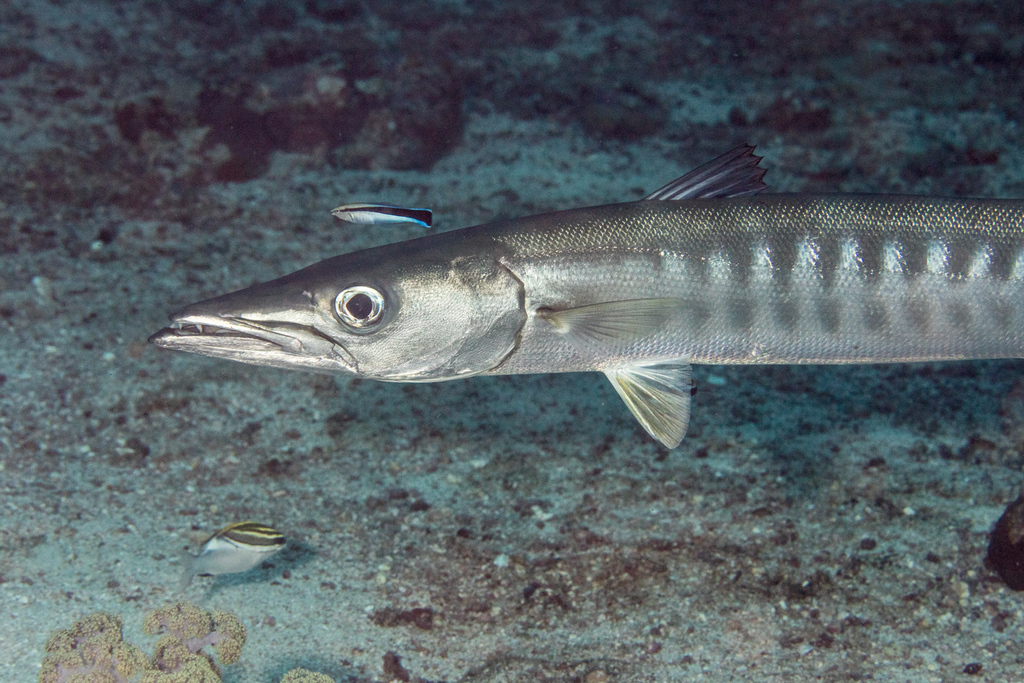
Blackfin Barracuda
Sphyraena qenie
The blackfin barracuda (Sphyraena qenie), also known as the chevron barracuda, is a species of barracuda that ranges from the Red Sea and East Africa to the Indo and Western Pacific and as far as French Polynesia.
From the article Blackfin barracuda on Wikipedia (CC BY-SA), quoted section by section
Description
The blackfin barracuda reaches a maximum size of 140 cm (55 in). The blackfin barracuda is known for its long black lateral bands that go around its body. These bands extend laterally down the torso and are v-shaped with the apex facing to the front. There are about 18 to 22 bands that are on the fish's body. The number of bands sets them apart from similar species, the S. jello and S. putnamae. It has elongated last rays on the second dorsal fin and anal fins and a blackish caudal fin. One of the most distinct features of this species of barracuda is that they lack gill rakers. As for their mouths, the maxilla, or upper jaw, goes in a vertical line through the front of their eyes and the lower jaw, which is longer than the upper jaw. This upper jaw has a conical tip that is distinct to this species. Next to the mouth, their preopercle does not have a skinny flap, as most others do. The anal fin is located in the middle under the second dorsal fin, and the heart is located near the anal. Although this species is very similar to S. putnamae, there are some differences that set it apart. S. qenie has 19 or 20 longitudinal scale rows that are level with the middle and ventral margins of the eye while S. putnamae has 11-15. As for the scales extending between the eye and preopercular margin, S. qenie has 25-27, and S. putnamae has 15-20. Additionally, the upper jaw of S. …
Range & habitat
This species of barracuda ranges from the Red Sea and East Africa to the Indo and Western Pacific and as far as French Polynesia and typically live in tropical and temperate waters. The Indo-Pacific Ocean has tropical and subtropical waters that make it a favorable habitat for S. qenie. The first sighting of this species in Indian waters was in 1966. Although rare, this species can also be found in the tropical East Pacific. In Japan, they can be found in the waters around Ryukyu, Amami Oshima, Yonaguni, Tanega, and Ishigaki Islands. For Ryukyu Island, only the adults migrate there from tropical waters when temperatures are too high. Additionally, during the summer seasons, they have also been spotted near Okinoerabu Island waters from July to October.
Wikipedia: “Distribution”
Where it lives
Recorded sightings
—
geo-referenced records in GBIF, from museums, herbaria and field observers.
Drag the globe to turn it. Dots are where records exist, not a range map; darker means more records.
In the stacks
Searching the stacks…
Every page naming Sphyraena qenie in the Biodiversity Heritage Library →
This page is assembled live from iNaturalist, GBIF, Wikipedia, the Source Library and the Internet Archive. It is not yet part of the hand-edited codex. iNaturalist taxon 136601.