On eBird ↗
Chinese Penduline-Tit
Live sightings near you, the range map, bar charts of when it is seen, and Macaulay Library photos and recordings.
Chinese Penduline-Tit
Remiz consobrinus
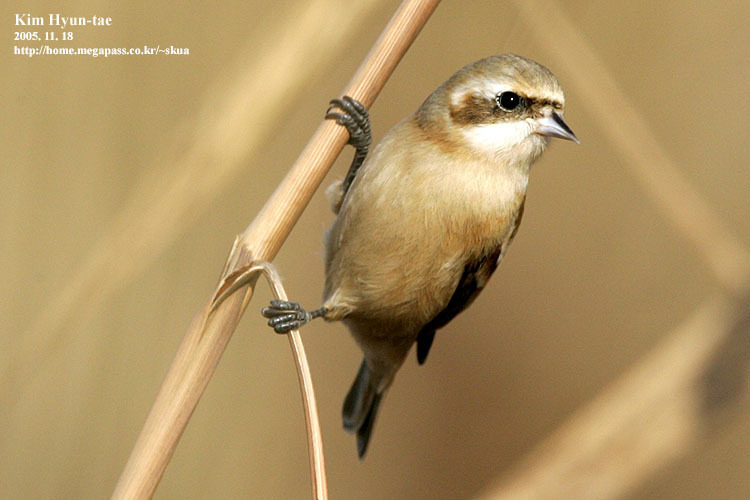
The Chinese penduline tit (Remiz consobrinus) is a species of bird in the family Remizidae. It is found in China, Japan, North Korea, South Korea, and Russia. Totally in the world there is 10 species of birds in the family Remizidae. They are similar to true tits, but make characteristic penduline nests. Inhibit in openfield and around wetland. They have sharp bill tips and sexes are alike.
From the article Chinese penduline tit on Wikipedia (CC BY-SA), quoted section by section
Description
The birds are 11 cm in length. They are small, pale birds of reedbeds with a fine-pointed bill, often in flocks of 10 to 20. Male: Greyish crown and nape. Black mask from forehead edged white. Chestnut mantle, half-collar and wing-coverts contrast with dark wings and black tail in flight. Whitish underparts are marked with buff. Female: Mask brown. Upperparts browner lacking chestnut.
Range & habitat
The Chinese penduline tit is found especially in reedbeds and marshes in Manchuria; it winters sparsely throughout eastern Asia (namely along the Yangtze river valley). It inhabits, in nesting and non-nesting, in areas of agricultural pastures, wetlands with marshes or brackish ponds. It is often in flocks of 10 to 20. It winters in the south of China. Voice: Very thin drawn out 'tseeoo', 'sseeoo'. The Chinese penduline tit is insectivorous. It feeds on insects, larvae, spiders, caterpillars and sometimes, especially in winter, on small seeds. The bird is an acrobatic climber, it can remain suspended by one leg and take its food with the other.
Wikipedia: “Habitat and behavior”
What it does
The male chooses the tree which will carry the nest from 3 to 15 m height. The nest of the Chinese penduline tit is a marvel of architecture. It has the aspect of a pear-shaped purse. The nest is extended by a tubular appendix and offers a lateral entrance. The female, having arranged the interior of the nest, generally lays between 5 and 10 eggs, which she incubates alone during 12 to 15 days. When the young have fledged, the nest is deformed and partly disintegrated. They return there to sleep during 15 to 20 days, then leave the place.
Wikipedia: “Reproduction”
Listen
Looking for field recordings…
Where it lives
Recorded sightings
—
geo-referenced records in GBIF, from museums, herbaria and field observers.
Drag the globe to turn it. Dots are where records exist, not a range map; darker means more records.
In the stacks
Searching the stacks…
Every page naming Remiz consobrinus in the Biodiversity Heritage Library →
This page is assembled live from iNaturalist, GBIF, Wikipedia, the Source Library and the Internet Archive. It is not yet part of the hand-edited codex. iNaturalist taxon 13678.