- Animals
- ›Chordates
- ›Vertebrates
- ›Mammals
- ›Therians
- ›Placental Mammals
- ›Ungulates, Carnivorans, and Allies
- ›Even-toed Ungulates and Cetaceans
- ›Ruminants
- ›Bovids
- ›Antelopes, Goats, and Sheep
- ›Dwarf Antelopes
- ›Nesotragus
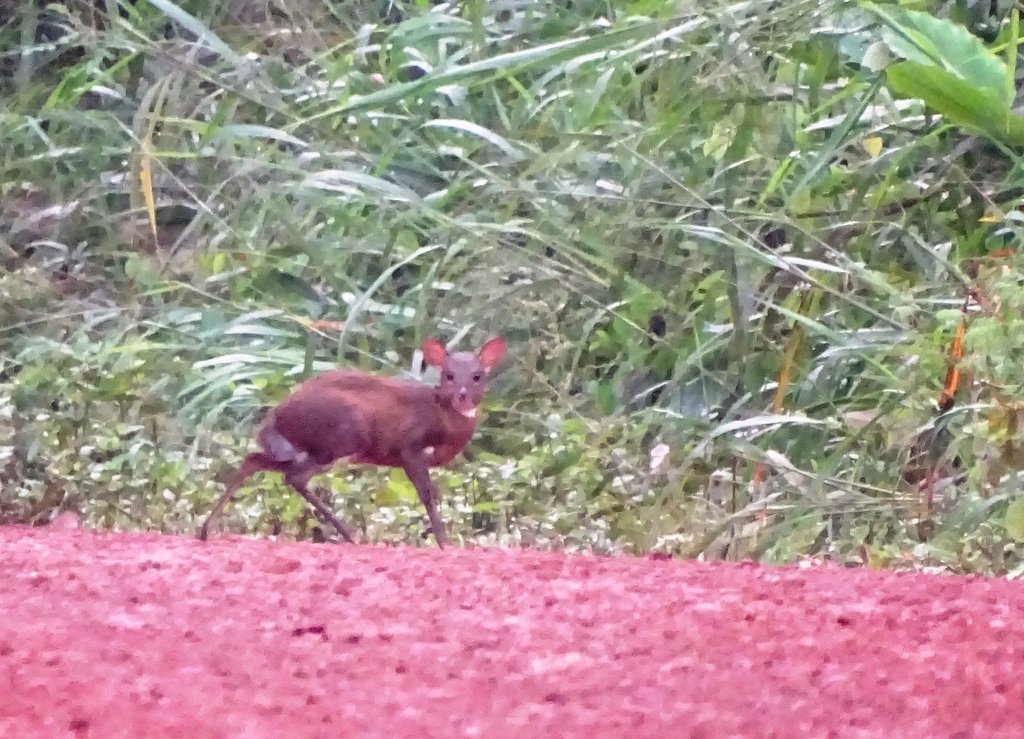
Dwarf Antelope
Nesotragus batesi
Bates's pygmy antelope (Nesotragus batesi), also known as the dwarf antelope, pygmy antelope or Bates' dwarf antelope, is a very small antelope living in the moist forest and brush of Central and West Africa. It is in the same genus as the suni.
From the article Bates's pygmy antelope on Wikipedia (CC BY-SA), quoted section by section
Description
Adult antelope weigh about 2 to 3 kg (4.4 to 6.6 lb), and are 50 to 57 cm (20 to 22 in) long, with a tail length of 4.5 to 5.0 cm (1.8 to 2.0 in). Only males have horns, about 3.8 to 5.0 cm (1.5 to 2.0 in) long. Their coat is shiny dark chestnut on the back and lighter toward the flanks. Male antelope are generously bigger than females.
Range & habitat
Bates pigmy antelope is native to tropical Central Africa. The range is separated into three distinct areas; southeastern Nigeria; the lower part of the Congo Basin; and northeastern Democratic Republic of Congo extending into western Uganda. Its typical habitat is humid lowland forest where it favours dense undergrowth. It also inhabits plantations, secondary forest, cleared areas and areas round human habitations.
Wikipedia: “Distribution and habitat”
What it does
Bates's pygmy antelope eat leaves, buds, shoots, fungus, grass, and herbs. They also eat crops, which makes them unpopular with farmers. They are often caught in snares near agricultural fields. They have a typical territory of 2 to 4 ha (4.9 to 9.9 acres). Males are territorial, marking their territory with scent produced in the preorbital glands. Females are friendlier with each other and sometimes live in small groups. They bark when fleeing. Most pygmy antelope mate at late dry and early wet seasons. Gestation period is 180 days. One young is born per pregnancy. The fawn weighs between 1.6 and 2.4 kg (3.5 and 5.3 lb).
Wikipedia: “Ecology”
Listen
Looking for field recordings…
Where it lives
Recorded sightings
—
geo-referenced records in GBIF, from museums, herbaria and field observers.
Drag the globe to turn it. Dots are where records exist, not a range map; darker means more records.
In the stacks
Searching the stacks…
Every page naming Nesotragus batesi in the Biodiversity Heritage Library →
This page is assembled live from iNaturalist, GBIF, Wikipedia, the Source Library and the Internet Archive. It is not yet part of the hand-edited codex. iNaturalist taxon 1368484.