On eBird ↗
Citrine Wagtail
Live sightings near you, the range map, bar charts of when it is seen, and Macaulay Library photos and recordings.
Citrine Wagtail
Motacilla citreola
The citrine wagtail (Motacilla citreola) is a small songbird in the family Motacillidae.
From the article Citrine wagtail on Wikipedia (CC BY-SA), quoted section by section
Description
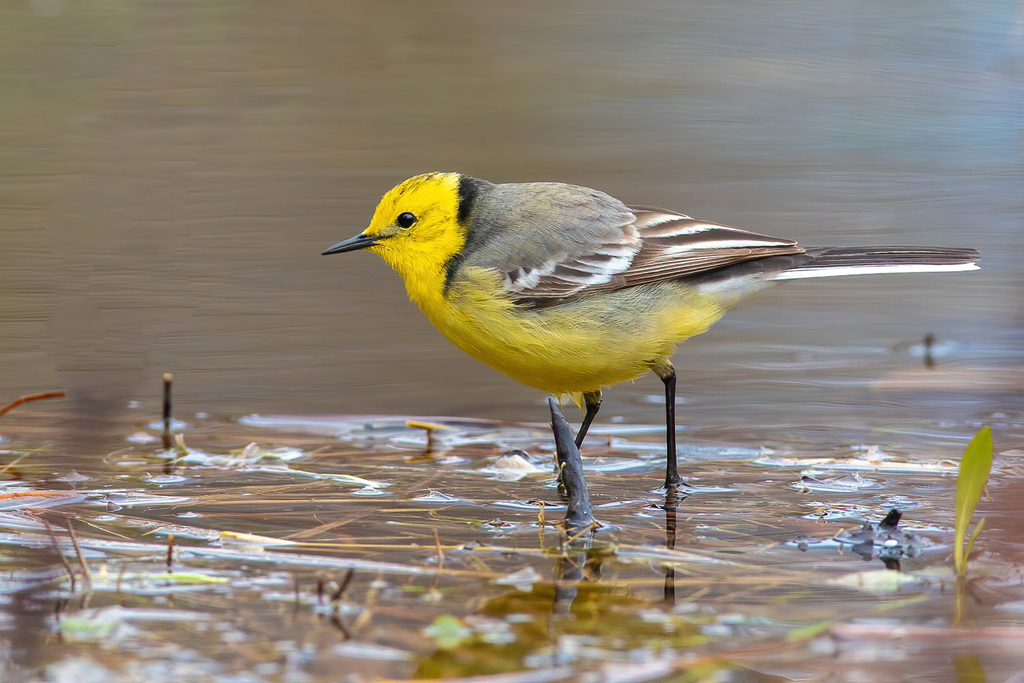
It is a slender, 15.5–17 cm long bird, with the long, constantly wagging tail characteristic of the genus Motacilla. The adult male in breeding plumage is basically grey or black above, with white on the remiges, and bright yellow below and on the entire head except for the black nape. In winter plumage, its yellow underparts may be diluted by white, and the head is brownish with a yellowish supercilium. Females look generally like washed-out versions of males in winter plumage.
Range & habitat
This species breeds in the central Palearctic in wet meadows and tundra. It migrates in winter to South Asia, often to highland areas. Its range is expanding westwards, and it is a rare but increasing vagrant to western Europe. Vagrants seem to extend the migration rather than straying en route; in Bhutan, for example, though along one of the species' migration flyways, the citrine wagtail has been recorded as an extremely rare passer-by rather than staying even for a few days or weeks.
Wikipedia: “Distribution”
What it does
It is an insectivorous bird of open country near water, such as wet meadows and bogs, and nests on the ground, laying 4–5 speckled eggs.
Wikipedia: “Ecology”
In human culture
The term citrine, and the specific name citreola, refer to its yellowish colouration.
Wikipedia: “Etymology”
Listen
Looking for field recordings…
Where it lives
Recorded sightings
—
geo-referenced records in GBIF, from museums, herbaria and field observers.
Drag the globe to turn it. Dots are where records exist, not a range map; darker means more records.
In the stacks
Searching the stacks…
Every page naming Motacilla citreola in the Biodiversity Heritage Library →
This page is assembled live from iNaturalist, GBIF, Wikipedia, the Source Library and the Internet Archive. It is not yet part of the hand-edited codex. iNaturalist taxon 13687.