On eBird ↗
Rock Pipit
Live sightings near you, the range map, bar charts of when it is seen, and Macaulay Library photos and recordings.
Rock Pipit
Anthus petrosus
The European rock pipit (Anthus petrosus), or simply rock pipit, is a species of small passerine bird that breeds in western Europe on rocky coasts. It has streaked greyish-brown upperparts and buff underparts, and is similar in appearance to other European pipits. There are two subspecies, of which the nominate is non-migratory, and the Fennoscandian one is migratory, wintering in shoreline habitats further west and south in Europe. The European rock pipit is territorial at least in the breeding season, and year-round where it is resident. Males will sometimes enter an adjacent territory to assist the resident in repelling an intruder, behaviour only otherwise known from the African fiddler crab.
European rock pipits construct a cup nest under coastal vegetation or in cliff crevices and lay four to six speckled pale grey eggs which hatch in about two weeks with a further 16 days to fledging. Although insects are occasionally caught in flight, the pipits feed mainly on small invertebrates picked off the rocks or from shallow water.
From the article European rock pipit on Wikipedia (CC BY-SA), quoted section by section
Description
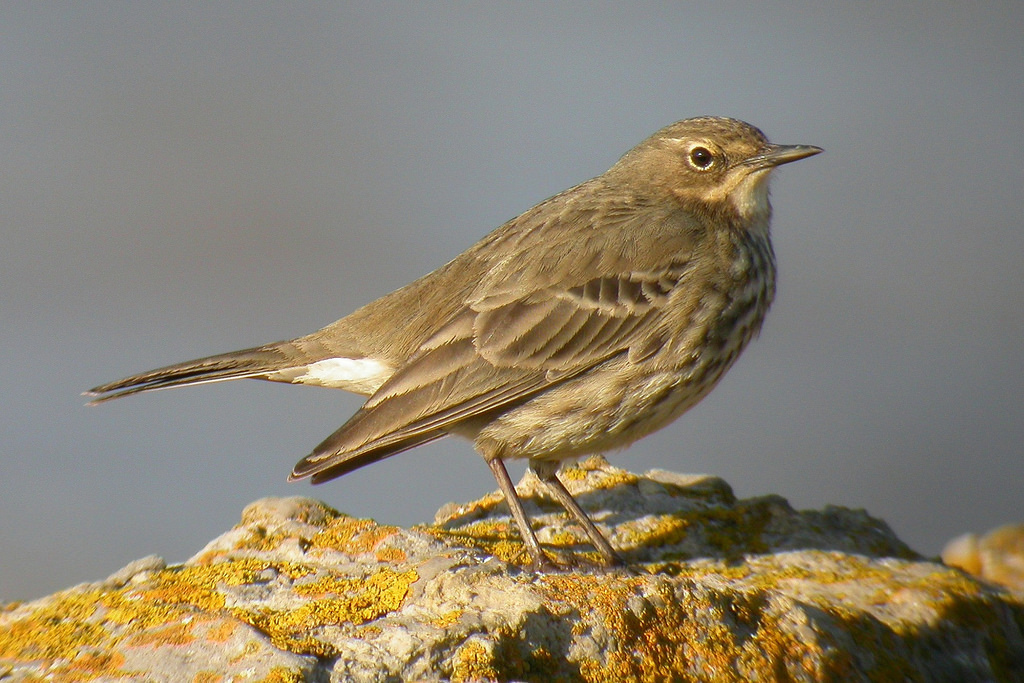
The European rock pipit is 16.5–17 centimetres (6.5–6.7 in) long and weighs 18–32.5 grams (0.63–1.15 oz). The nominate race has smoky-olive upperparts, weakly streaked with darker brown, and buff underparts, heavily marked with poorly defined brown streaks. The legs, bill and iris are dark brown or blackish, and there is a pale eye-ring. The sexes are alike; although males average slightly brighter than females, the overlap is complete and birds cannot be sexed on appearance or measurements. Immature birds resemble the adult, although they may sometimes be browner and more streaked above, looking superficially similar to meadow pipits. The eastern subspecies A. p. littoralis can only be reliably distinguished from the nominate subspecies in summer plumage, when it may show pinkish underparts and a pale supercilium (eyebrow), thereby resembling the water pipit. European rock pipits in winter are readily distinguishable from water pipits, but very difficult to assign to subspecies by appearance or measurements. The western populations are known to be nearly sedentary, so east of the Elbe basin vagrant Eurasian rock pipits are presumably mostly littoralis. Ringing results show that A. p. littoralis birds from Scandinavia winter widely within the breeding range of A. p. …
Range & habitat
The European rock pipit is almost entirely coastal, frequenting rocky areas typically below 100 metres (330 ft), although on St Kilda it breeds at up to 400 metres (1,300 ft). The European rock pipit is not troubled by wind or rain, although it avoids very exposed situations. It may occur further inland in winter or on migration. The breeding range is temperate and Arctic Europe on western and Baltic Sea coasts, with a very small number sometimes nesting in Iceland. The nominate race is largely resident, with only limited movement. A. p. littoralis is largely migratory, wintering on coasts from southern Scandinavia to southwest Europe, with a few reaching Morocco. Wanderers have reached Spitsbergen and the Canary Islands, but records in Europe away from the coast are rare. For example, a male shot at Dresden in 1894, now in the collection of the local State Museum of Zoology, is the sole specimen for Saxony. Migratory populations leave their breeding grounds in September and October, returning from March onwards, although in the far north they may not arrive before May.
Wikipedia: “Distribution and habitat”
What it does
The European rock pipit is a much more approachable bird than the water pipit. If startled, it flies a fairly short distance, close to the ground, before it alights, whereas its relative is warier and flies some distance before landing again. Eurasian rock pipits are usually solitary, only occasionally forming small flocks.
Breeding. The European rock pipit is highly territorial in the breeding season, and throughout the year where it is resident. Breeding males have a song display in which they fly to 15–30 metres (49–98 ft) above the ground, then circle or descend to the ground with a fluttering "parachute" flight. Territorial males will sometimes enter the territory of an adjacent male to cooperate in evicting an intruder. This behaviour, which requires the ability to distinguish the resident from the intruder, is only otherwise known from the African fiddler crab. Eggs are laid from early to mid-April in Britain and Ireland, from mid-May in southern Scandinavia, and from June in the north. The nest is always close to the shore, in a cliff crevice or hole, or under the cover of vegetation. It is constructed by the female from seaweed and dead grass, and lined with finer fibres or hair. The clutch is four to six eggs, glossy pale grey with darker grey or olive speckles mainly at the wider end. …
Wikipedia: “Behaviour”
Listen
Looking for field recordings…
Where it lives
Recorded sightings
—
geo-referenced records in GBIF, from museums, herbaria and field observers.
Drag the globe to turn it. Dots are where records exist, not a range map; darker means more records.
In the stacks
Searching the stacks…
Every page naming Anthus petrosus in the Biodiversity Heritage Library →
This page is assembled live from iNaturalist, GBIF, Wikipedia, the Source Library and the Internet Archive. It is not yet part of the hand-edited codex. iNaturalist taxon 13734.