On eBird ↗
Nilgiri Pipit
Live sightings near you, the range map, bar charts of when it is seen, and Macaulay Library photos and recordings.
Nilgiri Pipit
Anthus nilghiriensis
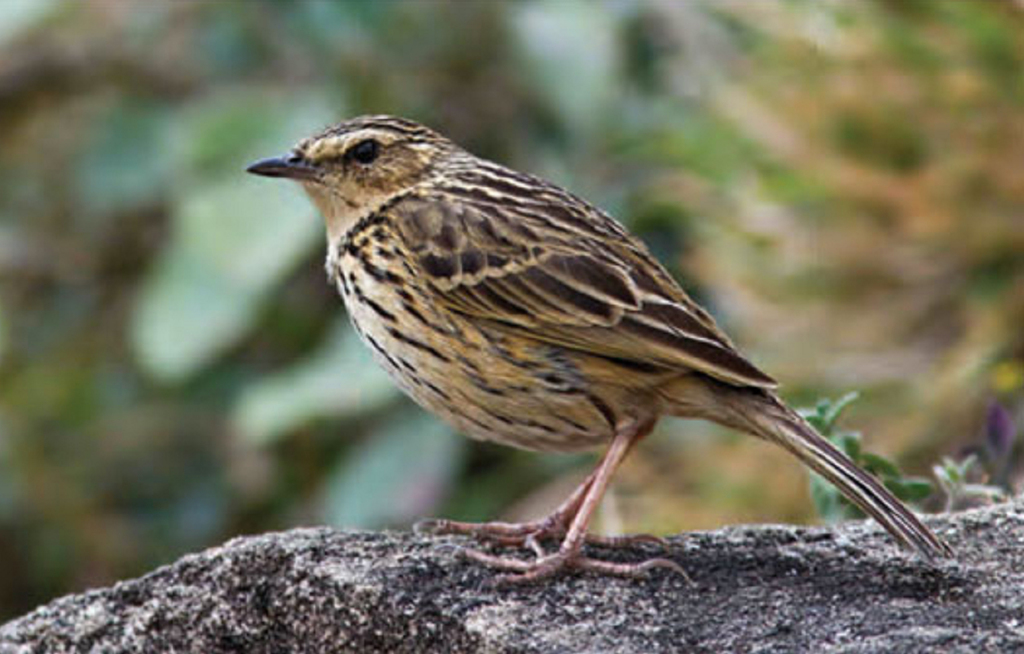
The Nilgiri pipit (Anthus nilghiriensis) is a distinctive species of pipit that is endemic to the high altitude hills of southern India. Richer brown in colour than other pipits in the region, it is distinctive in having the streaking on the breast continuing along the flanks. It is non-migratory and has a tendency to fly into low trees when disturbed and is closely related to the tree pipits, Anthus hodgsoni and Anthus trivialis.
From the article Nilgiri pipit on Wikipedia (CC BY-SA), quoted section by section
Description
The Nilgiri pipit is about 12.6–14 centimetres (5.0–5.5 in) long and is richly coloured, has dark lores, a buff supercilium and throat. It lacks any malar stripes. The flanks, breast and sides of neck are brighter buff and that bill is completely dark. The crown is heavily streaked in black as are the upperparts. The outer tail feathers are also buff coloured and there is no white in the plumage. The streaking on the breast is fine and it extends along the flanks. The first four primaries of the wing are almost equal and the fifth is about 1–2 mm shorter. The primaries from the second to the fifth are emarginate. The tail feathers are pointed and the second outer feather has a tapering triangle along the shaft and the third with a small triangle at the tip. Abnormal albino individuals have been reported.
Range & habitat
The Nilgiri pipit is closely associated with short montane grasslands interspersed with marshy grounds and small streams mostly in hill slopes above 1,000 metres (3,300 ft) in the Ponmudi hills and above 1,500 metres (4,900 ft) in the Nilgiris, Palani and High Ranges. They have also been claimed to occur in the Kalakkad Mundanthurai Tiger Reserve but a 2014 study suggests that the species is restricted to the high altitude grassy peaks of the Nilgiris and the Anamalais. Museum specimens exist from the Palani ranges but habitat changes may have led to its reduction or extirpation as the species was not found in surveys in the 21st century.
Wikipedia: “Distribution and habitat”
What it does
Nilgiri pipits are found singly or in pairs. When disturbed they usually fly into a low bush or tree. They breed in summer from April to July. The nest is a cup of grass in short grass. The clutch consists of two to three grey brown speckled eggs. They feed on grass seeds and insects with invertebrates becoming more important during the breeding season.
Wikipedia: “Behaviour”
Listen
Looking for field recordings…
Where it lives
Recorded sightings
—
geo-referenced records in GBIF, from museums, herbaria and field observers.
Drag the globe to turn it. Dots are where records exist, not a range map; darker means more records.
In the stacks
Searching the stacks…
Every page naming Anthus nilghiriensis in the Biodiversity Heritage Library →
This page is assembled live from iNaturalist, GBIF, Wikipedia, the Source Library and the Internet Archive. It is not yet part of the hand-edited codex. iNaturalist taxon 13744.