On eBird ↗
Long-legged Pipit
Live sightings near you, the range map, bar charts of when it is seen, and Macaulay Library photos and recordings.
Long-legged Pipit
Anthus pallidiventris
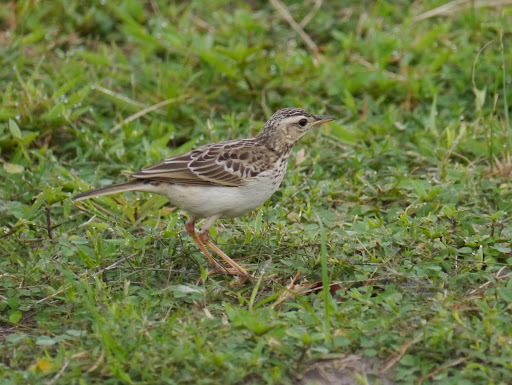
The long-legged pipit or long-clawed pipit (Anthus pallidiventris) is a species of bird in the family Motacillidae. It is found in Angola, Cameroon, Republic of the Congo, Democratic Republic of the Congo, Equatorial Guinea, and Gabon. Its natural habitat is subtropical or tropical dry lowland grassland.
From the article Long-legged pipit on Wikipedia (CC BY-SA), quoted section by section
Description
The long-legged pipit, aptly named for its stilt-like legs and tall body. The beak is also relatively long. Its olive-gray plumage is distinctive, featuring a prominent moustache stripe, minimal chest streaking, and an unstreaked back. While it's the only pipit within its range during summer, it may mingle with other pipit species in winter. Even then, its long legs, minimal chest markings, and unstreaked back remain key identifiers. Its song is a repetitive "tit-tidii"," and its calls include a "psip" contact call, a harsh "ptic-ptic", and a "poui-titit" flight call.
What it does
The long-legged pipit is found in natural grasslands, but also in pastures, farmland, airfields and in bare areas around villages and towns. Its diet consists of small grasshoppers and other flying insects, but also spiders. It forages on the ground, but can also jump up to catch flying insects. The pipit walks and runs with upright stance, constantly wagging tail up and down.
Wikipedia: “Ecology”
Listen
Looking for field recordings…
Where it lives
Recorded sightings
—
geo-referenced records in GBIF, from museums, herbaria and field observers.
Drag the globe to turn it. Dots are where records exist, not a range map; darker means more records.
In the stacks
Searching the stacks…
Every page naming Anthus pallidiventris in the Biodiversity Heritage Library →
This page is assembled live from iNaturalist, GBIF, Wikipedia, the Source Library and the Internet Archive. It is not yet part of the hand-edited codex. iNaturalist taxon 13745.