On eBird ↗
Buffy Pipit
Live sightings near you, the range map, bar charts of when it is seen, and Macaulay Library photos and recordings.
Buffy Pipit
Anthus vaalensis
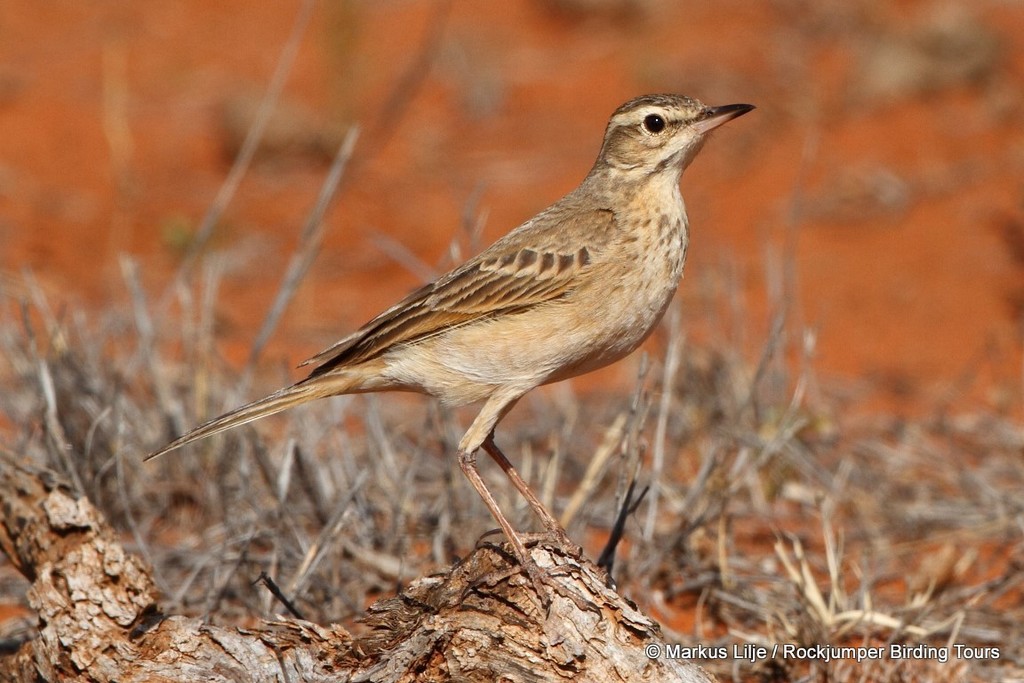
The buffy pipit (Anthus vaalensis) is a species of bird in the family Motacillidae. It is found in plains and open countryside in southern and eastern Africa. The IUCN has assessed its conservation status as being of least concern.
From the article Buffy pipit on Wikipedia (CC BY-SA), quoted section by section
Description
Its length is 16–18 cm (6.3–7.1 in), and its weight is 23–36.6 g (0.81–1.29 oz). It is often confused with the plain-backed pipit because both species have plain upperparts. The upperparts of the buffy pipit are paler and buffier than the plain-backed pipit. The buffy pipit has a pale supercilium, and its lower mandible has a pinkish base. It has faint markings on the breast, and the belly and flanks are buffy. The juvenile has mottles.
Range & habitat
The buffy pipit is found in Angola, Botswana, Democratic Republic of the Congo, Eswatini, Malawi, Mozambique, Namibia, South Africa, Tanzania, Zambia, and Zimbabwe, with a distribution size estimated at 5,660,000 km2 (2,190,000 sq mi). Its habitat is semi-arid plains with grasses and bare ground. It also occurs in pastures, burnt fields, and edges of saltpans.
Wikipedia: “Distribution and habitat”
What it does
One or two individuals are usually encountered, but flocks may be found in winter. It frequently wags its tail. Its song is a repeated tchreep-churup, and the call sshik is given when the bird is flushed. It eats invertebrates and seeds. Breeding has been recorded from July to February in Zimbabwe and August to December in South Africa. The nest is an open cup built on the ground.
Wikipedia: “Behaviour”
Listen
Looking for field recordings…
Where it lives
Recorded sightings
—
geo-referenced records in GBIF, from museums, herbaria and field observers.
Drag the globe to turn it. Dots are where records exist, not a range map; darker means more records.
In the stacks
Searching the stacks…
Every page naming Anthus vaalensis in the Biodiversity Heritage Library →
This page is assembled live from iNaturalist, GBIF, Wikipedia, the Source Library and the Internet Archive. It is not yet part of the hand-edited codex. iNaturalist taxon 13749.