On eBird ↗
Ocellated Quail
Live sightings near you, the range map, bar charts of when it is seen, and Macaulay Library photos and recordings.
Ocellated Quail
Cyrtonyx ocellatus
The ocellated quail (Cyrtonyx ocellatus) is a species of bird in the family Odontophoridae. It is found in El Salvador, Guatemala, Honduras, Mexico, and Nicaragua. Its natural habitats are subtropical or tropical moist montane forests and subtropical or tropical high-altitude shrubland. It is threatened by habitat loss. It is extremely similar to the Montezuma quail, and some authorities consider them to be conspecific.
From the article Ocellated quail on Wikipedia (CC BY-SA), quoted section by section
Description
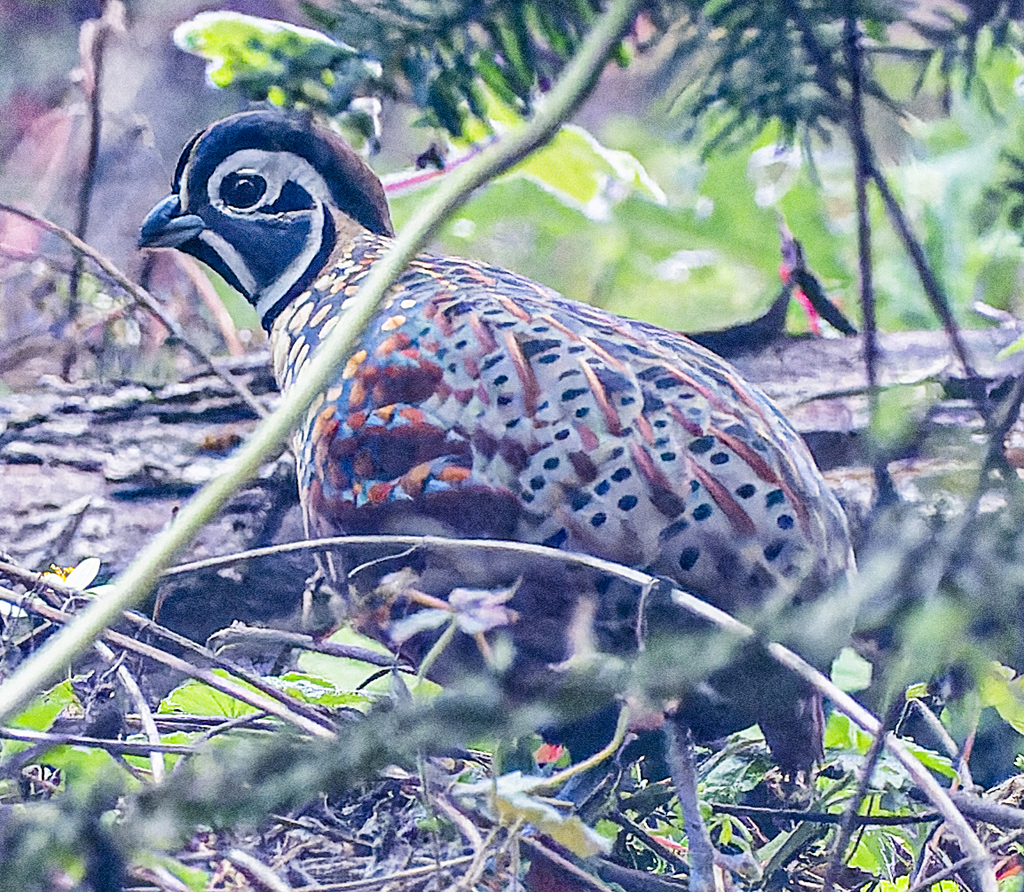
The ocellated quail is 20.5 to 23 cm (8.1 to 9.1 in) long. Males weigh an estimated 218 g (7.7 oz) and females an estimated 182 g (6.4 oz). The adult male's face has a black and white harlequin pattern. Its crown and nape are buffy brown to olive brown with a thick tawny crest on the rear of the crown. The throat is white with black stripes. Its upperparts are gray and brown with cinnamon stripes and black spots. The central breast is tawny cinnamon and its edges gray with cinnamon spots. The belly is a deeper cinnamon, the flanks gray with cinnamon scallops, and the vent area black. The female's face is buffy and black, the crest tawny, and the upperparts brown with buff lines. The breast and belly are wine red with black bars and spots.
Range & habitat
The ocellated quail is or was found in far southern Mexico, Guatemala, Honduras, El Salvador, and possibly Nicaragua. Only in Guatemala have there been a significant number of sightings since the late 1900s, with none in El Salvador and in Nicaragua only a c. 1900 specimen and a few early 2000s sight records near the Honduran border. It inhabits shrubland and open pine and oak forest, generally between 750 and 3,050 m (2,460 and 10,010 ft) of elevation.
Wikipedia: “Distribution and habitat”
What it does
The ocellated quail is entirely terrestrial. It forages for tubers and roots by digging with its feet. Especially during the breeding season it also takes a variety of insects.
Wikipedia: “Feeding”
Listen
Looking for field recordings…
Where it lives
Recorded sightings
—
geo-referenced records in GBIF, from museums, herbaria and field observers.
Drag the globe to turn it. Dots are where records exist, not a range map; darker means more records.
In the stacks
Searching the stacks…
Every page naming Cyrtonyx ocellatus in the Biodiversity Heritage Library →
This page is assembled live from iNaturalist, GBIF, Wikipedia, the Source Library and the Internet Archive. It is not yet part of the hand-edited codex. iNaturalist taxon 1391.