On eBird ↗
Montezuma Quail
Live sightings near you, the range map, bar charts of when it is seen, and Macaulay Library photos and recordings.
Montezuma Quail
Cyrtonyx montezumae
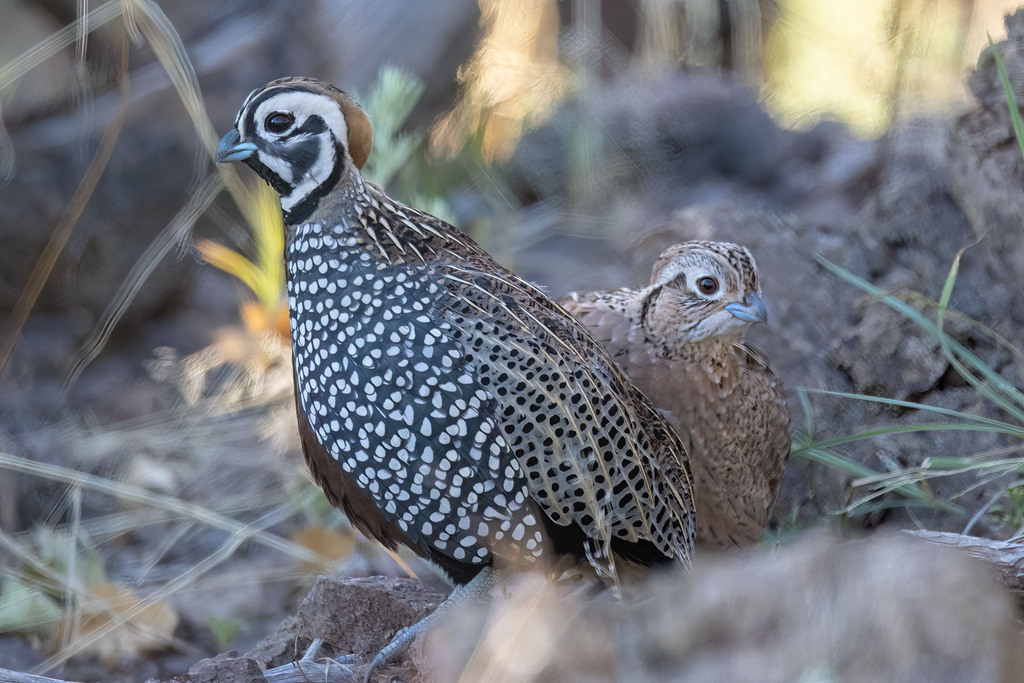
The Montezuma quail (Cyrtonyx montezumae) is a stubby, secretive New World quail of Mexico and some nearby parts of the United States. It is also known as Mearns's quail, the harlequin quail (for the male's striking pattern), and the fool quail (for its behavior).
From the article Montezuma quail on Wikipedia (CC BY-SA), quoted section by section
Description
At about 22 cm (8.75 in), it is one of the shortest quails of North America, although it weighs 122–230 g (4.3–8.1 oz), the same as some Callipepla quails that are somewhat taller. It has an even plumper build and shorter tail than other quails. The bird has a length of 20–23 cm (7.9–9.1 in) and wingspan of 41–43 cm (16–17 in). Both sexes have the back and wing coverts tan with longitudinal light-buff streaks formed by the feather shafts and circular or transversely oblong black spots arranged in bars. A crest on the nape makes the profile distinctively long front-to-back. The bill is black above and bluish-gray below. The adult males have a striking, swirling black-and-white face pattern. A single tan plume lies flat over the crest. Their sides are blue-gray (often looking black) with bold spots, which in northern birds are white and in southern birds are white towards the front and chestnut towards the back. The middle of the chest and belly is dark brown in northern birds, lighter and tawnier in southern birds. Females have a suggestion of the male's face pattern. Their underparts are light brown with a few fine black shaft streaks and other lines. Juveniles resemble females, but the underparts are grayish with white shaft streaks and black dots. …
Range & habitat
This species can be found from Oaxaca north through the interior of Mexico to the mountains of central and southeastern Arizona, central and southwestern New Mexico, and West Texas. It is absent from deserts and the Río Balsas valley. There are five subspecies divided into two plumage types, northern and southern, that intergrade in central Veracruz. Their habitat is open woods, most often oak, but also pine-oak and juniper, with grass at least 30 cm (1 ft) tall. Slopes of hills and canyons are particularly favored. Their range is decreasing and becoming fragmented.
Wikipedia: “Range and habitat”
What it does
In fall, Montezuma quail do not form large groups, as most American quail do. An average covey consists of eight birds, just parents and their offspring, although coveys bigger than 25 birds have been reported. At night, birds in a covey roost on southeast-facing slopes, gathered around a rock or tussock, facing outward. These birds are quite sedentary. A pair or covey typically forages within 50 m of the place where it foraged the day before. Coveys' territories in fall and winter are only 1 to 5 ha; in the breeding season, pairs spread out and territories may be as big as 50 ha. Otherwise, no seasonal movements are known. In the presence of humans, Montezuma quail crouch motionless in tall grass instead of running. They may allow an approach as close as 1 m before flying (taking off with a "loud, popping wing noise") and on rare occasions have been caught by hand.
Breeding. Males begin singing in February or March, but nesting does not start till July or August, the season of "monsoon" rains throughout its range. The long delay between pairing and nesting is unusual for quails. The nest is also unusual—a grass dome with one entrance, more elaborate than most nests in the family. The clutch comprises about 11 eggs (ranging from 2 to 15), which are "whitish" or "chalk-white". …
Wikipedia: “Behavior”
Listen
Looking for field recordings…
Where it lives
Recorded sightings
—
geo-referenced records in GBIF, from museums, herbaria and field observers.
Drag the globe to turn it. Dots are where records exist, not a range map; darker means more records.
In the stacks
Searching the stacks…
Every page naming Cyrtonyx montezumae in the Biodiversity Heritage Library →
This page is assembled live from iNaturalist, GBIF, Wikipedia, the Source Library and the Internet Archive. It is not yet part of the hand-edited codex. iNaturalist taxon 1392.