On eBird ↗
Masked Finch
Live sightings near you, the range map, bar charts of when it is seen, and Macaulay Library photos and recordings.
Masked Finch
Poephila personata
The masked finch (Poephila personata) is a small passerine bird in the estrildid finch family, Estrildidae. It is a common resident of dry savannah across northern Australia, from the Kimberley, across the Top End, the Gulf country and the southern part of Cape York Peninsula, as far east as Chillagoe, but always near water.
From the article Masked finch on Wikipedia (CC BY-SA), quoted section by section
Description
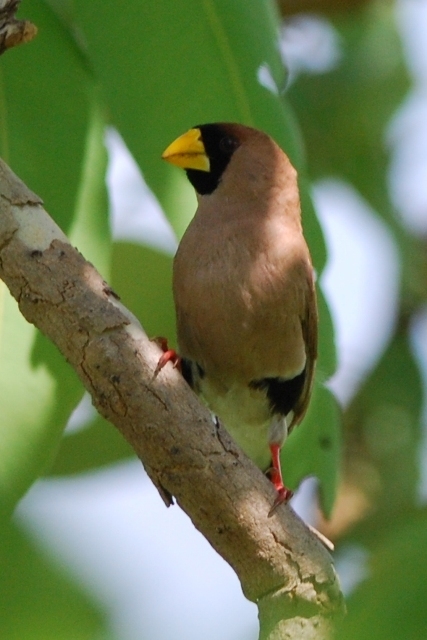
The masked finch is 12.5–13.5 cm (4.9–5.3 in) long. The male is larger, but the sexes are otherwise similar. It is cinnamon-brown above and paler below with a white rump, black mark on the flanks and black face mask. It has a heavy yellow bill and a pointed black tail. The eastern subspecies P. p. leucotis has whitish cheeks.
What it does
Pairs or small flocks of masked finches forage through the day, mostly on the ground for grass seeds. In the evenings and early mornings, large numbers—sometimes thousands— can gather around waterholes to drink, cleanse, and preen, flicking their tails sideways and chattering incessantly. Pairs build a domed nest from grasses, lined with fine grass, feathers, and charcoal, in the late wet or early dry season. The nest position varies: it can be as high as 20 metres (66 ft) or simply hidden in long grass. Five to six white eggs are laid.
Wikipedia: “Behaviour”
Listen
Looking for field recordings…
Where it lives
Recorded sightings
—
geo-referenced records in GBIF, from museums, herbaria and field observers.
Drag the globe to turn it. Dots are where records exist, not a range map; darker means more records.
In the stacks
Searching the stacks…
Every page naming Poephila personata in the Biodiversity Heritage Library →
This page is assembled live from iNaturalist, GBIF, Wikipedia, the Source Library and the Internet Archive. It is not yet part of the hand-edited codex. iNaturalist taxon 13928.