On eBird ↗
Southern Red Bishop
Live sightings near you, the range map, bar charts of when it is seen, and Macaulay Library photos and recordings.
Southern Red Bishop
Euplectes orix
The southern red bishop or red bishop (Euplectes orix) is a small passerine bird belonging to the bishop and widowbird genus Euplectes in the weaver family, the Ploceidae. It is common in wetlands and grassland in Africa south of the Equator. North of the Equator, it is replaced by the northern red bishop or orange bishop (E. franciscanus) which was formerly regarded as a subspecies of this species.
From the article Southern red bishop on Wikipedia (CC BY-SA), quoted section by section
Description
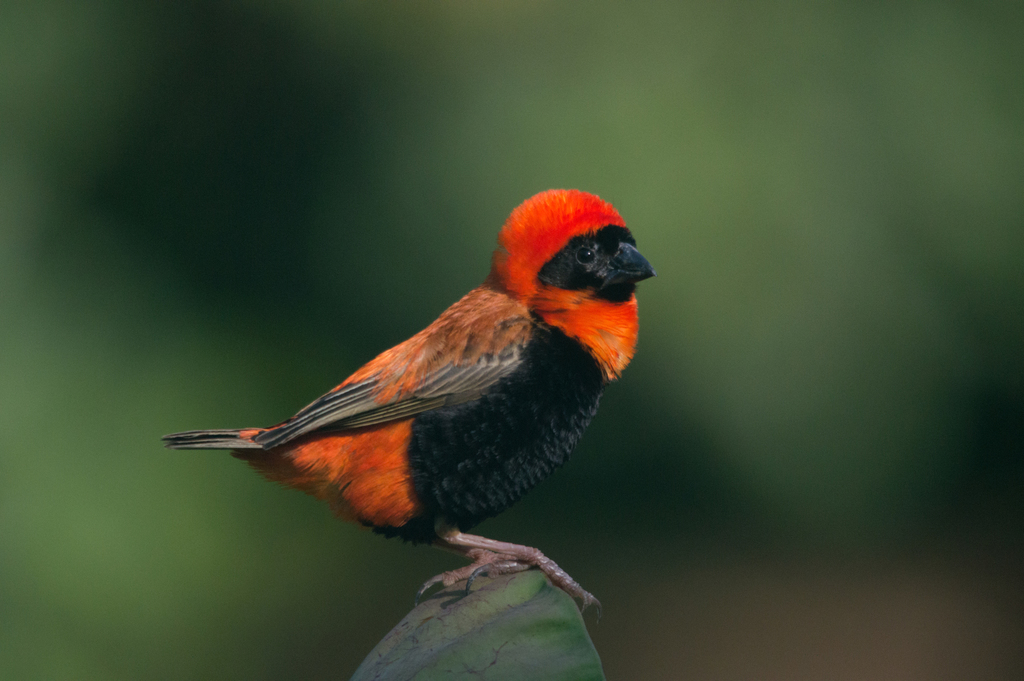
The southern red bishop is 10–11 centimetres long and has a thick conical bill. Breeding males are brightly coloured with red (occasionally orange) and black plumage. The forehead, face and throat are black and the rest of the head is red. The upperparts are red apart from the brown wings and tail. The upper breast and under tail-coverts are red while the lower breast and belly are black. The non-breeding male and female have streaky brown plumage, paler below. Females are smaller than the males. It has various twittering calls and a nasal contact call. The male has a buzzing song. Breeding males of the northern red bishop have a red throat, black extending further back on the crown and long tail-coverts which almost cover the tail. The females and non-breeding males are almost identical to those of the southern red bishop.
Range & habitat
It occurs from South Africa north to Angola, southern and eastern parts of the Democratic Republic of Congo, northern Zambia, southern Uganda, north-east Nigeria, and south-west Kenya. It is largely absent from the Namib Desert and Kalahari. In the breeding season it is found near water among grass, reeds, sedges or crops such as sugar cane. Outside the breeding season it will venture into drier grassland and savanna habitats.
Wikipedia: “Distribution and habitat”
What it does
It is a fairly gregarious bird, nesting in colonies and foraging in flocks. It feeds on seeds and some insects. It often roosts in mixed flocks with other members of the weaver family. At the start of the breeding season, the males build several nests to attract females. They perform a display flight with their feathers fluffed up. They are polygynous and mate with several females. The nest is most commonly built among reeds and is made of grasses and other plant materials woven together. Two to four eggs are laid.
Wikipedia: “Behaviour”
Listen
Looking for field recordings…
Where it lives
Recorded sightings
—
geo-referenced records in GBIF, from museums, herbaria and field observers.
Drag the globe to turn it. Dots are where records exist, not a range map; darker means more records.
In the stacks
Searching the stacks…
Every page naming Euplectes orix in the Biodiversity Heritage Library →
This page is assembled live from iNaturalist, GBIF, Wikipedia, the Source Library and the Internet Archive. It is not yet part of the hand-edited codex. iNaturalist taxon 13962.