On eBird ↗
White-winged Widowbird
Live sightings near you, the range map, bar charts of when it is seen, and Macaulay Library photos and recordings.
White-winged Widowbird
Euplectes albonotatus
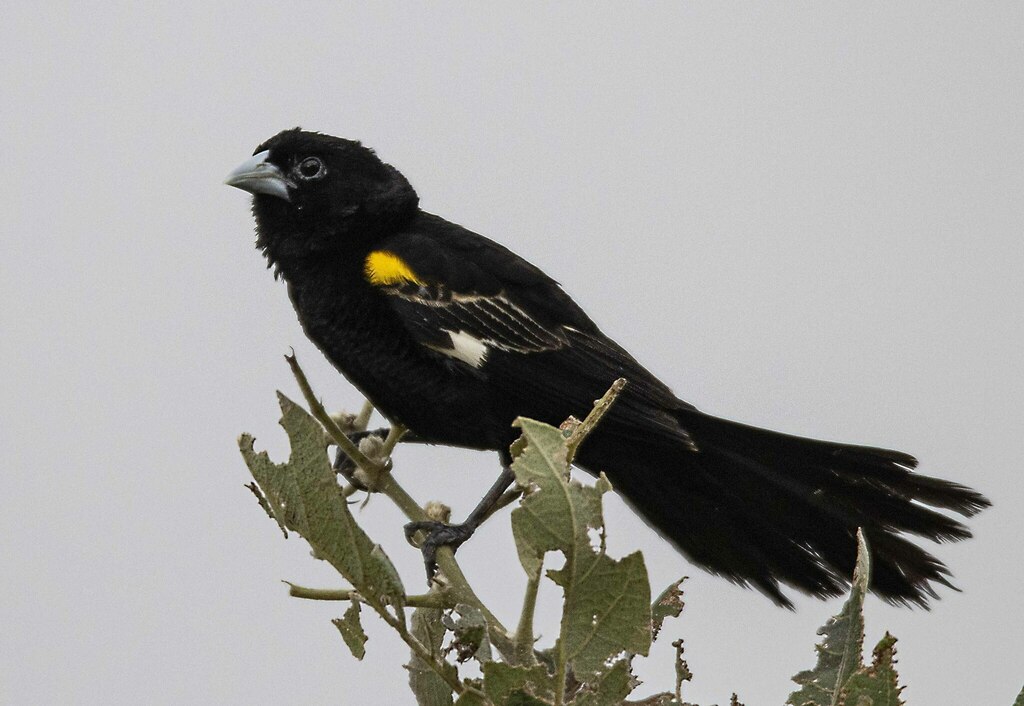
The white-winged widowbird (Euplectes albonotatus) is a species of passerine bird in the family Ploceidae native to Africa south of the Sahara. It is highly sexually dimorphic in its breeding season, during which the male's yellow plumage turns dark and he gains more white feathers, contrasting with the female's predominantly pale coloration. Three subspecies are recognised.
From the article White-winged widowbird on Wikipedia (CC BY-SA), quoted section by section
Description
The white-winged widowbird is 15 to 19 cm (5.9–7.5 in) in length and about 23 g (0.81 oz) in weight. The male is the only short-tailed widowbird in its region with white on its coverts. The breeding male is distinguished from the yellow-mantled widowbird by its shorter tail, wing color, lack of yellow on its back, and paler bill. Females are pale below.
Range & habitat
The white-winged widowbird is found in Angola, Botswana, Burundi, Central African Republic, the Republic of the Congo, the Democratic Republic of the Congo, Ethiopia, Eswatini, Gabon, Kenya, Malawi, Mozambique, Namibia, Rwanda, São Tomé, South Africa, Sudan, Tanzania, Uganda, Zambia, and Zimbabwe. Its preferred habitats are savanna, grasslands and wetlands, as well as cultivated land. Its call is "zeh-zeh-zeh" and "witz-witz-witz".
Wikipedia: “Distribution and habitat”
What it does
The white-winged widowbird is polygynous, with one male mating with 3–4 females, and lives in flocks. Oval nests, built solely by the male, are located in the branches of trees or shrubs. Nesting takes place from November to May, peaking from December to March. The female will lay a clutch of two to four white eggs, which she will incubate for 12–14 days. Feeding of chicks is done by the female in the nest for 11–14 days, with chick independence coming 22–25 days later. This bird mainly eats grass seeds, nectar, and insects.
Wikipedia: “Behaviour”
Listen
Looking for field recordings…
Where it lives
Recorded sightings
—
geo-referenced records in GBIF, from museums, herbaria and field observers.
Drag the globe to turn it. Dots are where records exist, not a range map; darker means more records.
In the stacks
Searching the stacks…
Every page naming Euplectes albonotatus in the Biodiversity Heritage Library →
This page is assembled live from iNaturalist, GBIF, Wikipedia, the Source Library and the Internet Archive. It is not yet part of the hand-edited codex. iNaturalist taxon 13965.