On eBird ↗
Red-collared Widowbird
Live sightings near you, the range map, bar charts of when it is seen, and Macaulay Library photos and recordings.
Red-collared Widowbird
Euplectes ardens
The red-collared widowbird (Euplectes ardens) is a species of bird in the family Ploceidae. Red-collared widowbirds are found in grasslands and bush clearings in western and southern Africa. They are known for their long tails and brilliant red badges, both of which act as sexual ornaments. They are often associated with other widowbird and bishop species. They are polygynous, where males acquisition of territory is an important determinant in their access to mates. Red-collared widowbirds have a wide range and there is little concern in terms of conservation status.
From the article Red-collared widowbird on Wikipedia (CC BY-SA), quoted section by section
Description
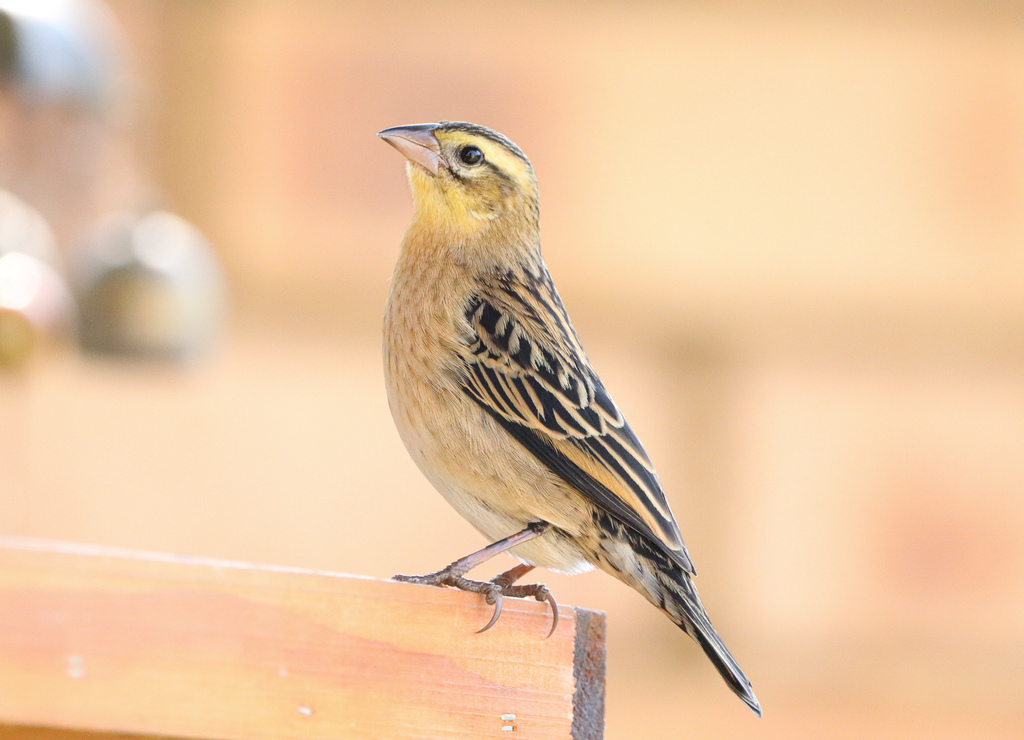
Similar to other widowbirds, male red-collared widowbirds have both seasonal and sexual dimorphism. Males are about 25 cm (9.8 in) in length while females are only 13 centimeters. A similar trend is seen with weight, where males range from 20 to 26 g (0.71 to 0.92 oz) and females are only between 16 and 22 grams. During non-breeding seasons, the male plumage is brown, while in breeding season, October to April, they have black plumage with a long tail, approximately 22 cm, and crescent-shaped carotenoid based chest patch. There is significant variation in brightness, hue, and chroma of the carotenoid badges. In contrast, females and subadults, like nonbreeding males, are streaky dull brown with a short tail, approximately 4 cm. Nonbreeding males, however, retain their black tails, while females and subadults' tails are dark-brown.
Range & habitat
Red-collared widowbirds are found throughout Eastern and Southern Africa. While their habitats are varied, they are often found in open grasslands, agricultural areas, clearings in forests, and on slopes with limited tree coverage.
Wikipedia: “Distribution and habitat”
What it does
Red-collared widowbirds feed on seeds of sorghum and other grass seeds. They also feed on nectar, small berries, and insects, specifically ants, caterpillars, and termites. They often form large roosts, with between 50 and 100 individuals, which feed together on the ground. These roosts included breeding males. They are often formed with association with other species, like red-billed quelea, fan-tailed widowbird, southern red bishop, white-winged widowbird, and yellow bishop.
Wikipedia: “Diet”
Listen
Looking for field recordings…
Where it lives
Recorded sightings
—
geo-referenced records in GBIF, from museums, herbaria and field observers.
Drag the globe to turn it. Dots are where records exist, not a range map; darker means more records.
In the stacks
Searching the stacks…
Every page naming Euplectes ardens in the Biodiversity Heritage Library →
This page is assembled live from iNaturalist, GBIF, Wikipedia, the Source Library and the Internet Archive. It is not yet part of the hand-edited codex. iNaturalist taxon 13978.