On eBird ↗
Black-throated Accentor
Live sightings near you, the range map, bar charts of when it is seen, and Macaulay Library photos and recordings.
Black-throated Accentor
Prunella atrogularis
The black-throated accentor (Prunella atrogularis) is a small passerine bird found in the Ural, Tian Shan and Altai Mountains. It is migratory, wintering in Afghanistan and neighboring countries. It is a rare vagrant in western Europe.
From the article Black-throated accentor on Wikipedia (CC BY-SA), quoted section by section
Description
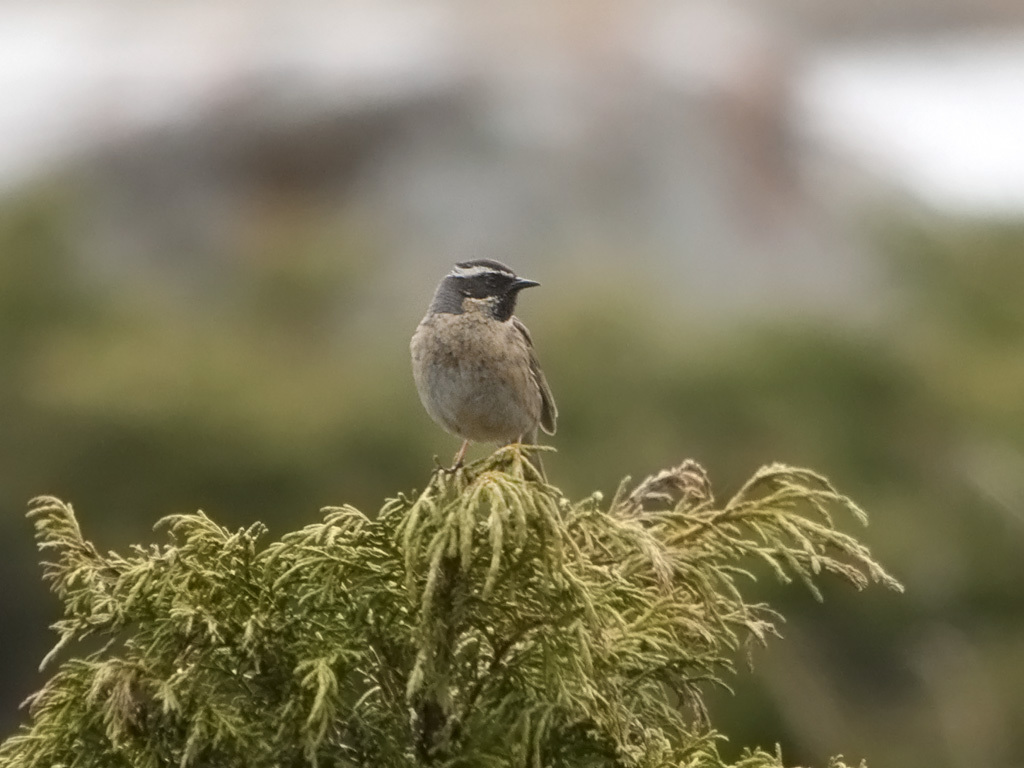
This is a dunnock-sized bird, 13.5–14 centimetres (5.3–5.5 in) in length. It has a streaked dark brown back, somewhat resembling a house sparrow, but adults have a black crown, face patch and throat, and a white supercilium. The breast is orange, and the belly white with orange stripes. Like other accentors, this species has an insectivore's fine pointed bill. Sexes are similar, but winter birds and juveniles are less contrasted. In particular, the dark throat may be almost absent in young birds. The call is a fine ti-ti-ti, and the song is similar to the dunnock's pleasant twittering.
What it does
The black-throated accentor builds a neat nest low in spruce thickets, laying 3-5 unspotted blue eggs. It winters in scrub or cultivation.
Wikipedia: “Ecology”
In human culture
The genus name Prunella is from German Braunelle - "brown" in diminutive form. The specific atrogularis is from Latin, meaning "black-throated"; ater - "black" and gular - "throat". There are two recognized subspecies:
P. a. atrogularis - Breeds in the northern and central Ural Mountains of northwestern Russia. Winters in eastern Iran, Turkmenistan and Uzbekistan, south to Afghanistan and the southwestern Indian subcontinent . P. a. Huttoni - Breeds in Central Asia, from the Altai Mountains south to the Tien Shan and Pamir Mountains. In winter it migrate south, to southwest Asia. The name Huttoni commemorates the British captain and mamologist Thomas Hutton (1807–1874) who served in India and Afghanistan.
Wikipedia: “Taxonomy and etymology”
Listen
Looking for field recordings…
Where it lives
Recorded sightings
—
geo-referenced records in GBIF, from museums, herbaria and field observers.
Drag the globe to turn it. Dots are where records exist, not a range map; darker means more records.
In the stacks
Searching the stacks…
Every page naming Prunella atrogularis in the Biodiversity Heritage Library →
This page is assembled live from iNaturalist, GBIF, Wikipedia, the Source Library and the Internet Archive. It is not yet part of the hand-edited codex. iNaturalist taxon 13989.