On eBird ↗
Southern Cordonbleu
Live sightings near you, the range map, bar charts of when it is seen, and Macaulay Library photos and recordings.
Southern Cordonbleu
Uraeginthus angolensis
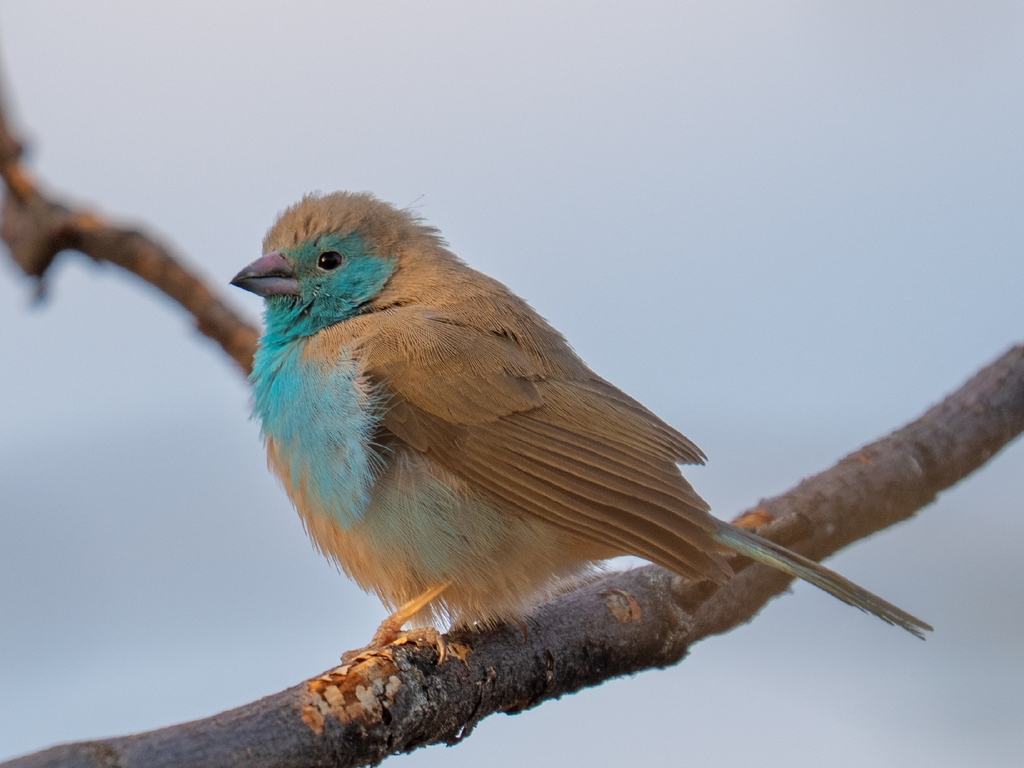
The blue waxbill (Uraeginthus angolensis), also called Southern blue waxbill, blue-breasted waxbill, Southern cordon-bleu, blue-cheeked cordon-bleu, blue-breasted cordon-bleu and Angola cordon-bleu, is a common species of estrildid finch found in Southern Africa. It is also relatively commonly kept as an aviary bird.
From the article Blue waxbill on Wikipedia (CC BY-SA), quoted section by section
Description
The blue waxbill has powder-blue face, breast, rump, and flanks with pale brown upperparts. The female is paler than the male and the blue is confined to the rump, tail, head, and upper breast, with the rest of the underparts being buffy brown. They measure 12–13 cm in length. The call is a soft 'seee-seee', often repeated as bird flits through the lower parts of bush and scrub.
Range & habitat
The blue waxbill occurs in southern Africa from Cabinda and the Congo to Kenya and Tanzania in the east south to northern South Africa. It may have been introduced to the islands of São Tomé and to Zanzibar. The blue waxbill occurs in a variety of habitats but generally prefers well-watered and semi-arid savanna, particularly where umbrella thorns Vachellia tortilis grow, also occupying natural growth in cultivated land, mopane Colosphermum mopane and forest edges.
Wikipedia: “Distribution and habitat”
What it does
The blue waxbill mainly eats grass seeds, which are taken from the inflorescences. This is supplemented with termites and other insects. They have also been recorded eating the fallen fruits of Boscia albitrunca. They are normally seen in pairs or family parties, but do form larger flocks which often mix in with flocks of other estrildid finches.
Wikipedia: “Food and feeding”
Listen
Looking for field recordings…
Where it lives
Recorded sightings
—
geo-referenced records in GBIF, from museums, herbaria and field observers.
Drag the globe to turn it. Dots are where records exist, not a range map; darker means more records.
In the stacks
Searching the stacks…
Every page naming Uraeginthus angolensis in the Biodiversity Heritage Library →
This page is assembled live from iNaturalist, GBIF, Wikipedia, the Source Library and the Internet Archive. It is not yet part of the hand-edited codex. iNaturalist taxon 14026.