On eBird ↗
Diamond Firetail
Live sightings near you, the range map, bar charts of when it is seen, and Macaulay Library photos and recordings.
Diamond Firetail
Stagonopleura guttata
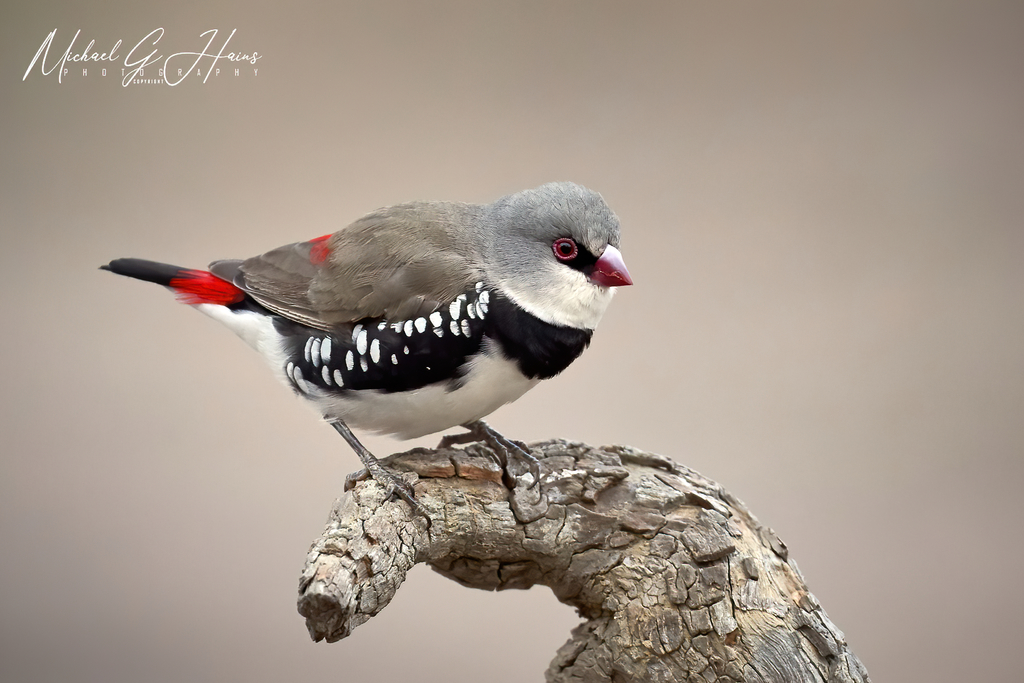
The diamond firetail (Stagonopleura guttata) is a species of estrildid finch that is endemic to Australia. It has a patchy distribution and generally occupies drier forests and grassy woodlands west of the Great Dividing Range from South East Queensland to the Eyre Peninsula in South Australia. While it is a small stocky bird it is one of the largest finches in Australia. The birds are very distinctive with a black breast-band on a white breast. The flanks are black with white spots and it has a scarlet rump (hence the name) and a black tail.
From the article Diamond firetail on Wikipedia (CC BY-SA), quoted section by section
Description
The diamond firetail is one of the largest of the Australian finches by both weight (15–19 g) and wingspan (64–71 mm). eBird describes the firetail having an olive back and grey head. The belly and throat are white with a complete black band. The flanks are black with distinctive white spots. The rump is bright red and the tip of the tail is black. The rump is also described as scarlet by some authors. Juvenile diamond firetails are duller than the adults and have a black bill. The rump is very distinctive in flight. These birds are generally seen in pairs or small flocks, sometimes up to a hundred birds. The birds fly low and in long lines.
Range & habitat
The diamond firetail has a patchy distribution from Southeast Queensland to the Eyre Peninsula in South Australia. The Australian Bird Guide shows its core distribution from southern Queensland (just north in Inglewood) through to Victoria and around the coast to the Eyre Peninsula in South Australia and the eBird distribution is similar. Birdlife Australia has a more extensive distribution from the Carnarvon Ranges in Queensland to the Eyre Peninsula and Kangaroo Island which is broader than other references. This broader distribution reflects the historic range of the bird based on the surveys done for The Atlas of Australian Birds. The species was recorded as far north as the Kirrama Tableland in North Queensland in 1917, as a "new record for the district". The bird is mostly sedentary and lives in open grassy eucalypt forest and woodland, heath, mallee country, farmland and grassland with scattered trees. The bird's habitat has been threatened by alteration of vegetation structure caused by over-grazing, weed invasion, salinisation and other flow-on processes. This loss of main food plants and habitat results in competition with invasive species, and increased predation.
Wikipedia: “Distribution and habitat”
What it does
Diamond firetails are ground feeders with a diet of grass seeds; ripe or partially ripe. They have also been observed eating insects and larvae. While feeding they will be seen hopping on the ground but if disturbed they will fly into nearby trees.
Wikipedia: “Feeding”
At the table
The birds will eat lettuce, spinach, chickweed, spray millet, eggfood, broccoli tops, sprouted seed, meal worms, small cockroaches, small crickets, hulled oats and carrot tops.
Wikipedia: “Nutrition”
In human culture
The striking plumage of the diamond firetails make them popular in aviculture. However, they are not particularly suited for inexperienced keepers as they are hard to breed, are assertive in behaviour, and are difficult to sex. In some Australian states, strict licensing requirements apply.
Mutations. There are few mutations in the diamond firetail. However, one mutation produces an orange tail instead of the fiery red. In this case the bird is known as the yellow diamond. Other mutations are the pied diamond which has splashes of white, the white diamond, and the fawn diamond.
Nutrition. The birds will eat lettuce, spinach, chickweed, spray millet, eggfood, broccoli tops, sprouted seed, meal worms, small cockroaches, small crickets, hulled oats and carrot tops.
Wikipedia: “Aviculture”
Listen
Looking for field recordings…
Where it lives
Recorded sightings
—
geo-referenced records in GBIF, from museums, herbaria and field observers.
Drag the globe to turn it. Dots are where records exist, not a range map; darker means more records.
In the stacks
Searching the stacks…
Every page naming Stagonopleura guttata in the Biodiversity Heritage Library →
This page is assembled live from iNaturalist, GBIF, Wikipedia, the Source Library and the Internet Archive. It is not yet part of the hand-edited codex. iNaturalist taxon 14093.