On eBird ↗
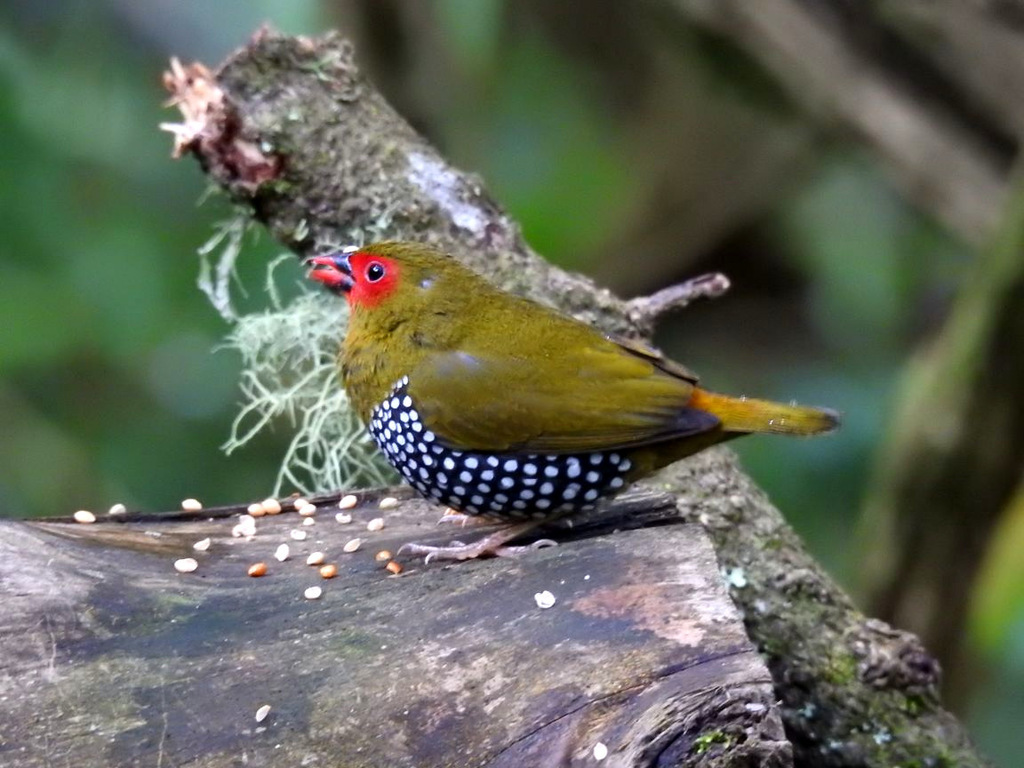
Green-backed Twinspot
Live sightings near you, the range map, bar charts of when it is seen, and Macaulay Library photos and recordings.
Green-backed Twinspot
Mandingoa nitidula
The green-backed twinspot or green twinspot (Mandingoa nitidula) is an estrildid finch found in many parts of Sub-Saharan Africa. The IUCN has classified the species as being of least concern.
From the article Green-backed twinspot on Wikipedia (CC BY-SA), quoted section by section
Range & habitat
The green-backed twinspot inhabits lowland moist forests of the tropical region. It may also be found in grassland and shrubland habitats. Males are distinguished from females by their bright red facial feathers. Females have an olive-green face and darker (almost black) beak.
Wikipedia: “Habitat”
In human culture
The green backed twinspot prefers its privacy in regards to breeding. Males in the breeding season will raise their heads, looking straight up while "dancing" on the perch next to the female, moving in a side-stepping fashion. The female, if receptive, will crouch down and point her tail to the male. Green backed twinspots tend to pair with one female and care for her and the young while breeding. Up to four eggs are laid about five days after mating, usually one daily. The female will go in and out of the nest frequently until all eggs are laid and will sit in place to incubate thereafter, ensuring all hatch in relatively close proximity. This species enjoys a large, planted aviary with plenty of privacy for breeding. Temperatures in captivity should not dip below 70 °F or exceed 84 °F. Green back twinspots may be housed as single pairs, singles, or in groups up to four pairs in a large flight. The birds eat millet, dark leafy greens, fresh bananas, cooked brown rice and mixed finch seed.
Wikipedia: “Aviculture”
Listen
Looking for field recordings…
Where it lives
Recorded sightings
—
geo-referenced records in GBIF, from museums, herbaria and field observers.
Drag the globe to turn it. Dots are where records exist, not a range map; darker means more records.
In the stacks
Searching the stacks…
Every page naming Mandingoa nitidula in the Biodiversity Heritage Library →
This page is assembled live from iNaturalist, GBIF, Wikipedia, the Source Library and the Internet Archive. It is not yet part of the hand-edited codex. iNaturalist taxon 14132.