On eBird ↗
Jacky-winter
Live sightings near you, the range map, bar charts of when it is seen, and Macaulay Library photos and recordings.
Jacky Winter
Microeca fascinans
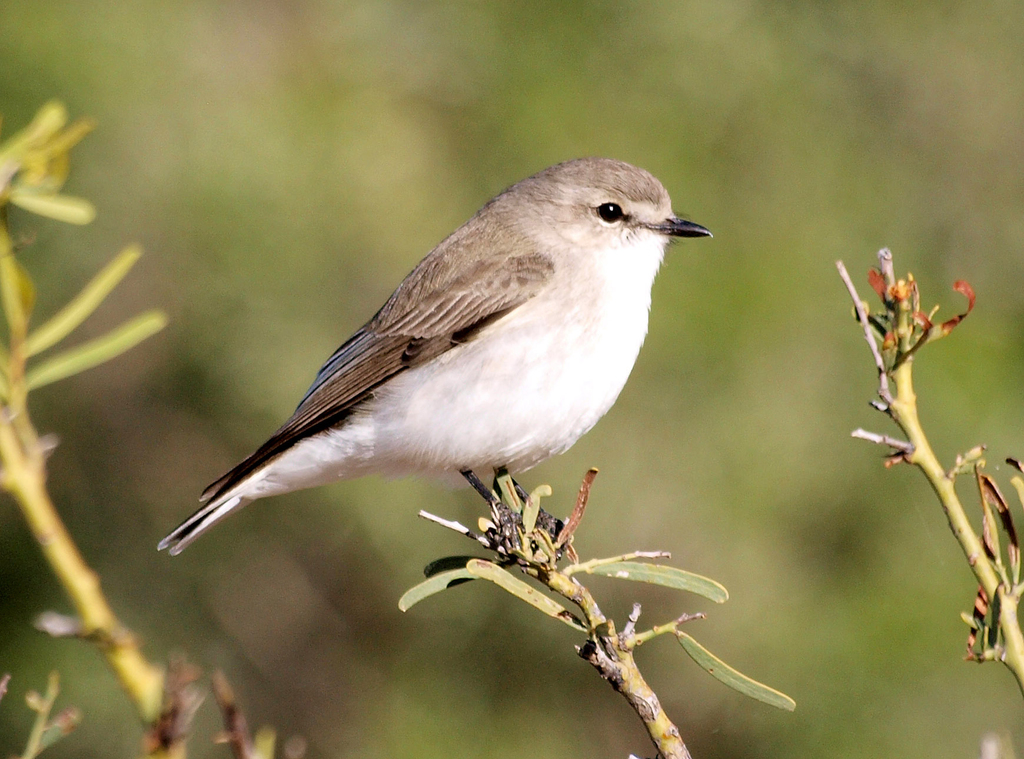
The jacky winter (Microeca fascinans) is a small grey-brown robin found commonly throughout Australia and also in Papua New Guinea. The jacky winter acquired its name due to rapid and strong vocalisations, which sound like jacky-jacky winter-winter. Their call is also often referred to as sounding like peter-peter-peter. Its habitats include open woodlands and farmlands.
From the article Jacky winter on Wikipedia (CC BY-SA), quoted section by section
Description
The jacky winter is around 12 – 14 cm in length (including the tail) and its weight varies from 14 – 18 g. The plumage of M. f. fascinans includes a greyish breast with white on the bottom half, its head and back is greyish-brown, while its wings are a darker brown with white edges. The bill is black, it has a narrow eye-line and a buff alula stripe. The tail of M. f. fascinans is blackish brown with white outer feathers. Its legs are black. Subspecies M. f. assimilis is very similar to M. f. fascinans; however, it is darker, with more grey over the breast and flanks, covering up the white which is seen on M. f. fascinans. M. f. pallida is smaller than the other two subspecies, being only around 13 cm. M. f. pallida is much more pallid than the other subspecies, and is usually a sandy brown colour.
Range & habitat
There are three races of jacky winter found in Australia. Microeca fascinans fascinans (leucophaea) is the most familiar race, and is found in central and eastern Queensland, New South Wales, Victoria, and southeastern South Australia. There are also Microeca fascinans assimilis, which is found in South Australia and south Western Australia, and Microeca fascinans pallida, which is found in northern and western Queensland, Northern Territory, and the Kimberley in Western Australia. Microeca fascinans zimmeri is a subspecies of jacky winter found in Papua New Guinea
Wikipedia: “Distribution”
What it does
The jacky winter can be heard vocalising before sunrise and usually stops towards the middle of the day. Occasionally closer to sunset, it can be heard again. During the day they can be seen perched atop trees and posts, preening their feathers or even sunning to kill the parasites, which may be present in amongst the feathers.
Diet. The jacky winter is an insectivore and a sit-and-search predator, which moves amongst perches to locate food. This is a continuous activity that can cover long distances in order to find prey items. The jacky winter has two methods of hunting, which include hawking and ground-pouncing. Hawking is when a bird flies and drops to the ground, grabbing their prey during flight, while ground-pouncing is when they fly from a perch, grabbing prey as they land. Both of these hunting styles are used quite commonly by the jacky winter.
Reproduction. In many species of birds, the male plumage is quite bright and flamboyant to attract the opposite sex in hope of finding a partner to mate with. The jacky winter is instead a sexually monomorphic bird, which means that both the male and female are almost identical in appearance. Rather than plumage playing a significant role in attracting the opposite sex, the jacky winter male uses song to attract a female during courtship. …
Wikipedia: “Behaviour”
Listen
Looking for field recordings…
Where it lives
Recorded sightings
—
geo-referenced records in GBIF, from museums, herbaria and field observers.
Drag the globe to turn it. Dots are where records exist, not a range map; darker means more records.
In the stacks
Searching the stacks…
Every page naming Microeca fascinans in the Biodiversity Heritage Library →
This page is assembled live from iNaturalist, GBIF, Wikipedia, the Source Library and the Internet Archive. It is not yet part of the hand-edited codex. iNaturalist taxon 14162.