On eBird ↗
Red-capped Robin
Live sightings near you, the range map, bar charts of when it is seen, and Macaulay Library photos and recordings.
Red-capped Robin
Petroica goodenovii
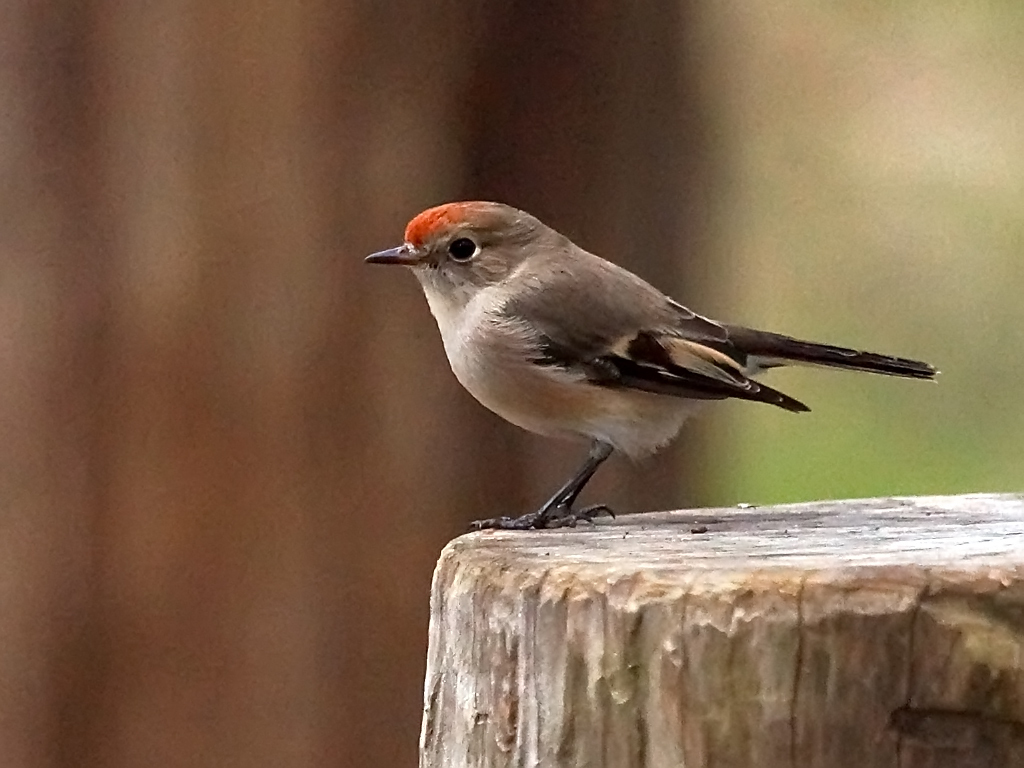
The red-capped robin (Petroica goodenovii) is a small passerine bird native to Australia. Found in drier regions across much of the continent, it inhabits scrub and open woodland. Like many brightly coloured robins of the family Petroicidae, it is sexually dimorphic. Measuring 10.5–12.5 cm (4.1–4.9 in) in length, the robin has a small, thin, black bill, and dark brown eyes and legs. The male has a distinctive red cap and red breast, black upperparts, and a black tail with white tips. The underparts and shoulders are white. The female is an undistinguished grey-brown. This species uses a variety of songs, and males generally sing to advertise territories and attract females. Birds are encountered in pairs or small groups, but the social behaviour has been little studied.
The position of the red-capped robin is unclear; it and its relatives are unrelated to European or American robins, but they appear to be an early offshoot of the songbird infraorder Passerida. The red-capped robin is a predominantly ground-feeding bird, and its prey consists of insects and spiders. Although widespread, it is uncommon in much of its range and has receded in some areas from human activity.
From the article Red-capped robin on Wikipedia (CC BY-SA), quoted section by section
Description
The smallest of the red robins, the red-capped robin is 10.5–12.5 cm (4.1–4.9 in) long with a wingspan of 15–19.5 cm (5.9–7.7 in), and weighs around 7–9 g (0.25–0.31 oz). Males and females are of similar size. It has longer legs than the other robins of the genus Petroica. The male has a distinctive scarlet cap and breast. Its upperparts are jet-black with white shoulder bars, and its tail is black with white tips. The underparts and shoulder are white. All colours are sharply delineated from one another. The female is an undistinguished grey-brown above with a reddish tint to the crown, and paler underneath with dark brown wings and pale buff wing-patch. Some females have a reddish tint to the breast. Both sexes have a small, black bill, and dark brown eyes and legs. Immature birds initially resemble the female; it is only with their second moult, which takes place at around a year of age that males adopt their distinctive adult plumage. The red-capped robin moults once a year, after the breeding season, which takes place between December and April.
Two red keto-carotenoid pigments, canthaxanthin and adonirubin, are responsible for the redness in the red-capped robin's plumage. The birds are unable to synthesize these compounds themselves, and hence need to obtain them from their food. …
Range & habitat
The red-capped robin is found across Australia, except for Tasmania, Cape York, the Top End, and most of the Kimberley (there have been occasional sightings in the southernmost parts). Offshore populations exist on Rottnest Island, as well as Greenly and Pearson Islands off the Eyre Peninsula, but it is not found on Kangaroo Island. Although widespread, it is uncommon in many areas; it is rare east of the Great Dividing Range, in coastal regions in the south of the continent, and in the northern parts of its range—it is seldom encountered north of 20°S. Its movements are generally poorly known, particularly outside the breeding season. It is sedentary in much of the southern parts of its range, although the red-capped robin is a spring and summer visitor to the Nullarbor Plain and Adelaide region in South Australia, and central Victoria. It is a winter visitor in the northern parts of its range. The red-capped robin prefers more arid habitat than its relatives, and inhabits drier areas, while the scarlet robin occupies wetter forests, where they co-occur. The red-capped robin's preferred habitat is dry Acacia, Callitris, or mixed scrubland or woodland, dominated by such species as mulga (Acacia aneura), Georgina gidgee (Acacia georginae), raspberry jam (Acacia acuminata), black cypress-pine (Callitris endlicheri), white cypress-pine (C. …
Wikipedia: “Distribution and habitat”
What it does
The red-capped robin is generally encountered alone or in pairs, although groups of up to eight birds—a mated pair and their young—may be seen in autumn and winter. The species may join mixed-species flocks with other small insectivorous passerines; species recorded include the willie wagtail (Rhipidura leucophrys), southern whiteface (Aphelocephala leucopsis), rufous whistler (Pachycephala rufiventris) and black-faced woodswallow (Artamus cinereus) in Queensland, and the chestnut-rumped thornbill (Acanthiza uropygialis), buff-rumped thornbill (A. reguloides) or inland thornbill (A. apicalis) in Western Australia. The red-capped robin typically perches in a prominent location low to the ground, often flicking its wings and tail. It is very active and does not stay still for long. The female has been reported as being fairly tame, while the male is more wary of human contact. The red-capped robin is territorial during the breeding season; the area occupied has been measured between 0.25 and 1.2 ha (0.6–3 acres). A pair lives and forages within their territory before dispersing in autumn. The male proclaims ownership by singing loudly from a suitable perch at the territory boundary, and confronts other males with a harsh scolding call should they make an incursion. …
Wikipedia: “Behaviour”
Listen
Looking for field recordings…
Where it lives
Recorded sightings
—
geo-referenced records in GBIF, from museums, herbaria and field observers.
Drag the globe to turn it. Dots are where records exist, not a range map; darker means more records.
In the stacks
Searching the stacks…
Every page naming Petroica goodenovii in the Biodiversity Heritage Library →
This page is assembled live from iNaturalist, GBIF, Wikipedia, the Source Library and the Internet Archive. It is not yet part of the hand-edited codex. iNaturalist taxon 14169.