On eBird ↗
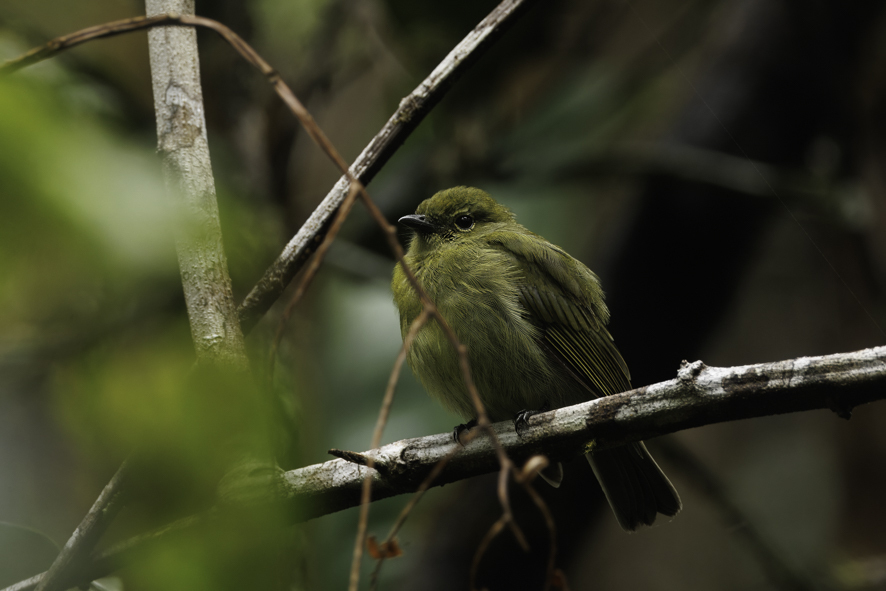
Olive Manakin
Live sightings near you, the range map, bar charts of when it is seen, and Macaulay Library photos and recordings.
Olive Manakin
Xenopipo uniformis
The olive manakin (Xenopipo uniformis) is a species of bird in the family Pipridae. It is found in Brazil, Guyana, and Venezuela.
From the article Olive manakin on Wikipedia (CC BY-SA), quoted section by section
Description
The olive manakin is 13 to 13.5 cm (5.1 to 5.3 in) long and weighs 16.5 to 21 g (0.58 to 0.74 oz). Unusual for a manakin, the sexes have the same plumage. The species also has longer wings and tail relative to its size than many other manakins. Adults of the nominate subspecies have dark olive upperparts. Their throat and underparts are a slightly paler olive and their belly has a yellowish cast. Subspecies X. u. duidae is slightly smaller and brighter than the nominate. Both subspecies have a dark iris, bill, and legs and feet.
Range & habitat
The olive manakin has a highly disjunct distribution. The nominate subspecies has the largest contiguous range. It encompasses east-central Bolívar in eastern Venezuela and continues slightly into extreme northern Brazil's Roraima and somewhat further into west-central Guyana. The nominate is also found on tepuis in southern Bolívar. Subspecies X. u. duidae is found in Venezuela on Cerro Duida and Cerro Sipapo, tepuis in Amazonas. There are also a very few scattered records further south and east in Brazil, at least two of which are very distant from the species' core range. The olive manakin inhabits humid and wet mossy forest and stunted woodland, especially areas heavy with Melastomataceae. In elevation it ranges between 800 and 2,100 m (2,600 and 6,900 ft) in Venezuela and up to 1,200 m (3,900 ft) in Brazil.
Wikipedia: “Distribution and habitat”
What it does
The olive manakin is known to feed on small fruits and probably also includes insects in its diet. Its foraging behavior has not been studied.
Wikipedia: “Feeding”
Listen
Looking for field recordings…
Where it lives
Recorded sightings
—
geo-referenced records in GBIF, from museums, herbaria and field observers.
Drag the globe to turn it. Dots are where records exist, not a range map; darker means more records.
In the stacks
Searching the stacks…
Every page naming Xenopipo uniformis in the Biodiversity Heritage Library →
This page is assembled live from iNaturalist, GBIF, Wikipedia, the Source Library and the Internet Archive. It is not yet part of the hand-edited codex. iNaturalist taxon 14230.