On eBird ↗
Golden-winged Manakin
Live sightings near you, the range map, bar charts of when it is seen, and Macaulay Library photos and recordings.
Golden-winged Manakin
Masius chrysopterus
The golden-winged manakin (Masius chrysopterus) is a species of bird in the family Pipridae. It is found in Colombia, Ecuador, Peru, and Venezuela.
From the article Golden-winged manakin on Wikipedia (CC BY-SA), quoted section by section
Description
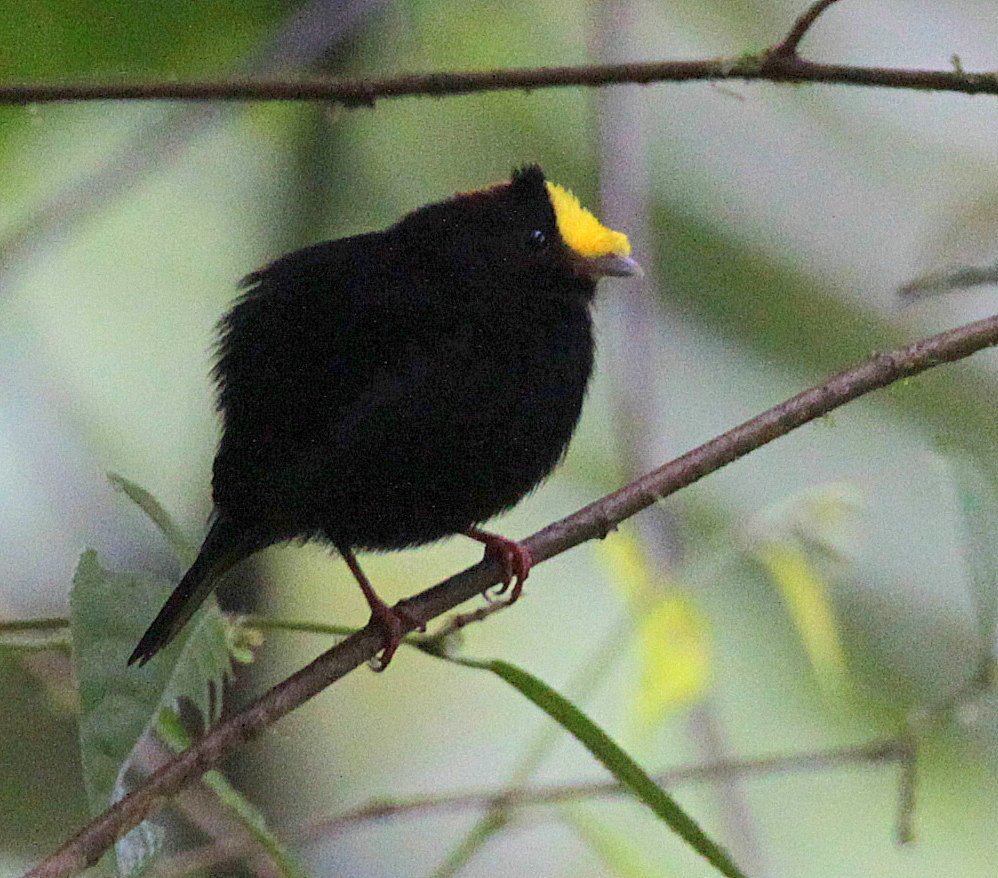
The golden-winged manakin is about 11 cm (4.3 in) long and weighs 9.0 to 13.5 g (0.32 to 0.48 oz). The species is sexually dimorphic. Adult males have a bright golden-yellow forecrown of plush feathers that curve forward over the bill and short black plumes on either side of it that project up as "horns". Their plumage otherwise is mostly black with a patch of orange-red on the hindcrown, a patch of golden-yellow on the throat, and entirely yellow primaries, secondaries, and outermost tail feathers. Adult females are mostly olive-green with a yellow-olive throat, belly, and wing linings. They do not have the male's showy forecrown feathers. The other subspecies of the golden-winged manakin differ from the nominate and each other thus:
M. c. bellus: male's rear crown patch is red M. c. pax: (male) darker yellow on throat, wings, and tail; red or flame orange rear crown and nape; (female) darker yellow throat M. c. coronulatus: male's rear crown and nape are reddish brown M. c. peruvianus: (male) deeper richer yellow on throat, wings, and tail; darker red rear crown and nape; (female) slightly richer olive green upperparts and more yellowish olive underparts Both sexes of all subspecies have a dark brown iris, a pinkish gray bill, and purplish pink legs and feet.
Range & habitat
The golden-winged manakin has a disjunct distribution. The subspecies are found thus:
M. c. bellus: western Colombia from the west side of the Western Andes north of Cauca Department east to the west side of the Central Andes M. c. pax: east side of Colombia's Eastern Andes from Cundinamarca Department and south on the east side of the Andes in Ecuador to northern Zamora-Chinchipe Province M. c. coronulatus: west side of Colombia's Western Andes from Cauca Department south on the west side of the Andes in Ecuador to Loja Province M. c. chrysopterus: in Venezuela on east side of the Andes from Táchira and Barinas south and on west side from Mérida south, continuing on both sides of Colombia's eastern Andes to Boyacá Department and the east side of the Central Andes M. c. peruvianus: Andes from southern Zamora-Chinchipe south into Peru to Cajamarca Department on the west side and separately in San Martín Department on the east The golden-winged manakin inhabits wet montane cloudforest, though it will forage in clearings and forest edges. In elevation it ranges between 1,000 and 2,100 m (3,300 and 6,900 ft) in Venezuela, 600 and 2,400 m (2,000 and 7,900 ft) in Colombia, mostly 800 and 2,000 m (2,600 and 6,600 ft) in Ecuador but locally lower in the west, and 1,200 and 2,000 m (3,900 and 6,600 ft) in Peru.
Wikipedia: “Distribution and habitat”
What it does
The golden-winged manakin feeds mostly of small fruits, with those of the Melastomataceae genus Miconia apparently favored, and also feeds on small insects. They typically forage singly and do associate loosely with mixed-species feeding flocks. Often they and a few other species will forage in one tree though not associating with each other. They take fruits while briefly hovering after a short sally from a perch.
Wikipedia: “Feeding”
Listen
Looking for field recordings…
Where it lives
Recorded sightings
—
geo-referenced records in GBIF, from museums, herbaria and field observers.
Drag the globe to turn it. Dots are where records exist, not a range map; darker means more records.
In the stacks
Searching the stacks…
Every page naming Masius chrysopterus in the Biodiversity Heritage Library →
This page is assembled live from iNaturalist, GBIF, Wikipedia, the Source Library and the Internet Archive. It is not yet part of the hand-edited codex. iNaturalist taxon 14310.