- Animals
- ›Chordates
- ›Vertebrates
- ›Mammals
- ›Therians
- ›Placental Mammals
- ›Ungulates, Carnivorans, and Allies
- ›Even-toed Ungulates and Cetaceans
- ›Ruminants
- ›Bovids
- ›Antelopes, Goats, and Sheep
- ›Goats and Sheep
- ›Budorcas
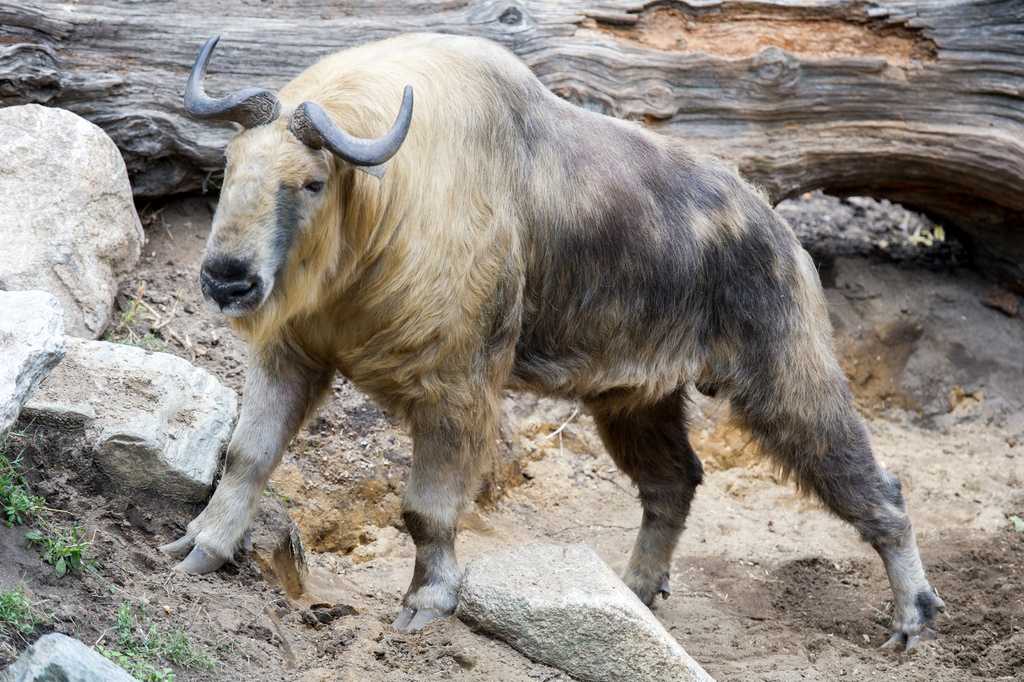
Chinese Takin
Budorcas tibetana
The Sichuan takin or Tibetan takin (Budorcas tibetana) is a species of Budorcas closely related to takin (goat-antelope). Listed as a vulnerable species, the Sichuan takin is native to Tibet and the provinces of Sichuan, Gansu and Xinjiang in the People's Republic of China.
From the article Sichuan takin on Wikipedia (CC BY-SA), quoted section by section
Range & habitat
Takin inhabit the same dense bamboo forests as the better known giant panda. Sichuan takins live in these dense thickets and bamboo groves, in family groups of up to 30 individuals. Despite being large, stocky and relatively slow moving, the Sichuan takin is quite agile in maneuvering its rocky habitat with often steep and challenging slopes. The inaccessibility of the takin's mountainous habitat has meant that there is little information on this species’ behavior and ecology; specifically on their distribution and population size.
Wikipedia: “Habitat”
What it does
Takins have adaptations that help them stay warm and dry during the bitter cold of winter in the Himalayan Mountains. A thick, secondary coat is grown to keep out the chill. The large, moose-like snout has large sinus cavities to warm up the air a takin inhales before it gets to the lungs. Without this adaptation, takins would lose a large amount of body heat just by breathing. Yet another protection is their oily skin. Although they have no skin glands, their skin secretes an oily, bitter-tasting substance that acts as a natural raincoat in storms and fog. Streaks of this oily stuff can be seen where takins rub. They also have an odor that smells like a combination of horse and musk. Takins eat in the early morning and again in the late afternoon, and they rest when they are not feeding. Since they live at altitudes above 14,000 ft (4,300 metres), they feed on many kinds of alpine and deciduous plants and evergreens. When it comes to food, takins eat almost any vegetation within reach. This includes the tough leaves of evergreen rhododendrons and oaks, willow and pine bark, bamboo leaves, and a variety of new-growth leaves and herbs. They can easily stand on their hind legs, front legs propped against a tree, to reach for higher vegetation if they need to.
Herding and migration. Each spring, takins gather in large herds and migrate up the mountains to the tree line. …
Wikipedia: “Behavior and ecology”
Listen
Looking for field recordings…
Where it lives
Recorded sightings
—
geo-referenced records in GBIF, from museums, herbaria and field observers.
Drag the globe to turn it. Dots are where records exist, not a range map; darker means more records.
In the stacks
Searching the stacks…
Every page naming Budorcas tibetana in the Biodiversity Heritage Library →
This page is assembled live from iNaturalist, GBIF, Wikipedia, the Source Library and the Internet Archive. It is not yet part of the hand-edited codex. iNaturalist taxon 1431007.