On eBird ↗
Orange-bellied Manakin
Live sightings near you, the range map, bar charts of when it is seen, and Macaulay Library photos and recordings.
Orange-bellied Manakin
Lepidothrix suavissima
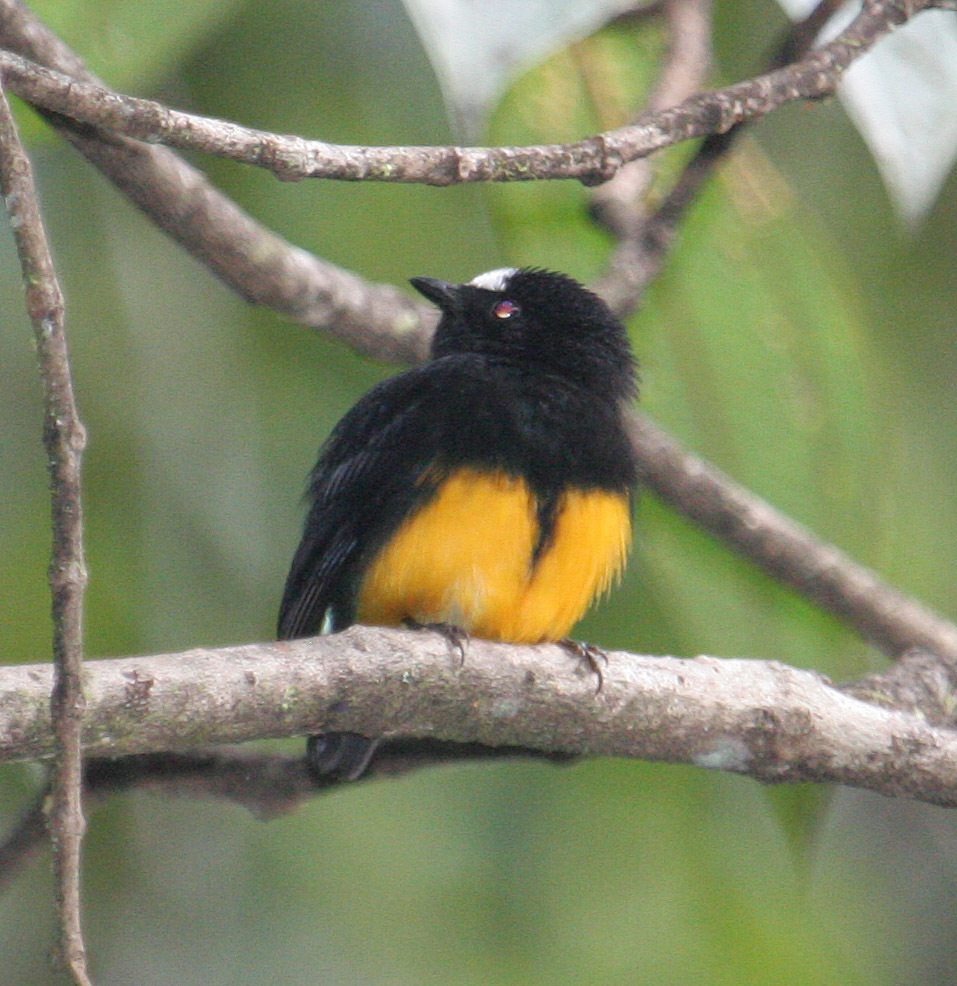
The orange-bellied manakin (Lepidothrix suavissima), also known as the tepui manakin, is a species of bird in the Pipridae family. It resembles and is closely related to the white-fronted manakin (L. serena), and the two were formerly considered conspecific.
From the article Orange-bellied manakin on Wikipedia (CC BY-SA), quoted section by section
Description
The orange-bellied manakin is about 9 cm (3.5 in) long; one male weighed 8.5 g (0.30 oz). The species is sexually dimorphic. Adult males have a white forecrown, a bright azure-blue lower rump and uppertail coverts, and a yellow-orange belly. The rest of their plumage is black. Adult females have a bluish forehead, a grayish face and throat, and a yellow belly and undertail coverts. The rest of their plumage is green. Both sexes have a dark brown iris, a black bill, and grayish to almost black legs and feet.
Range & habitat
The orange-bellied manakin is found at several locations in southeastern Venezuela. It is found mostly in southeastern Bolívar and central Amazonas states; it also occurs locally in northwestern and northeastern Bolívar. From Bolívar its range continues east across extreme northern Brazil and much of central Guyana. It inhabits the interior and edges of humid to wet foothill and montane forest. In eastern and southeastern Venezuela, Brazil, and western Guyana it is found on the lower slopes of tepuis. Further west in Venezuela and east in Guyana it is in more rolling and lower elevation country. In Venezuela it ranges in elevation mostly between 500 and 1,800 m (1,600 and 5,900 ft) with sight records as low as 250 m (800 ft). It also reaches 1,800 m (5,900 ft) in Brazil.
Wikipedia: “Distribution and habitat”
What it does
The orange-bellied manakin feeds on small fruit and insects. It usually forages singly or in pairs, grabbing its food while briefly hovering after a short flight from a perch. It apparently forages more actively when mixed-species feeding flocks are near but do not join them.
Wikipedia: “Feeding”
Listen
Looking for field recordings…
Where it lives
Recorded sightings
—
geo-referenced records in GBIF, from museums, herbaria and field observers.
Drag the globe to turn it. Dots are where records exist, not a range map; darker means more records.
In the stacks
Searching the stacks…
Every page naming Lepidothrix suavissima in the Biodiversity Heritage Library →
This page is assembled live from iNaturalist, GBIF, Wikipedia, the Source Library and the Internet Archive. It is not yet part of the hand-edited codex. iNaturalist taxon 14317.